Get Full Government Meeting Transcripts, Videos, & Alerts Forever!
Get email alerts on the Robotics Grants topic
No spam. Unsubscribe anytime.
Students and educators tell education committee a robotics grant program would expand STEM access
Summary
Supporters, including students, parents and longtime mentors, urged the Joint Committee on Education to back H'702/S'460, a bill to create elementary and secondary robotics grants, saying new funding would reduce startup costs and broaden participation in First/FTC/FRC programs.
Boston and suburban students, parents and coaches urged the Joint Committee on Education to favor a proposed elementary and secondary school robotics grant program, H 702/S 460, saying state funding would widen access to robotics and STEM at a young age.
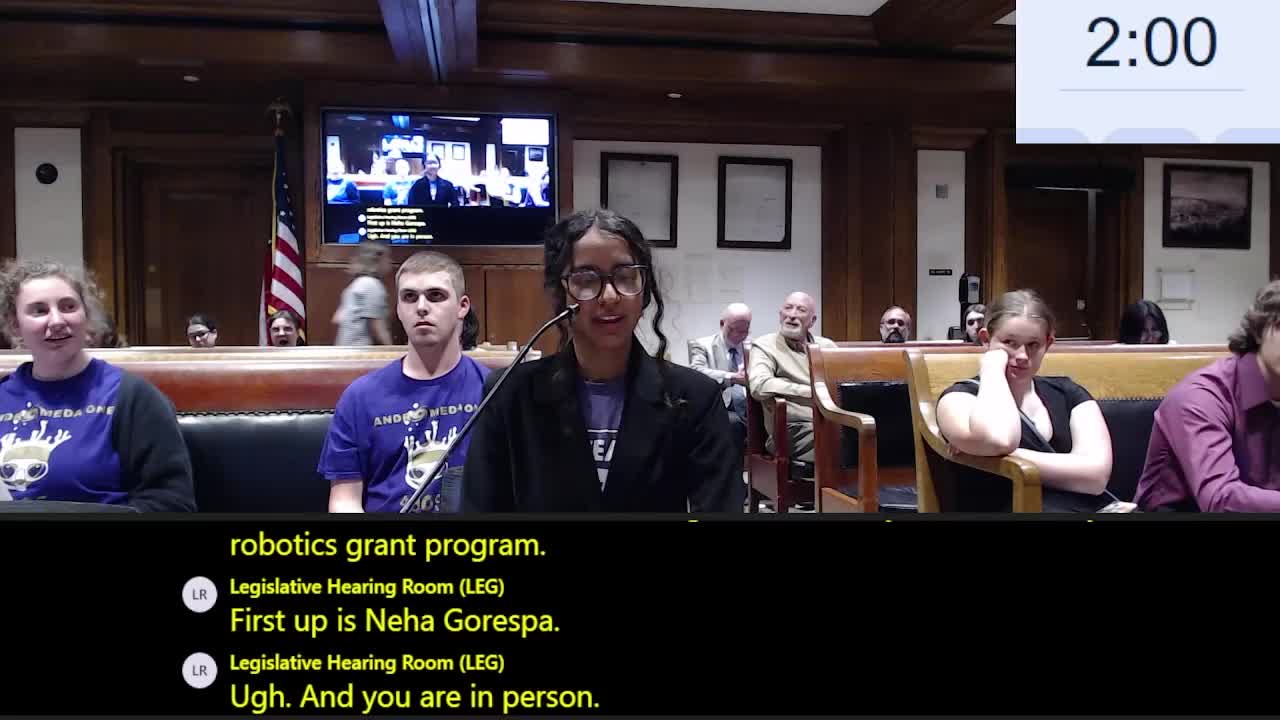
Students who testified described how participation in FIRST and other robotics programs taught technical skills, public speaking, teamwork and leadership. "By voting for Bill H 702 and S 460, you will not only be investing in the future of robotics, but also the security of the lives of Massachusetts next generation," said Neha, a senior who described her experience on Team Ultraviolet.
Nut graf: Witnesses said robotics programs are costly to start and run, and that state grants could help districts and community groups found new teams, buy tools and offer mentorship. Several coaches and alumni described how the programs also connect young people to internships and college scholarships.
Parents and mentors described local teams that now mentor elementary and middle school students, operate workshops, and provide access to professional mentors. A long-term mentor who has worked with multiple student teams said robotics "uses robots to build kids," describing how students who were once shy found leadership roles.
Students and mentors asked the committee to fund a grant program that would allow districts of different sizes to establish programs and to continue existing mentoring networks so teams in under-resourced communities can sustain themselves.
Ending: The committee heard widespread support but took no vote at the hearing. Supporters left written materials and asked lawmakers to include sustainable, accessible grant rules that prioritize outreach to lower-income and rural districts.