Get Full Government Meeting Transcripts, Videos, & Alerts Forever!
Get email alerts on the Finance And Housing Policy topic
No spam. Unsubscribe anytime.
Residents press council on PILOT deals and school funding; mayor and administrators respond
Summary
Citizens raised concerns about payment-in-lieu-of-taxes (PILOT) agreements, school funding and CubeSmart and Walnut Hill examples; mayor and business administrator said the school district receives required funds and explained PILOT mechanics and affordable-housing pressures.
During public comment the council heard extended remarks from a resident concerned about how PILOT (payment-in-lieu-of-taxes) agreements affect school funding and town finances.
John Grieves, a Clark resident, urged the council to limit PILOTs for residential properties, asked that any town payments tied to pilot arrangements be shared with the school district beyond the pre-development baseline, and called for tougher negotiation terms with developers. He cited Walnut Hill Apartments and CubeSmart as examples and said some PILOTs result in the township keeping money that would otherwise flow to the school district under a standard tax assessment.
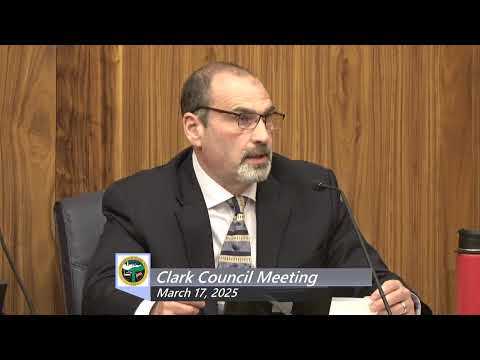
Mayor Angel Albanese and Business Administrator Jim Ulrich responded during the meeting. The mayor said the district "is getting the cash that they need to run the schools," and explained that the school budget and tax bills are set by the school; if additional operating funds are needed the board of education would raise that in its budget process. The mayor also said Clark is among a small number of municipalities that has elected to return part of PILOT proceeds to the school district.
Ulrich addressed specific PILOT terms and escalations used in some agreements. He said CubeSmart's agreement starts at 10% and escalates over time; per Ulrich's explanation the percentage increases in multi‑year steps during the 30‑year term (examples cited in the meeting: first five years at 10%, then 10.5%, later steps to 11% and above, ending at 12.5% in the final period). He also stressed the larger context of affordable-housing obligations, noting municipal compliance and potential state penalties for failing to meet housing obligations.
Nut graf: The exchange placed PILOT policy and affordable-housing obligations on the agenda for future discussions; residents requested broader or more uniform rules for sharing PILOT proceeds with the school district and asked for tougher negotiation stances on developer terms.
What happens next: Council members and the mayor said they will continue discussions with the school district and review PILOT terms on a case-by-case basis; the administration noted that affordable-housing obligations at the state level constrain municipal options.
Ending: The council did not adopt a new PILOT policy at the meeting; the matter remains an open subject for future meetings and potential ordinance or policy review.