Get Full Government Meeting Transcripts, Videos, & Alerts Forever!
Get email alerts on the Public Employee Release Time topic
No spam. Unsubscribe anytime.
Sponsor says bill would bar public employers from paying employees for union 'release time' activities
Summary
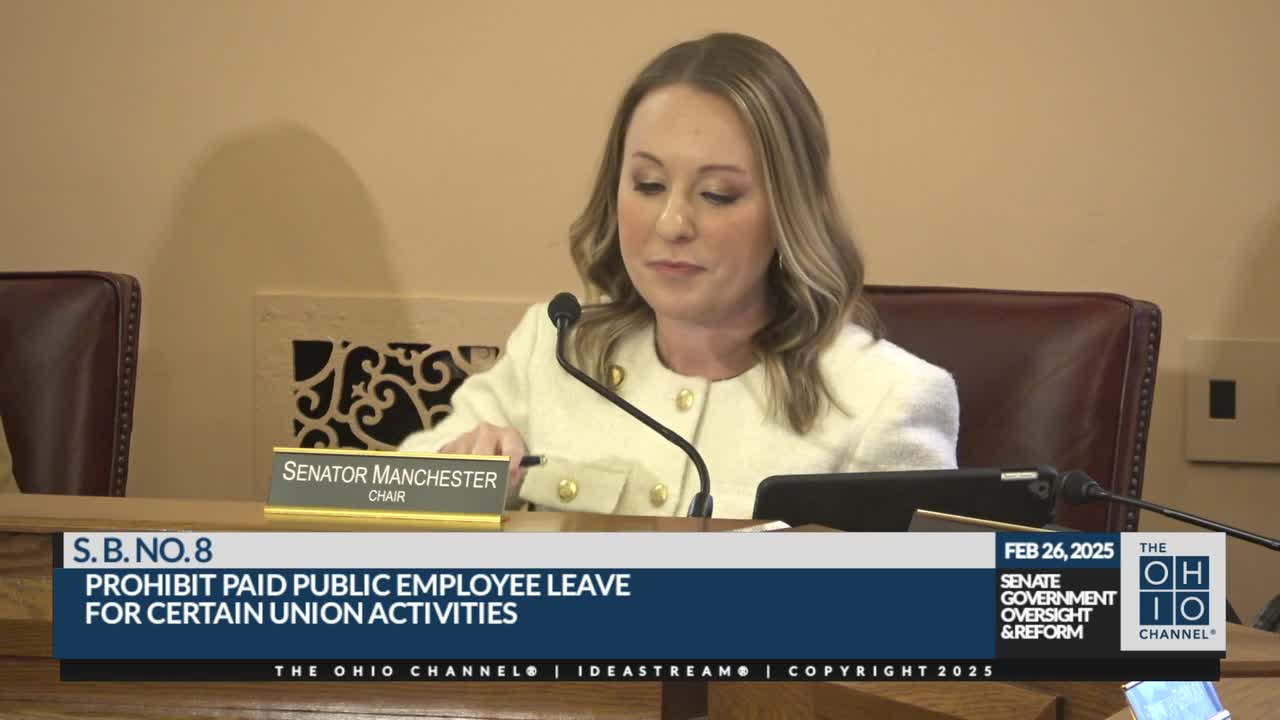
At a first hearing, the sponsor of Senate Bill 8 told the Government Oversight and Reform Committee the bill would prohibit public employers from providing paid release time for employees to carry out certain union activities; committee members pressed the sponsor on the breadth of the prohibition and potential impacts on public services.
Senator Huffman provided sponsor testimony to the Senate Government Oversight and Reform Committee on Senate Bill 8, which would prohibit public employers from providing paid leave or compensation for employees to perform certain union activities while on public time.
Huffman told the committee the measure targets “release time” arrangements in which public employees are relieved of their regular duties to work for unions while receiving public pay. The sponsor cited third-party reports claiming large local costs for release time and noted a recent Arizona Supreme Court decision striking down release-time arrangements under that state’s constitution.
Committee members pressed the sponsor on the bill’s scope. Ranking Member Weinstein asked whether the bill would bar employees — for example firefighters — from advocating for a local fire levy while on city time. Huffman said he would need to review definitions more closely but suggested that time used to benefit the city could be treated differently. Vice Chair Brenner asked whether the bill would prevent employees from using personal leave time for union activities; the sponsor said personal time would remain an option.
Huffman cited the Ohio Constitution’s prohibition on use of public funds to aid private enterprises as a basis for the bill’s approach and referenced examples from other jurisdictions and the Arizona court ruling. Committee members expressed concern about defining which activities would be prohibited and about unintended impacts on passing local levies or public services.
The committee took no vote; the bill received sponsor testimony and questions only.