Get Full Government Meeting Transcripts, Videos, & Alerts Forever!
Get email alerts on the Labor Unions Release Time topic
No spam. Unsubscribe anytime.
Committee Hears Proponents for Bill to Bar ‘Release Time’ Paid by Taxpayers
Summary
The Senate Government Oversight and Reform Committee held a second hearing on Senate Bill 8, which would prohibit so-called release time—paid leave for public employees to conduct union business—hearing proponent testimony from Americans for Prosperity Ohio and FGA Action; no vote was taken.
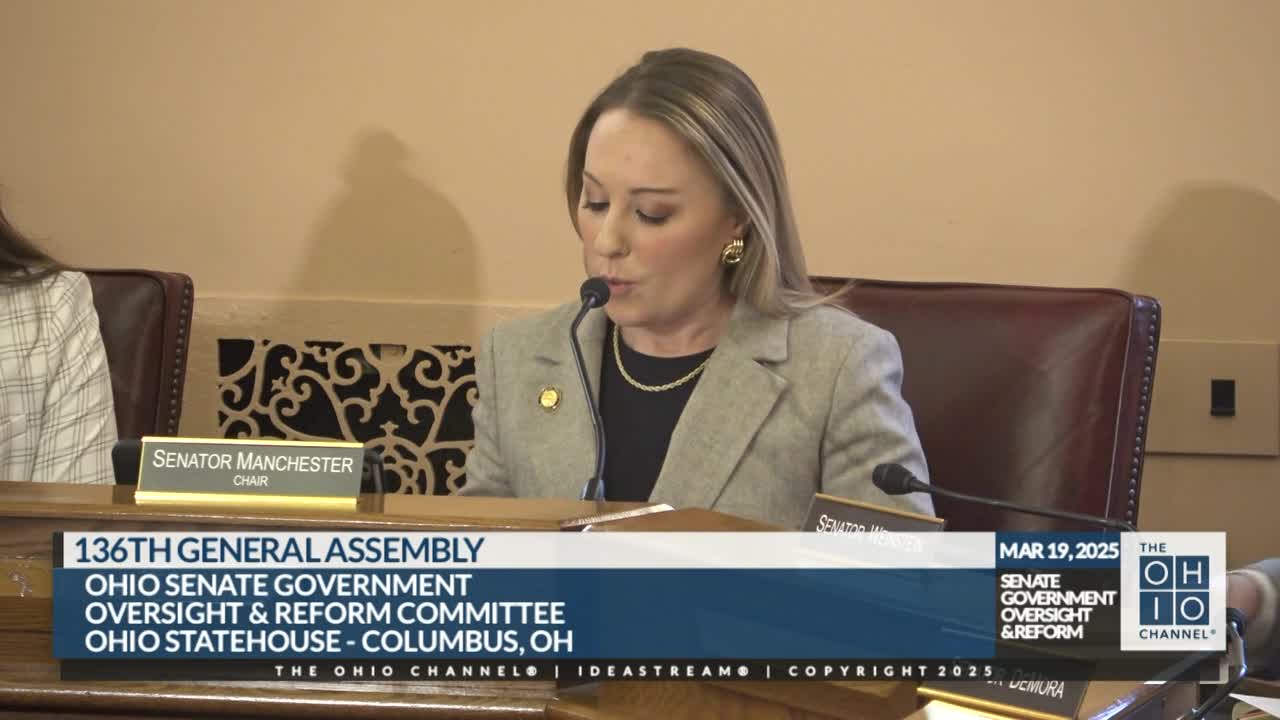
Chair Manchester convened the Senate Government Oversight and Reform Committee and called up Senate Bill 8 for a second hearing.
Hannah Cubbins, legislative director for Americans for Prosperity Ohio, testified in favor of the bill, saying the measure “prohibits the practice of release time,” which she described as government employees being “released from the jobs they were hired to do and instead conduct business for their respective organized labor unions while still receiving their full salary and benefits paid for by the taxpayers.”
Cubbins told the committee the bill “does nothing to change the ability for public employees to join unions and participate in union functions,” and that it “merely clarifies that the cost of such membership and representation should be borne by those who voluntarily give their support to organized labor operations rather than by taxpayers.” She cited figures from a Goldwater Institute analysis submitted in written testimony, saying that it found the city of Columbus paid “more than $1,100,000 and 38,469 hours” to individuals because of release time during a specified multi-year period and that a department of corrections figure was “roughly 597,000 and then 22,681 hours,” noting she was relying on the institute’s methodology in written testimony.
Bo Uchen testified on behalf of FGA Action, saying “taxpayer dollars should always be reserved for services for the public, not special interest handouts,” and describing examples of union contract provisions that, he said, allow long periods of paid time for union business. Uchen said some contracts in Ohio authorize extensive release time, citing a Columbus contract that allows union leaders to “work both full time for the union while still receiving full time salary and benefits from the city” and an Akron teachers’ contract that he said “authorizes 125 days per year for union business.”
Committee members asked multiple witnesses to clarify specifics. Senator DeMora asked for examples of harm to the public when employees use release time to engage in political activity; Cubbins said she did not have a specific incident at hand and that determinations of public benefit can be “highly subjective.” Senator Weller noted that some release time may cover activities done “on behalf of their city,” such as testimony before local bodies, and suggested the raw hours cited in studies may be skewed if they do not distinguish functions performed for the public versus for unions. Cubbins said she could not speak to the Goldwater Institute’s methodology and was open to reviewing alternative metrics.
Ranking Member Weinstein raised concern about the bill’s potential breadth and asked whether the measure, as written, could be interpreted subjectively to bar activities such as a police officer advocating for better training. Cubbins said she was “open” to an amendment clarifying such distinctions.
The committee noted written testimony filed by Brian Williams on behalf of the Associated Builders and Contractors of Ohio and by Brian Norman of the Goldwater Institute. The committee did not take a vote on the bill; the record states this was the second hearing and the matter concluded with testimony.
Members who engaged in questioning included Senator DeMora, Senator Weller, and Ranking Member Weinstein; Chair Manchester and Vice Chair Brenner presided.
The committee did not advance Senate Bill 8 at this meeting; the hearing concluded after proponent testimony and questions.