Get Full Government Meeting Transcripts, Videos, & Alerts Forever!
Get email alerts on the Child Support Pass Through topic
No spam. Unsubscribe anytime.
Senators seek to let Ohio TANF recipients keep small portion of child support payments
Summary
Sponsors of Senate Bill 67 told the Government Oversight and Reform Committee that the bill would allow families on Ohio Works First to keep up to $100 per child (maximum $200 per family) of child support without losing TANF eligibility; sponsors cited state estimates that roughly 12,000 families would retain about $12 million annually.
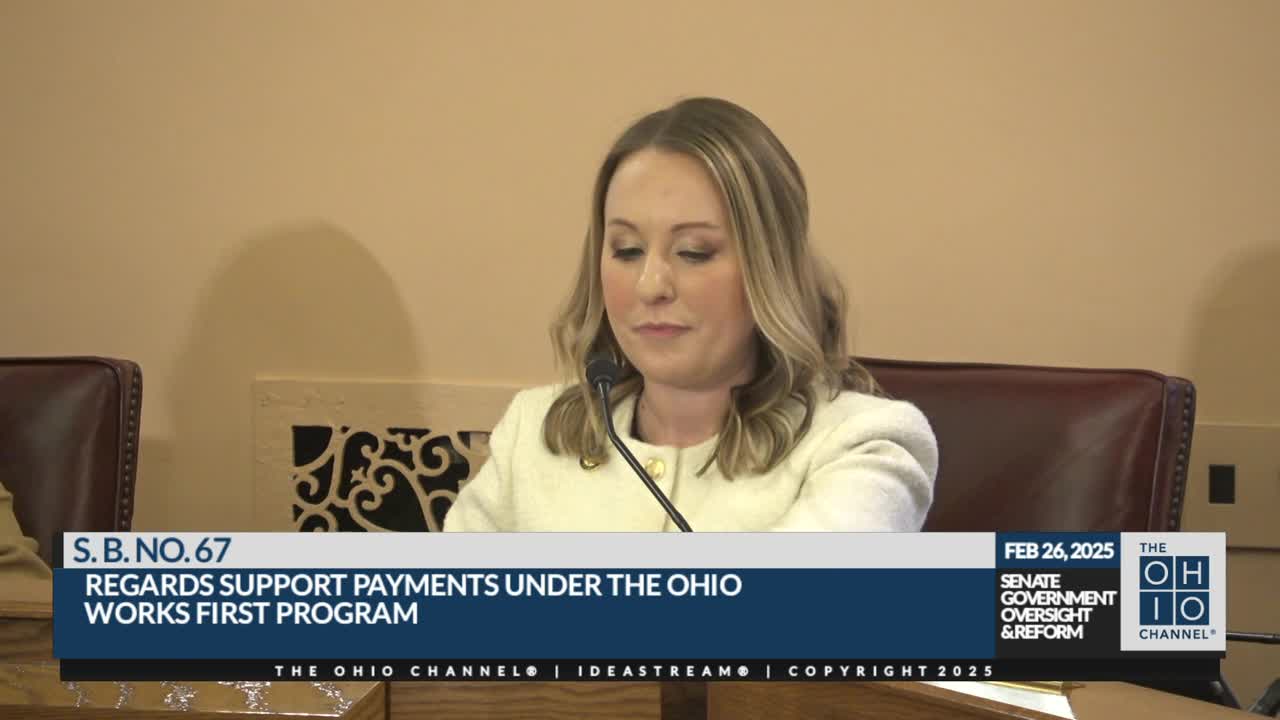
Senators appearing before the Senate Government Oversight and Reform Committee on the first hearing of Senate Bill 67 said the bill would allow custodial parents receiving Ohio Works First, the state’s TANF cash assistance program, to retain a limited pass-through of child support payments.
Supporters told the committee that the bill would create a pass-through and income disregard of $100 per child, up to $200 per family, so those amounts would not be counted in determining Ohio Works First eligibility.
Senators Roman, Chuck and Liston, the bill’s sponsors, said federal law currently requires families on TANF to assign child support to the state and that under existing practice roughly two-thirds of some collections are forwarded to the federal government. Sponsor testimony cited a rough estimate from ODGFS that about 12,000 families statewide would retain roughly $12 million annually if the pass-through were adopted, and that about $8 million of the currently collected funds are sent to the federal government rather than remaining with Ohio families.
Supporters argued the change would provide low-income custodial parents with more consistent funds for daily needs and could increase incentives for noncustodial parents to make regular payments. “Allowing parents to retain a portion of these payments — $100 a month per child and up to $200 a month per family — we can encourage better parenting approaches,” a sponsor said. They also cited experiences in other states that have adopted pass-throughs, saying some states saw increased payments and reduced reliance on other assistance programs.
Ranking Member Weinstein asked for clarification about the cost and distribution of collections. Sponsors said the $12 million figure was a rough estimate from ODGFS and that, of that total, about $8 million was remitted to the federal government under current rules while about $4 million stayed within Ohio’s program funds. Sponsors acknowledged an implementation lag in the bill to allow state systems to be updated before the pass-through takes effect.
The hearing concluded with no committee vote; sponsors said they would solicit public feedback as the bill moves through the process.
Less central details discussed included citations to the 1996 federal welfare reforms that shaped current assignment rules and sponsors’ assertion that the pass-through aligns with statutory TANF purposes such as encouraging parental involvement.
The committee held a first hearing; no final action was taken.