Get Full Government Meeting Transcripts, Videos, & Alerts Forever!
Get email alerts on the Juvenile Justice Staffing And Rehabilitation topic
No spam. Unsubscribe anytime.
Ohio Department of Youth Services seeks funding to address rising population, staffing and program needs
Summary
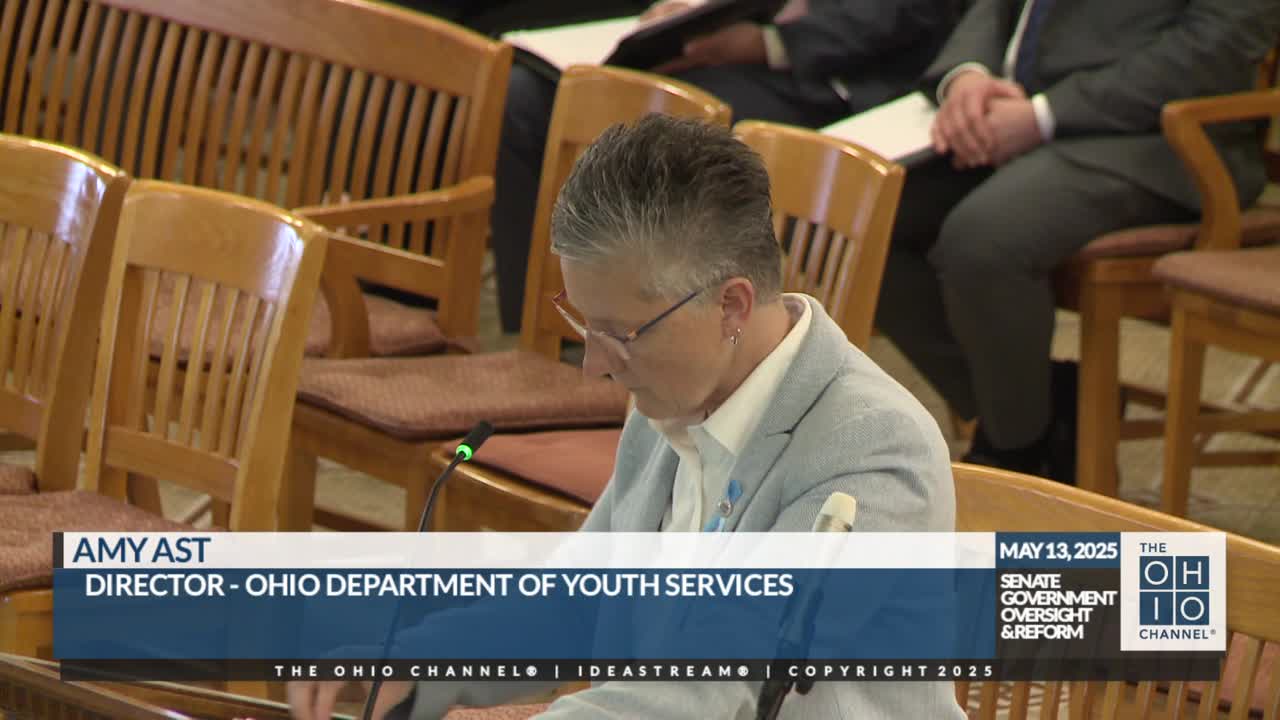
Director Amy Ast told the Government Oversight and Reform Committee that DYS has seen a population increase in youth in state custody, staffing pressures, and is seeking funding for staff retention, body‑worn cameras expansion, community corrections facility operations and education and reentry programs including a BUILD initiative.
Amy Ast, director of the Ohio Department of Youth Services, told the Senate Government Oversight and Reform Committee that DYS’s population at juvenile correctional facilities increased from 299 in September 2020 to 492 as of May (an increase she said was about 65 percent over five years), and that staffing and retention are central budget concerns.
Ast said DYS operates three state juvenile correctional facilities in Circleville, Highland Hills and Massillon, and funds 11 locally operated community corrections facilities. The department provides subsidies to counties for evidence‑based community programming, and Director Ast said “the key is getting the right youth in the right environment receiving the right services.”
The nut graf: Ast said higher staffing costs and rising population require investments to keep facilities safe, maintain educational programming, and expand community options that reduce recidivism.
Ast said staffing makes up about 45% of the department’s budget and described vacancy improvements after recent pay and incentive changes: corrections officer vacancies fell from 26% to 13.5%, teacher vacancies from 17% to 10%, and behavioral health staff vacancies from 35% to 32.5%. She said total vacancies dropped from 18% in January 2024 to 11% at the time of testimony.
On safety tools and training, Ast said frontline staff are equipped with body‑worn cameras and that designated staff now carry OC spray; the department has increased scenario‑based training and verbal de‑escalation instruction for responding to youth in crisis. With budget funding, Ast said the agency hopes to expand body‑worn cameras to teachers, recreation staff and parole officers to capture the staff perspective on incidents and inform training.
Ast highlighted education and reentry efforts: each state correctional facility operates an accredited high school. In the 2023–24 school year, 53 youth earned high school diplomas and 35 earned GEDs—the highest totals in more than a decade—while youth earned over 1,300 skill certificates and 187 industry credentials. Ast said the department is developing BUILD (Buckeye United Industry and Leadership Development), a program to prepare graduates and GED completers for work by combining technology with instruction in emotional regulation, workplace soft skills and problem solving.
Ast described community programs funded by DYS, including Reclaim Ohio subsidies that support intensive probation, counseling, mentorship and other alternatives. She said there were 83,484 Reclaim program admissions statewide last fiscal year and that 81% of youth enrolled did not recidivate within 12 months. Ast said DYS is adding a subsidy database to better track outcomes and that DYS will ask for funding to operate additional community corrections facilities planned for counties with high commitments.
Senator Landis asked whether expanded body‑worn cameras would improve staff retention and safety; Ast replied that camera footage helps identify precipitating factors for incidents and supports training and safety efforts, and she said the department’s recruitment and retention strategies include expanded interview access, on‑the‑job supports for new officers and participation in national best‑practice workgroups.
Ast closed by saying, “This budget is an investment and it shows that we value our staff, our youth, our families, and Ohio's communities,” and asked for the committee’s support.