Get Full Government Meeting Transcripts, Videos, & Alerts Forever!
Get email alerts on the State Budget Tax Policy topic
No spam. Unsubscribe anytime.
Ohio tax commissioner outlines child credit, tobacco and gaming tax changes in DeWine budget
Summary
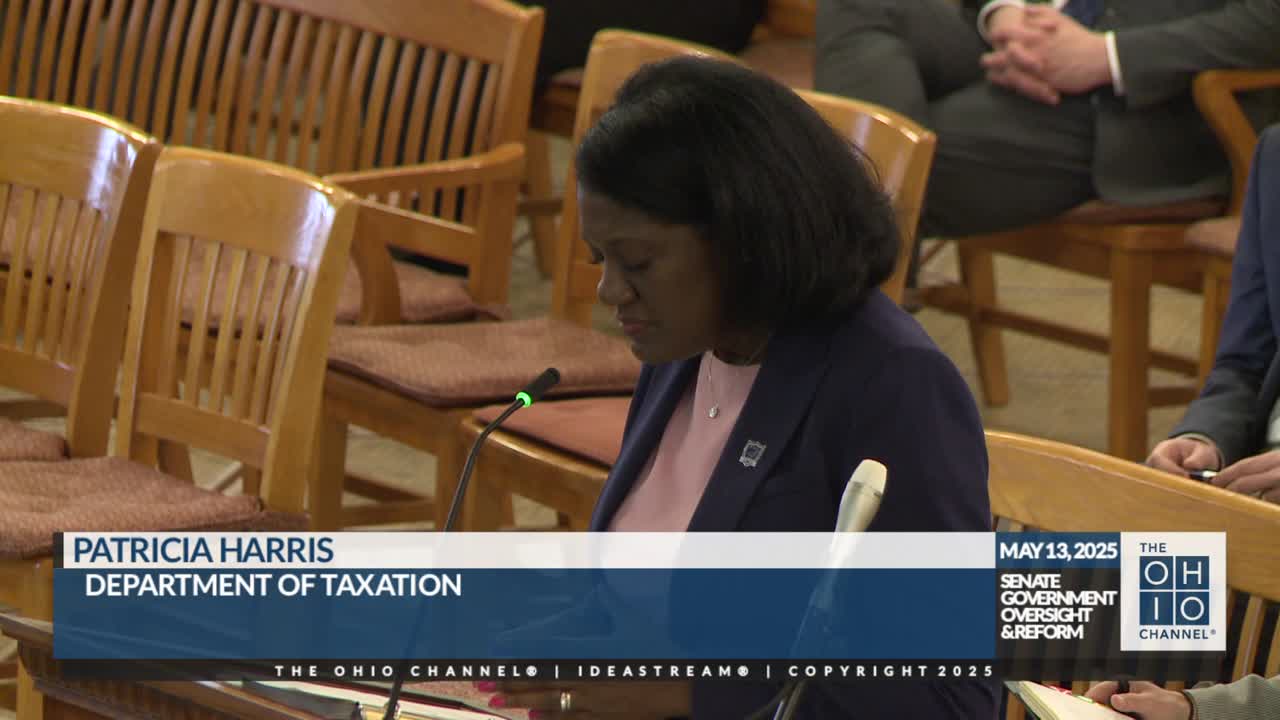
Ohio Department of Taxation Commissioner Patricia Harris told the Senate Government Oversight and Reform Committee that Governor Mike DeWine’s proposed FY26–27 budget would add a refundable child tax credit, raise tobacco and vaping taxes, increase the sports gaming receipt tax, and expand historic preservation tax credits.
Ohio Department of Taxation Commissioner Patricia Harris told the Senate Government Oversight and Reform Committee that Governor Mike DeWine’s proposed fiscal 2026–27 operating budget includes a refundable child tax credit, higher tobacco and vaping taxes, a rise in the sports gaming receipt tax and an expanded historic preservation credit.
Harris, testifying at the committee’s informal hearing on Sub House Bill 96, said the budget would provide a refundable credit “of up to $1,000 for each child under the age of 7” and estimated the measure would help about 450,000 Ohio families. She said the credit would be phased in and include income phaseouts so the benefit decreases as income rises.
The nut graf: Harris said the tax changes are intended to both raise revenue and change behavior — funding supports for children and communities while higher excise rates aim to reduce youth tobacco and vaping use.
Harris gave revenue and program details. She said the Department of Taxation administered more than 30 state and local taxes and reported net collections of $36.1 billion in fiscal 2024, with about $7.1 billion distributed to local governments and school districts. To help fund the child credit, the executive proposal would raise the cigarette excise tax from $1.60 per pack to $3.10 and levy a one‑time floor tax on unsold retail and wholesale product to capture the increased liability on existing inventory. Harris said the cigarette increase has not been adjusted since 2015 and cited public‑health research estimating that the change would cut youth smoking and improve long‑term health outcomes.
The budget would also increase taxes on other tobacco products, raise the per‑milliliter tax on vape liquids from 10¢ to 20¢, and modernize the definition of “vapor products” to include noncombustible nicotine delivery items such as oral nicotine pouches while exempting FDA‑approved cessation products, Harris said. On premium cigars she said the proposal raises the tax cap from 64¢ to $1.58 per cigar.
Harris said the executive budget would raise Ohio’s adult‑use cannabis excise tax from 10% to 20%, projecting roughly $87 million additional revenue in fiscal 2026 and $176 million in fiscal 2027 to an Adult Use Tax Fund, which Harris said would support items including jail construction, law enforcement training, substance‑abuse education and the 988 hotline.
On gaming, Harris said the proposal would increase the sports gaming receipt tax levied on operators from 20% to 40%, with an estimated $138 million in additional revenue in fiscal 2026 and $150 million in fiscal 2027. She said those proceeds are dedicated to a new sports facility construction and sports education fund.
Harris also outlined a proposed permanent increase in the state historic preservation tax credit annual cap from $60 million to $120 million and a new $10 million residential historic preservation tax credit program, which would allow refundable credits to reimburse 25% of qualifying owner‑occupied restoration expenses, up to $120,000 per project.
She listed technical and administrative changes in the proposal meant to simplify administration: a uniform penalty abatement authority for the tax commissioner, permission to send certain refund notices electronically with taxpayer consent, expanded withholding options for some retirement distributions to cover state and school district taxes, and continued modernization of the department’s online platform. Harris pointed to the department’s new tax administration platform and outreach efforts, saying “over 900,000 taxpayer accounts were created” on the system and additional taxes have been added to online services.
During a short Q&A, Senator Denora DeMora asked whether the department had views on House amendments to the governor’s proposals; Harris said, “We support the executive budget. We stand by the numbers that we have provided,” and reiterated support for the cigarette and sports gaming provisions.
Harris closed by asking the committee to consider the proposals as packaged in the executive budget and offered to follow up with staff on specifics.
This account is based on testimony to the Senate Government Oversight and Reform Committee; the House had already made changes to parts of the budget that Harris noted might differ from the executive proposal.