Get Full Government Meeting Transcripts, Videos, & Alerts Forever!
Get email alerts on the Veterans And Military Development topic
No spam. Unsubscribe anytime.
VFW, AMVETS urge higher state subsidies, stronger protections and suicide outreach in committee hearing
Summary
Representatives of two veteran service organizations told the Ohio House Veterans and Military Development Committee that rising claims work after the PACT Act has stretched service officers and that modest state subsidy increases would allow hiring more accredited staff.
Representatives of two major veteran service organizations told the Ohio House Veterans and Military Development Committee on an informational panel that rising claims work since the PACT Act and other pressures have strained state-level veteran service programs and that modest increases in state subsidy would allow them to hire more accredited service officers.
David Root, state legislative chairman of the Veterans of Foreign Wars Department of Ohio, told the committee that "there's 2 bills in the house and 1 in the senate right now addressing the enhanced homestead exemption for veterans" and that the VFW supports expanding state protections for veterans against predatory claim preparers. "The VFW is calling these predators claim sharks," Root said, and he urged a state law that would add penalties in addition to the federal accreditation rules administered by the VA Office of General Counsel.
Root told the committee the VFW currently operates seven VA-accredited veteran service officers in Cleveland, Cincinnati and Dayton and that the organization receives a $450,000 annual General Revenue Fund subsidy under the executive budget (HB 96). "Without it, our veteran service office would not be able to do a fraction of what they do," he said, and asked the committee to consider increasing the subsidy to $475,000 or $500,000 to cover cost-of-living and workload increases.
Root said claim filings handled by VFW service officers rose by about 75% year-over-year, from roughly 1,463 claims in 2023 to 2,569 in 2024, and that related workloads—Board of Veterans' Appeals hearings, reviews and phone/email contacts—also rose substantially. He credited the federal PACT Act with prompting much of that growth: "Two words, PACT Act," he said when asked for the reason for the spike.
Don McCauley, executive director of American Veterans (AMVETS) Department of Ohio, gave the committee an overview of AMVETS programs in the state, including seven service officers at six VA locations, annual scholarships (about $41,000 in awards), support for ROTC and junior ROTC programs, and the "1 is Too Many" 24-hour veterans crisis line and related outreach. McCauley described charitable gaming (electronic bingo) as one revenue source that helps local AMVETS posts remain open and fund community programs.
On suicide prevention, committee members and witnesses discussed coordination among veteran service organizations, county mental health boards and county VA offices. McCauley described AMVETS' crisis-line setup—an 800 number forwarding to a small, trained responder team—and noted the organization's shorter answer times compared with historical averages. Committee members also emphasized the statewide 988 hotline as part of the referral network and asked witnesses about models for local coordination and outreach.
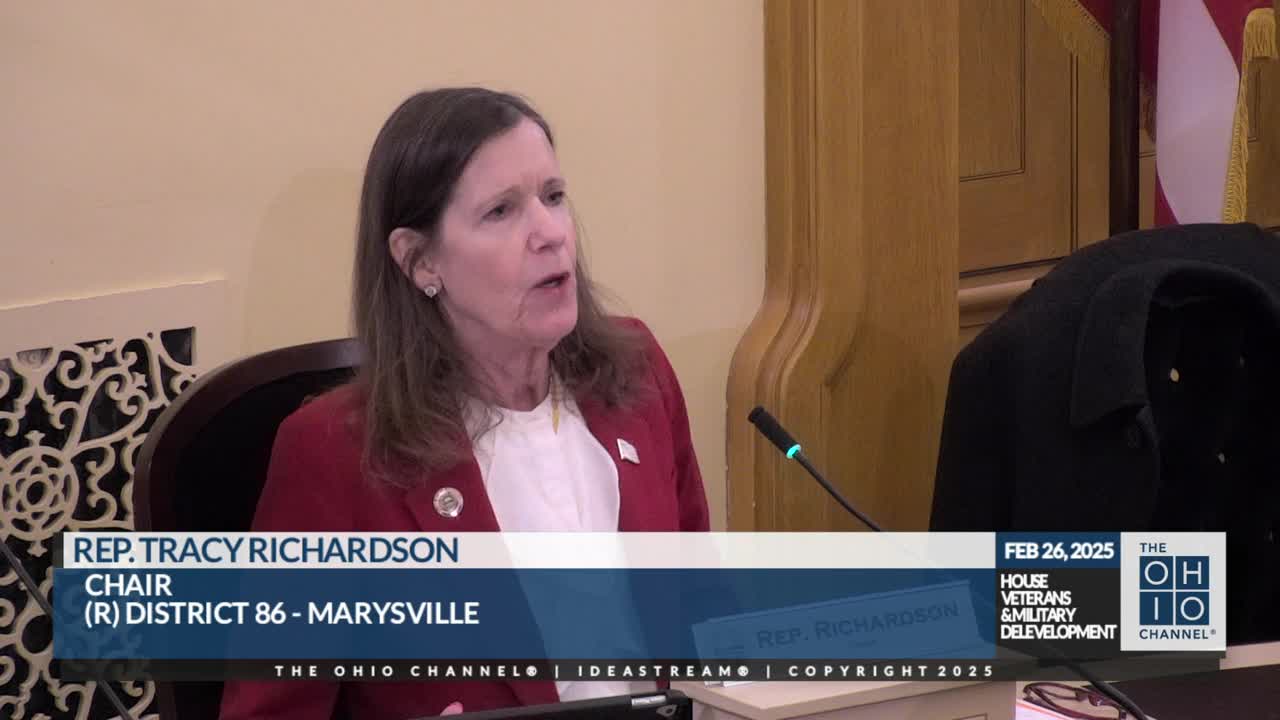
Committee members asked both presenters multiple questions. Representative Willis praised the VFW's regular legislative updates and offered to help sponsor state-level protections against predatory claim preparers. Representative DeVila and Representative Matthews asked about membership rules (Root said VFW membership remains limited to veterans who served overseas) and the organizations' capacity to expand service-officer staffing. Representative McNally pressed for detail on coordination with county-level services on suicide prevention; witnesses said they publish materials to counties and are willing to discuss partnerships further.
The hearing was informational; the committee did not vote on legislation during the presentations. Witnesses asked the committee to consider subsidy increases in HB 96 and to support state legislation modeled on a proposed "Veterans Protection" measure that would add penalties for non‑accredited, for‑fee preparers who mislead veterans.
The committee heard both presentations, asked follow-up questions, and closed the panel after additional public comments and exchanges.