Get Full Government Meeting Transcripts, Videos, & Alerts Forever!
Get email alerts on the Organ Donation Employer Tax Credit topic
No spam. Unsubscribe anytime.
Committee hears advocates on tax credit to encourage employer-paid leave for living organ donors
Summary
Proponents told the Ways and Means Committee House Bill 122 would create a tax credit for employers that provide paid leave to employees who serve as living organ donors, arguing the measure would remove a financial barrier to donation and increase transplants.
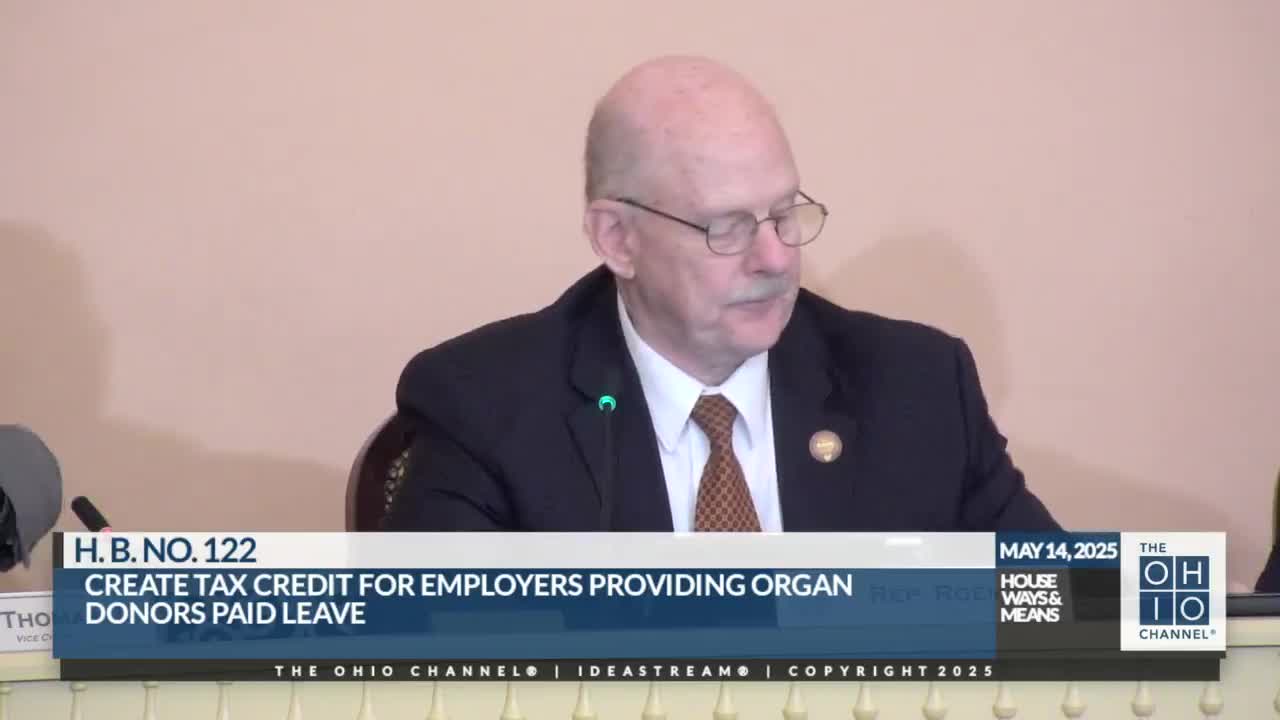
The House Ways and Means Committee held a second hearing on House Bill 122, which would create a tax credit for employers that provide paid leave to employees who serve as living organ donors.
Proponents including Megan Haggerty of the National Kidney Foundation and Corey King of UCHealth testified that living organ donation — especially kidney and liver donation — yields better outcomes than long-term dialysis or deceased-donor transplants and that financial and job-security concerns deter potential donors. "The creation of a tax credit for employers to provide paid leave for employees who desire to serve as a living donor is a positive step forward towards removing a significant barrier to organ donation," Megan Haggerty said.
UCHealth's Corey King said transplant centers perform significant numbers of living-donor transplants and that the recovery period for kidney and liver donors can be substantial; he said the bill would encourage employers to provide paid leave without forcing donors to exhaust personal sick leave or face job loss. "It is allowing the employer to allow the employee to take this time off," King said, adding that recovery can be six to eight weeks for some procedures and that paid leave could prevent job or income loss for donors.
Committee members asked practical questions about coverage of donor medical expenses and whether Medicaid commonly appears as the primary payer for transplants. Witnesses explained that donor medical costs are typically billed to the recipient's insurance and that recipients on dialysis represent a larger cost burden to Medicare and Medicaid; proponents said increasing living donation could reduce government spending on dialysis in the long term. Haggerty and King said other types of living donation — beyond kidney — include partial-liver donation and bone marrow donation, and that recovery times vary.
The committee received written testimony from additional organizations, and no vote was taken at the hearing.