Get Full Government Meeting Transcripts, Videos, & Alerts Forever!
Get email alerts on the Manufacturing Grants topic
No spam. Unsubscribe anytime.
House committee hears $12 million grant proposal to help small manufacturers modernize
Summary
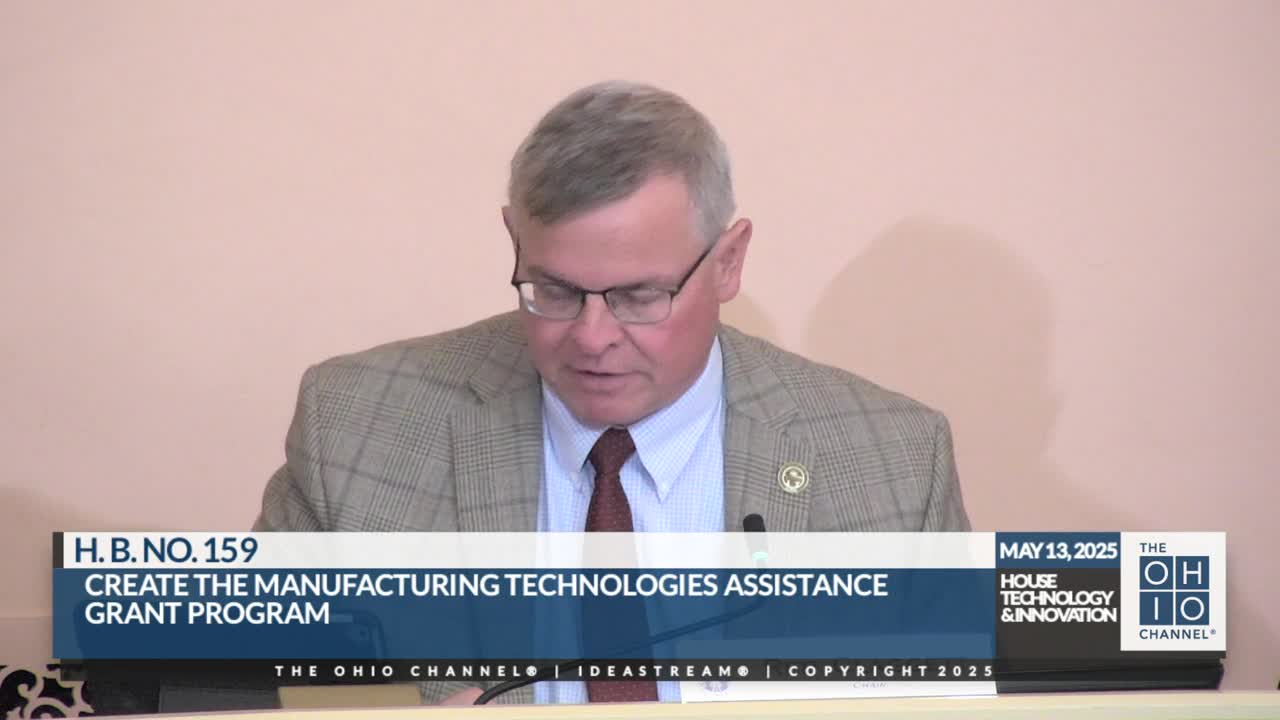
The House Technology and Innovation Committee held a second hearing May 13 on House Bill 159, which would create the Manufacturing Technology Assistance Grant Program (MTAP), a $12 million appropriation to provide up to $150,000 per eligible manufacturer for equipment upgrades and smart-technology integration.
The House Technology and Innovation Committee on May 13 held a second hearing on House Bill 159, a proposal to create the Manufacturing Technology Assistance Grant Program (MTAP) and allocate $12 million for one-time grants to small and medium-sized manufacturers. Jeff Spain, a representative of the MEP at Columbus State, told the committee that “The Manufacturing Technology Assistance Grant Program, MTAP, will allow manufacturers with under 500 employees to apply for $150,000 in grant funding for equipment upgrades and smart technology integration.”
The program is pitched as a way to help firms adopt industry 4.0 technologies and strengthen Ohio’s manufacturing base. Spain said manufacturing accounted for the majority of high-paying job growth and described his center’s work supporting local firms. He told the committee that the MEP at Columbus State had helped more than 80 Central Ohio manufacturers in the past five years, producing $82,400,000 in increased or retained sales, $33,000,000 in cost savings, $83,800,000 in investment, and the creation of 2,077 manufacturing jobs.
Eric Jankowski, representing Delaware-based TJ Clark International, described how MTAP could help his company buy equipment such as CNC plasma cutters and metallic 3-D printers and said the program “represents a crucial opportunity to empower Ohio's small to mid sized manufacturers to thrive in an increasingly competitive global market.” Jankowski said his business currently employs 16 people, expects to add 10 to 15 employees to meet defense-related demand, and would use MTAP to bring more manufacturing work in‑state rather than purchasing parts from outside Ohio.
Committee members pressed witnesses on program design and oversight. Representative Friesen asked whether grants provide more immediate value than tax cuts; Jankowski replied, “For us, this program would represent our ability to move quickly to adopt technologies whereas the tax, in my opinion, the tax cut, although would be very welcome, would take much longer for us to be able to realize any benefits.” Spain suggested state oversight of awards through the Ohio Department of Development and said he would support a clawback if funds were not used as intended: “Yes, I would support a clawback.” Rick Carfagna of the Ohio Chamber of Commerce said the bill includes matching and accountability requirements and noted “there is a stipulation that all unused funds, funds for ineligible expenses and funds not matched by private contributions be returned.”
Witnesses and committee members discussed allocation rules in the bill, including a bifurcated distribution that reserves half the funds for firms with 0–50 employees and half for firms with 51–500 employees, and a provision allowing unencumbered funds to be reallocated between categories. Proponents said the split aims to ensure smaller firms have access to awards while matching requirements and Ohio MEP review would vet projects.
No vote was taken. The committee concluded the bill’s second hearing and moved on to other business.