Get Full Government Meeting Transcripts, Videos, & Alerts Forever!
Get email alerts on the Manufacturing Grants topic
No spam. Unsubscribe anytime.
Committee hears bill to create Manufacturing Technologies Assistance Grant Program for Ohio manufacturers
Summary
Representatives presented House Bill 159 to create a $24 million Manufacturing Technologies Assistance Grant Program offering up to $150,000 per award to help small and mid-size Ohio manufacturers adopt automation, robotics and other production technologies; lawmakers questioned targeting, job impacts and matching requirements.
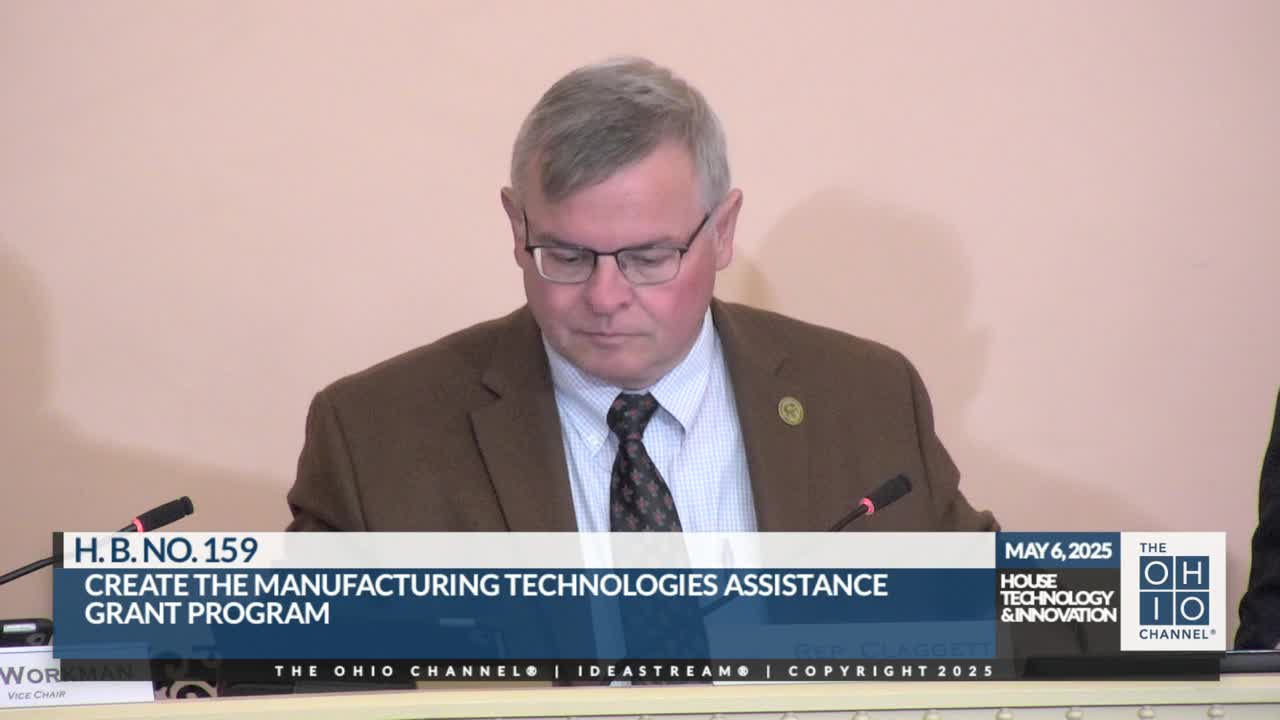
Chairman Claggett and the Ohio House Technology and Innovation Committee heard sponsor testimony on House Bill 159 on a proposal to create the Manufacturing Technologies Assistance Grant Program (MTAP) to help small and medium manufacturers in Ohio adopt new technologies.
The bill would allow eligible manufacturers to apply to the director of the Ohio Department of Development for grants of up to $150,000 for projects that “would increase the productivity, efficiency, and competitiveness of a manufacturing operation through the adoption and integration of manufacturing technologies,” Representative Santucci said in sponsor testimony.
The program would divide applicants into two size profiles — companies with 50 or fewer full‑time employees and those with 51 to 500 — and would require applicants to be a manufacturer by North American Industry Classification (NAICS) and to have operated a facility in Ohio for at least three years, Representative Demetrio said. The bill designates $24,000,000 in initial funding for MTAP to be administered by the Ohio Department of Development, he said.
Why it matters: supporters said the grants aim to help legacy Ohio manufacturers modernize older equipment, adopt automation or enterprise resource planning systems, and increase competitiveness in national and global markets. Representative Santucci noted that manufacturing remains a large share of employment in parts of Northeast Ohio and that smaller firms sometimes lack capital to upgrade technology.
Committee members pressed sponsors on eligibility, potential job losses from automation, safety outcomes and the size of awards. Representative Bahama asked whether the bill would target particular manufacturing subsectors; sponsors replied the bill does not target subsectors but uses qualification criteria to prioritize projects. Representative St. Touche asked about job losses from automation; Representative Santucci responded that technological adoption can remove repetitive tasks while creating other work and said the committee should monitor workforce impacts.
Representatives also clarified financial and compliance rules. Brandon (a staff presenter) explained the program’s match requirement: “it is 1 for 1,” meaning the business must provide matching funds on a dollar‑for‑dollar basis, and the bill would require repayment of unmatched state dollars if the business fails to provide the stated match. Representative White asked whether unionized shops could receive funds; sponsors replied the program would be available to union and nonunion manufacturers.
Sponsoring lawmakers pointed to programs in neighboring states as models, saying Iowa and Indiana have used similar technology investment grants. Committee members repeatedly raised workplace safety as a consideration; sponsors and supporters said upgraded equipment could reduce workplace injuries but that supporting data would be sought as the program is implemented.
No formal vote on HB159 was taken; the hearing concluded with committee members thanking sponsors and noting further consideration would follow.
Ending: Sponsors said the measure is intended as a pilot to be evaluated if funded and administered by the department; they asked the committee for support as the bill moves through the legislative process.