Get Full Government Meeting Transcripts, Videos, & Alerts Forever!
Get email alerts on the Housing Land Use topic
No spam. Unsubscribe anytime.
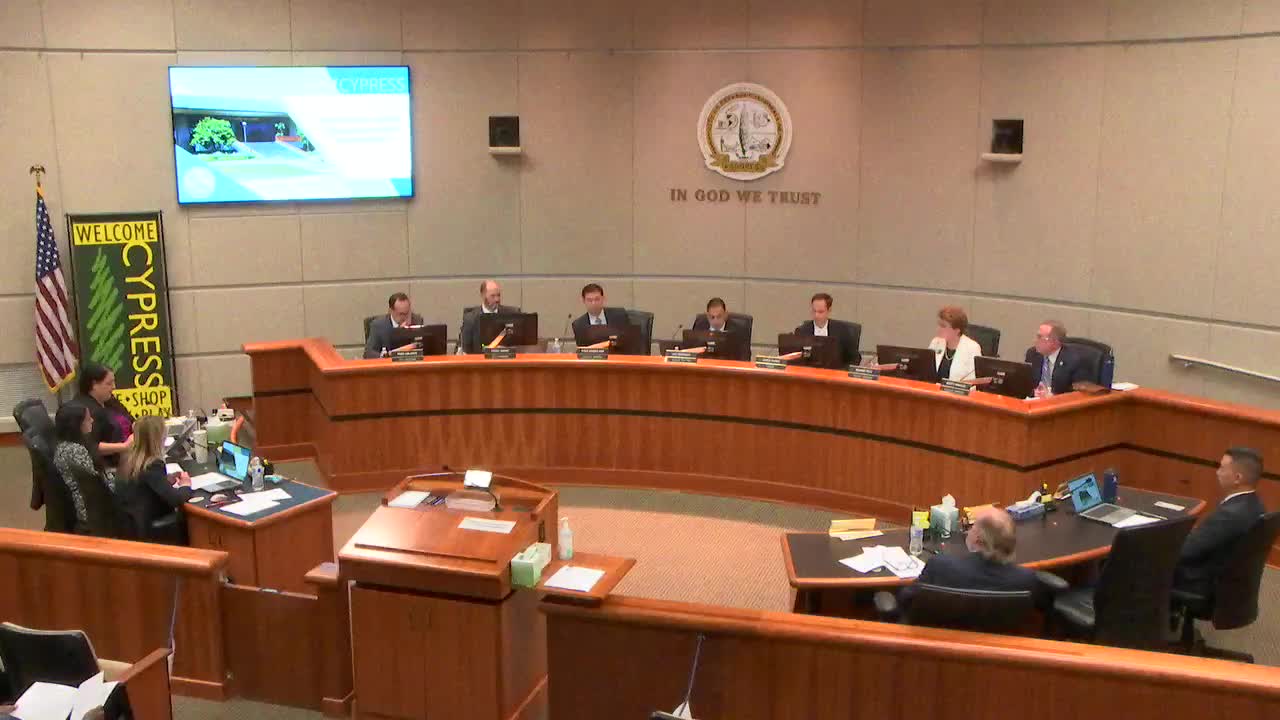
Cypress Council approves Lincoln Avenue zoning changes to implement state-required housing element
Summary
After a public hearing, the City Council voted unanimously to amend the Lincoln Avenue Specific Plan and the general plan land-use element to align with the city's 2021–2029 housing element, enabling residential densities of 20–30 units per acre, objective design standards, and a 50-foot residential height limit to allow mixed‑use development.
CYPRESS — The City Council on Monday unanimously introduced an ordinance and adopted a related general‑plan resolution to amend the Lincoln Avenue Specific Plan (LASP) and the general plan land‑use element so the city can implement its certified 2021–2029 housing element.
Planning Director Alicia Velasco told the council the changes are required by state law and by the housing element certification process: “The housing element is required by state law which mandates that cities plan for a certain number of units every 8 years. For the current cycle, the state required the city of Cypress to plan for 3,936 units.”
Those units, Velasco said, were distributed across several planning areas after the city took credit for 1,296 already permitted or zoned units and after voters approved 676 units under Measure S. The LASP amendments approved Monday primarily do three things: permit residential development at 20–30 units per acre across most of the LASP area, adopt objective residential design standards that remove discretionary permits for projects that meet the standards, and raise the residential height limit from 35 feet to 50 feet to encourage mixed‑use buildings with ground‑floor commercial uses.
Velasco emphasized the changes do not authorize construction by the city: “I would like to clarify that there's no actual residential development proposed this evening. These amendments only eliminate the governmental barriers to establish the necessary zoning to allow private development to develop these properties…so there's no actual construction proposed tonight, and the city doesn't have to build any of these units.”
At the public hearing, several residents voiced concerns about traffic, circulation and neighborhood impacts. Marilyn Reams, a resident who said she lives near Cattell and Enterprise, urged the council to work with Los Alamitos regarding a traffic signal at Enterprise Drive and said additional development could worsen existing problems: “we are…slid back off of Catella and Enterprise and cannot get out as it is. The traffic on Catella is unbelievable.” Kelly Kaye and other speakers also asked about potential effects on local elections and on neighborhood services.
Councilmembers asked staff clarifying questions about mixed‑use building examples, rear‑yard setbacks and the legal imperative to act. Velasco and the city attorney confirmed the city must implement the housing element regardless of its charter status. The staff report noted the program environmental impact report for housing element implementation had been certified previously and no further environmental review was required for these specific amendments.
After discussion the council voted to introduce the ordinance by title and adopt the land‑use resolution. The motion carried unanimously; the ordinance was read by title and further reading was waived.
The amendments complete the LASP update required by the housing element process for the Lincoln Avenue area, staff said, and will be followed by separate zoning actions for specific parcels when private proposals are filed.