Get Full Government Meeting Transcripts, Videos, & Alerts Forever!
Get email alerts on the Renewable Energy Municipal Project topic
No spam. Unsubscribe anytime.
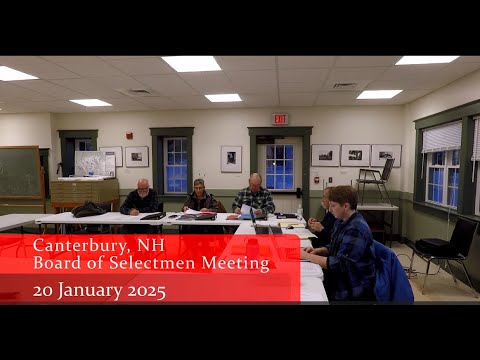
Canterbury hears case for $180,000 municipal solar project, selectmen weigh reserve fund for Community Power adder
Summary
A local energy advocate presented a design and financial model for a 60-kilowatt solar array and battery storage for municipal buildings and urged creation of a capital reserve to capture Community Power adder receipts for energy projects.
Tom Franco, a member of the town energy committee and an employee of Revision Energy, presented a proposal for a 60-kilowatt rooftop solar system and a ~20-kilowatt battery for Canterbury’s municipal complex, and recommended a warrant article to finance the work with a bond rather than new taxes. Franco said the system would be sized to produce roughly the town’s annual municipal-site generation and that, conservatively, the panels would generate $12,000–$14,000 per year to offset electric costs.
Why it matters: Franco told the Selectboard the project would cut the municipal electric budget over 25 years and that he modeled a $180,000 bond as the most likely path without adding to taxpayers’ annual burden. He said the town would likely see net savings once bond payments and energy production are accounted for, and that battery storage could reduce peak-demand charges.
Franco said the state Community Power program does create a small discretionary reserve from participating towns’ adders; Canterbury’s account currently accrues about $1,000 per month and is roughly $4,000 total so far. He proposed a separate town capital-reserve fund so those adder dollars could be collected into the town treasury and used for town renewable projects rather than remaining controlled by the Community Power authority. Selectboard members discussed establishing the capital-reserve account with a small initial deposit and making the selectboard the expending agent.
Questions from board members focused on project cost, equipment warranties, battery safety and siting, and construction timing. Franco said the panels carry manufacturer/installer guarantees for 25 years (he used 25 years in his financial model) and estimated a payback period near 10–11 years; he acknowledged panel warranties and long-term O&M must be specified in bids. Fire and safety questions arose; a municipal speaker advised that newer battery chemistries (including safer lithium formulations and nonflammable alternatives) exist and that installations can meet fire-marshal requirements with appropriate enclosure and two-hour fire-rated construction or an external weatherproof cabinet.
Franco recommended the town pursue a March warrant article to bond the $180,000 project, start the bidding process immediately if the article passes, and expect construction to start later in the year. Selectboard members noted practical constraints: bonding calendars (July and January sales), vendor lead times, and the need to define detailed specs and operations-and-maintenance commitments in the RFP so the town will have a serviceable O&M arrangement for the system for the warranty period.
The board also discussed an existing pilot arrangement under which the state or Community Power program is loaning tabulators/tablets to some towns; Franco reiterated that the Community Power adder money can help cover future projects but is not sufficient in isolation for a full solar-plus-battery installation.
Ending: The Selectboard did not vote on the project at the meeting; members asked Franco to return with refined cost/spec information (particularly battery chemistry and O&M language) and said they would review a draft warrant article and bond timing before town meeting.