Get Full Government Meeting Transcripts, Videos, & Alerts Forever!
Get email alerts on the Land Use Right Of Way topic
No spam. Unsubscribe anytime.
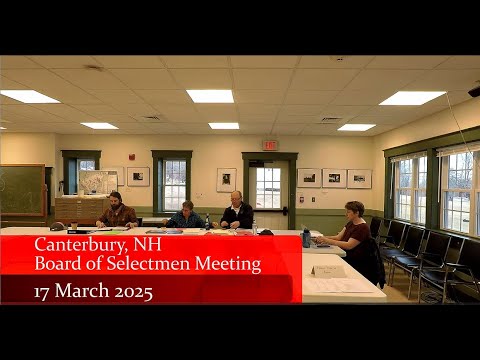
Canterbury board agrees to contact abutters after resident seeks access through town-owned strip
Summary
Select Board discussed a decades-old discrepancy in deeds after property owner requested access to rear parcel; board directed staff to contact nearby landowners to explore a negotiated land swap but made no formal land transfer or development decision.
Select Board members discussed a boundary and right-of-way dispute after a resident, identified in the meeting as Mr. Booth, asked for access to land behind the municipal building that he owns.
The discussion focused on whether an existing right-of-way is a continuous 50-foot corridor — a width several speakers said would be required if the lane were ever used as a public road — and on physical obstacles that would make access costly, including underground propane tanks, a utility pole and a waterline that runs around the tanks.
Mr. Booth said he does not have immediate development plans but wants to “leave that option open,” and he suggested a boundary adjustment or land swap as a possible solution. Ken Folsom, who spoke for town staff, recommended bringing all neighboring landowners together to review deeds and surveys and to try to negotiate a compromise. “Maybe we could get everybody out and look at the maps and look at the deeds and try and figure out what’s a good, compromise on all this,” Folsom said during the meeting.
Board members and staff described a mismatch between deed language and the town survey: deeds on record indicate a 50-foot right-of-way in places, while the town survey shows the corridor narrowing to as little as about 28–34 feet where the driveway and underground tanks sit. The narrowing, participants said, would prevent the corridor from meeting the width some speakers said is required for a road. Speakers noted that moving the underground tanks, water line or the utility pole would be expensive.
The board did not vote to alter property lines or to start a formal acquisition process. Instead, members instructed staff to contact the nearby landowner, Lenny Mordarski, and to invite all potentially affected parties to a meeting to explore a voluntary solution. Ken Folsom said he will reach out to Mordarski and report back; the board penciled follow-up for a meeting in April.
Board members and staff emphasized that any future proposal to build a road or multiple houses would be reviewed by the town’s planning board and publicly noticed. Several participants recommended that any dispute over deed interpretation ultimately be resolved through the planning process or by agreement among the private landowners rather than through immediate town action.
The Select Board characterized the action taken as staff outreach to abutters and a request to convene stakeholders; no formal land swap, sale or planning application was authorized at this meeting.