Get Full Government Meeting Transcripts, Videos, & Alerts Forever!
Get email alerts on the Town Budget 2025 26 topic
No spam. Unsubscribe anytime.
Board reviews 2025-26 budget; accepts BAA adjustment that lowers mill-rate projection to 29.15
Summary
The Winchester Board of Selectmen discussed the proposed 2025-26 town budget, capital priorities and a $400,000 contingent revenue item tied to a renewable-auction agreement. The board accepted a BAA adjustment that recalculated the mill rate to 29.15 and incorporated the revised figure into the proposed budget.
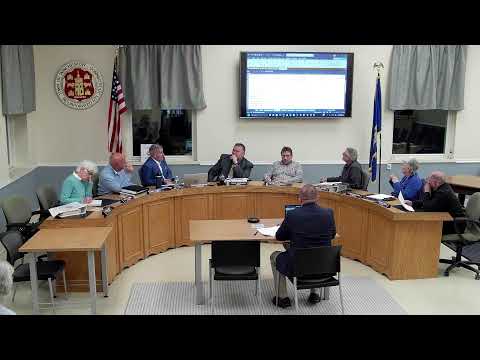
Winchester's Board of Selectmen spent the bulk of Thursday's special meeting reviewing the town's proposed 2025-26 budget, discussing capital priorities and acknowledging a $400,000 miscellaneous revenue line tied to a renewable-auction agreement that the board approved earlier in the evening. The board later accepted an assessor adjustment (BAA) that changes the projected mill rate to 29.15 and directed staff to incorporate that adjusted figure into the proposed budget.
Town Manager Paul Harrington presented slides showing revenues, state aid and recommended capital spending. He said state Education Cost Sharing (ECS) aid has remained roughly flat and listed municipal grant categories that contribute to local revenues. Harrington described a proposed $700,000 transfer from fund balance for one-time capital expenses to supplement the capital improvement plan if the electorate approves the referendum question. He said his proposed cuts trimmed capital requests from 59 projects to 27 and held $400,000 as contingent revenue sourced to the Treetech agreement previously discussed in the meeting.
Harrington and selectmen discussed the timing and conditions for using the developer payment. Staff said the $400,000 would land in the general fund only after the town receives the developer payment; if payment is late the funds could be unavailable for the current fiscal year and the developer has offered $450,000 if payment occurs after June 30, 2026. Board members emphasized that capital projects tied to that revenue could not proceed until the money was received and that some projects could be put on hold as a contingency.
The budget presentation reviewed capital line items the manager recommended trimming, including reductions to general roadway repair and guardrail replacement, plus proposed feasibility and equipment purchases. Harrington said some capital requests already had prior funding and he removed those from the reduction exercise; remaining projects were prioritized for fast-start work if the contingent revenue arrives.
Board discussion broadened to include the board's role in negotiations with Gilbert (a local educational provider discussed later in public discussion), the town's unassigned fund balance and options for selling town-owned properties to bolster revenues. Harrington noted the Economic Stabilization Fund could cover the first year's debt service if the board chooses to borrow for approved projects.
During the meeting the board accepted a Board of Assessment Appeals (BAA) adjustment to the grand list. The manager reported the completed BAA hearings changed the adjustment from an earlier $2,500,000 estimate to a finalized $646,618. A board member moved to accept the adjusted BAA number of $646,618 and to adopt the updated mill-rate projection of 29.15 in the proposed budget. The motion was seconded and carried unanimously.
Harrington said staff will circulate an updated version of the budget reflecting the adopted BAA adjustment and the board's prior motion authorizing the manager to sign the renewable auction agreement. The board scheduled further budget discussion at its next meeting; the town budget meeting is set for May 12 at Gilbert School with referendum timing to follow charter rules.
The board also discussed operational revenue lines, including building-permit receipts and miscellaneous revenues, and noted that items such as postage and ambulance reimbursement rates are subject to market and policy changes. Several selectmen urged staff to provide more line-item detail for school capital requests and to coordinate further with education officials ahead of future budget meetings.