Get Full Government Meeting Transcripts, Videos, & Alerts Forever!
Get email alerts on the Invasive Plants Japanese Knotweed topic
No spam. Unsubscribe anytime.
Winchester conservationists outline mapping and treatment plan for Japanese knotweed
Summary
A Winchester Town presentation focused on mapping, best-management practices and targeted herbicide use to control Japanese knotweed along roadsides and the Housatonic River, stressing early detection, careful technique and multi-year monitoring.
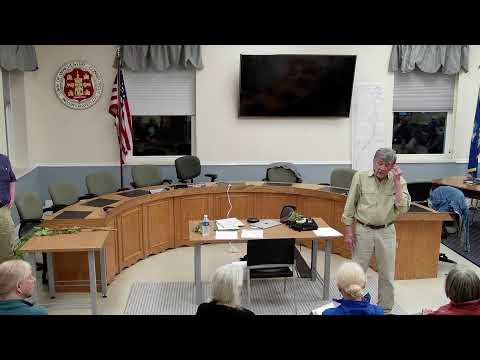
Tom Zetterstrom, a local conservationist and fine-art photographer, told a Winchester Town audience that mapping and targeted treatments can stop Japanese knotweed from converting riverbanks and roadsides into dense monocultures.
“Prevention, early detection, always the right answer,” Zetterstrom said, describing paddled surveys and roadside mapping he has led on the Housatonic River and in nearby towns.
Zetterstrom framed the issue as ecological and logistical: dense knotweed stands exclude native plants and reduce insect biomass, with downstream transport of rhizome fragments spreading new infestations. He described a 2017 paddled survey of the Housatonic that covered 41 river miles with 12 volunteers and produced a map of knotweed patches; the mapping work helped prioritize treatment sites in towns including Canaan, Salisbury, Cornwall and Falls Village. He said many patches are associated with roadwork, gravel pits and soil storage sites.
The presentation emphasized layered approaches rather than single fixes. Options Zetterstrom described included: early detection and removal of small patches by digging; repeated cutting during the growing season; stem injection or cut‑and‑treat methods for woody or riparian sites; foliar spraying in late summer and fall; and long‑term monitoring for three to five years after treatment. For small or recently established patches he recommended roughly a 2 percent glyphosate mix; for long‑established patches he said treatment concentrations may be increased to 3–7 percent and that foliar applications should use a wetlands‑approved glyphosate formulation (AquaNeat was cited) and an appropriate surfactant in non‑aquatic sites.
Zetterstrom described a recent local project at a covered‑bridge site where volunteers used a 12‑foot orchard ladder and careful spraying technique to avoid drift into the river; he said follow‑up planting of native seed mixes helped reestablish vegetation after treated knotweed dieback. He noted personal protective equipment and spot treatment methods and warned that some surfactant combinations can be toxic in or near water.
On biological control, Zetterstrom discussed the psyllid released overseas (referred to in his talk as Aphalara itadori) as a potential long‑term tool but cautioned that it is not an immediate solution. He also cited academic research he said showed sharp insect biomass declines in riparian areas dominated by knotweed.
Town and regional coordination was a recurring theme. Zetterstrom urged public-works crews to manage fill and soil storage areas and to flag suspected patches; he recommended using pink flagging tape to mark sites for follow-up treatment. He named Steve Geddes as the Connecticut Department of Transportation district arborist who has responded to town requests in the region and encouraged residents to report patches to DOT or town crews.
Audience members asked practical questions about herbicide concentrations, foam applicators and timing. Zetterstrom and other presenters recommended avoiding spraying during peak blossom periods (mid‑August to mid‑September in many seasons), said late summer and fall are generally the most effective windows for knotweed foliar treatment, and advised that cutting and treating certain vines (for example oriental bittersweet) is best done in mid‑summer to avoid seed formation.
A member of the Winchester Conservation Commission announced that the commission has started an iNaturalist mapping project to document knotweed along town roads so the department of public works can prioritize follow‑up. The commission invited volunteers to help and said its regular meetings are on the first Tuesday of the month.
The presentation included several practical takeaways: map first, prioritize small patches for early removal, use careful application techniques to minimize non‑target impacts, plan for multiple years of follow‑up, and coordinate town, state and volunteer efforts. Zetterstrom and others described local successes where town crews and volunteer teams reduced or eliminated roadside patches, and they urged ongoing monitoring to prevent reinfestation.
Community members were directed to published resources cited in the talk, including extension and conservation group fact sheets and regional best‑management guidance, and were told the presentation would be posted on the town of Winchester website for later viewing.
Ending: The presentation closed with an invitation for residents to help map knotweed and to contact the Conservation Commission or the Connecticut DOT district arborist for assistance; organizers said spot‑treatment, stewardship and multi‑year monitoring are necessary to prevent re‑establishment.