Get Full Government Meeting Transcripts, Videos, & Alerts Forever!
Get email alerts on the Criminal Records Expungement topic
No spam. Unsubscribe anytime.
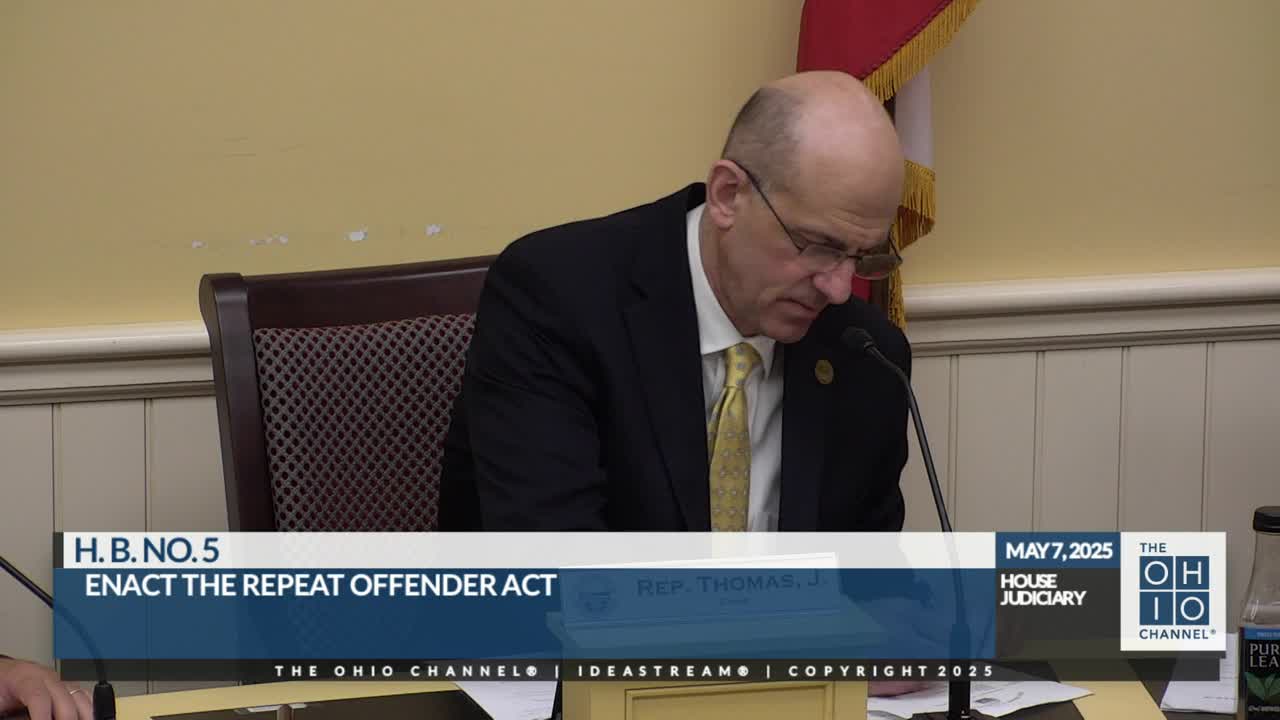
Committee adopts amendment to House Bill 5 changing sealing/expungement timelines to comply with Bloom decision
Summary
The committee agreed to an amendment to House Bill 5 that modifies sealing and expungement timing and standards to respond to the Bloom decision; sponsors described a graduated eligibility schedule at one, five, seven and ten years
The House Judiciary Committee adopted an amendment to House Bill 5 that changes the bill's ceiling and expungement provisions to align with the Ohio Supreme Court's Bloom decision, committee members said on the record.
Representative Williams moved to amend HB 5 with Amendment No. 0417. The chair found the amendment in order; the sponsor described the measure as creating a graduated timeline and standards for sealing and expungement: eligibility to seal at one year; at five years a presumption favoring sealing unless the government's interest substantially outweighs a defendant's; eligibility to apply for full expungement at seven years; and at ten years the scale "tilts in the favor of the applicant," according to the sponsor's summary.
With no objections, committee members agreed to the amendment and the chair said the amendment "shall become part of the bill." No roll call was requested in committee on the amendment.
The sponsor framed the change as an effort to make the statute consistent with Bloom, in which the Ohio Supreme Court invalidated mandatory sealing provisions that foreclose individualized balancing under the Ohio Constitution's public‑access/open‑courts framework. Committee members made no further changes on the floor of the hearing; the amendment summary was entered into the record.
Speakers involved in this action were Representative Williams (mover) and Chair Thomas (chairing the committee).