Get Full Government Meeting Transcripts, Videos, & Alerts Forever!
Get email alerts on the Cannabis Policy topic
No spam. Unsubscribe anytime.
Hardline bill to overhaul Issue 2 draws broad testimony; ACLU and prosecutors clash with industry and local officials
Summary
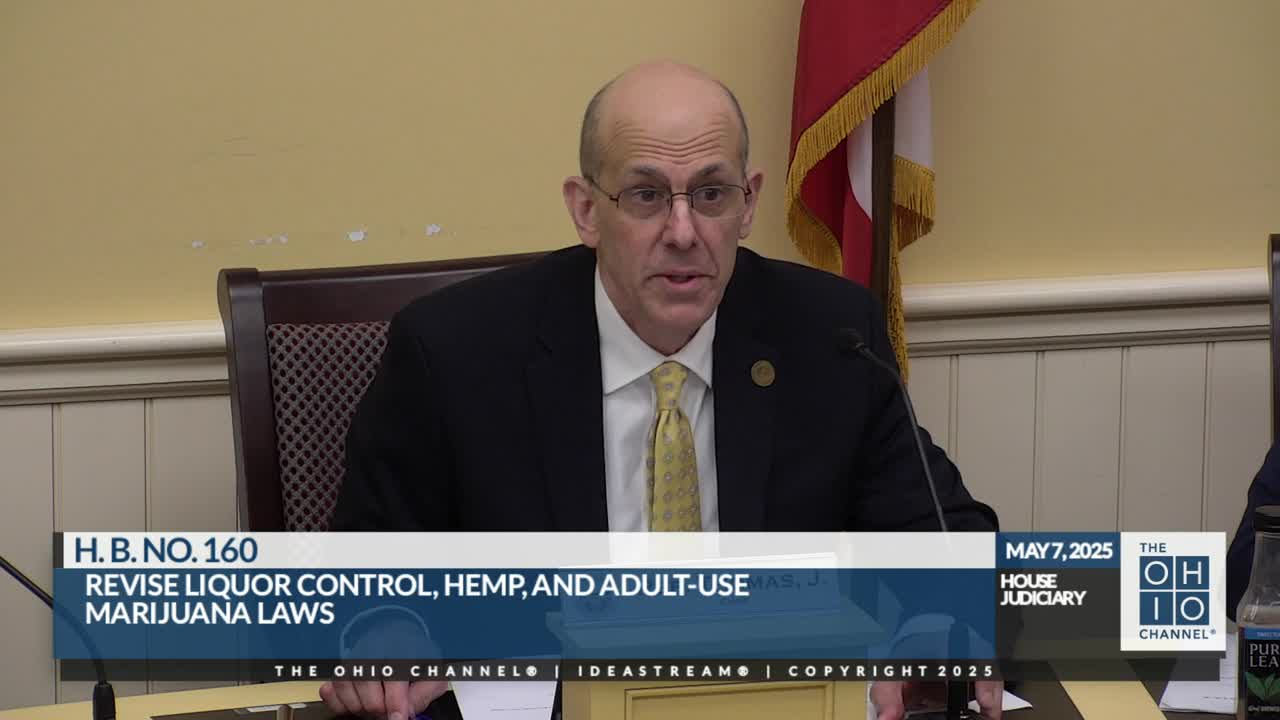
A full committee hearing on House Bill 160 drew business leaders, civil‑liberties advocates, prosecutors and local officials to debate changes to Ohio’s post‑Issue 2 cannabis law, including home‑grow limits, criminal penalties, tax distributions and how to regulate intoxicating hemp products.
The House Judiciary Committee heard hours of testimony on House Bill 160, legislation that seeks to revisit much of the adult‑use cannabis framework enacted following Issue 2 (2023). Supporters of the bill told the committee the measure addresses public‑safety gaps and illicit‑market growth; opponents said it would re‑criminalize users, move tax money away from host communities and undercut the social equity and jobs program voters approved.
Louis Tobin, representing the Ohio Prosecuting Attorneys Association, urged stricter limits on home cultivation, saying the current 12‑plant framework produces far more product than a household can reasonably possess. Tobin told the committee his association favors reducing allowable home plants "from 12 to 6," citing yield estimates and the risk that excess product fuels the black market. Tobin also criticized language in HB 160 that would protect a person only if they do not cultivate "more than double" the allowed plants, calling that a confusing and overly permissive safe harbor that could undermine enforcement.
The American Civil Liberties Union of Ohio, represented by Gary Daniels, urged the committee to reject HB 160 or substantially narrow it. Daniels said HB 160 would "impose a litany of negative changes" that he described as worse than the pre‑Issue 2 status quo: expanded criminal penalties for sharing cannabis, new mandatory jail time tied to vehicle offenses including some that could apply to passengers, and changes that would undercut the social‑equity and jobs program voters approved. "HB 160 tosses this all overboard in favor of a system quickly devolving to favor those with the most resources and influence," Daniels said. He also requested the committee consider restoring the enacted distribution and funding provisions from Issue 2 rather than redirecting tax revenue to the general fund.
Industry and consumer groups gave mixed testimony. The Ohio Cannabis Coalition (licensed industry operators) and multiple hemp and beverage manufacturers warned that some HB 160 provisions could push consumers to out‑of‑state markets or the illicit market and would harm federally legal hemp businesses. Several witnesses urged a more targeted approach to address dangerous synthetic cannabinoids and mislabeled hemp products rather than broad criminalization.
Local government testified about local budget expectations. Lexi Lawson, chair of the Anderson Township Board of Trustees, told the committee her township allowed dispensaries based in part on voter expectations that a portion of the adult‑use excise tax would be distributed to host communities. Lawson said Anderson Township anticipated roughly $1.5 million annually and asked legislators not to redirect host‑community funds away from local governments.
Several witnesses also pressed the committee on the social‑equity and jobs program created by Issue 2. Opponents of the bill said the program as written includes race‑conscious eligibility criteria that have proved difficult to implement and may be subject to constitutional challenge; supporters of the program urged the legislature to preserve the program’s goals and find a constitutionally permissible way to implement them. Representative Williams acknowledged the statutory language references categories such as "racial minority group" and suggested the committee could revise the language to achieve the voters' intent while addressing constitutional concerns.
Other recurring themes in testimony included:
- Open‑container‑style rules: witnesses debated whether vehicle open‑container analogues should apply to cannabis and whether penalties should mirror alcohol enforcement.
- Landlord‑tenant provisions: witnesses opposed criminalizing lease violations where landlords ban cannabis use, arguing most lease disputes are civil matters and criminal penalties would be disproportionate.
- Homegrow and possession alignment: defense attorneys and some industry witnesses urged harmonizing plant counts, dry‑weight yields and possession limits so a legal home harvest would not trigger prosecution because of yield conversion math.
The committee did not vote on HB 160 at the hearing. Members asked witnesses and stakeholders to submit specific amendment language. Several proponents and opponents said they planned to file technical amendments or work with sponsors to narrow or clarify provisions.
Speakers who testified or were quoted included Louis Tobin (Ohio Prosecuting Attorneys Association), Gary Daniels (ACLU of Ohio), Anthony Riley (Ohio Cannabis Live), Lexi Lawson (Anderson Township Board of Trustees), Kristen Mullins (Ohio Grocers Association), Rodney Hennessy (Ohio Cannabis Consumer Coalition), Wesley Bridal (hemp beverage manufacturer), JJ Coombs (Alpha Brands), and multiple small business owners, farmers and patient advocates.