Get Full Government Meeting Transcripts, Videos, & Alerts Forever!
Get email alerts on the School Zone Safety topic
No spam. Unsubscribe anytime.
Sponsors call for tougher penalties in active school zones after student’s death; committee hears House Bill 203
Summary
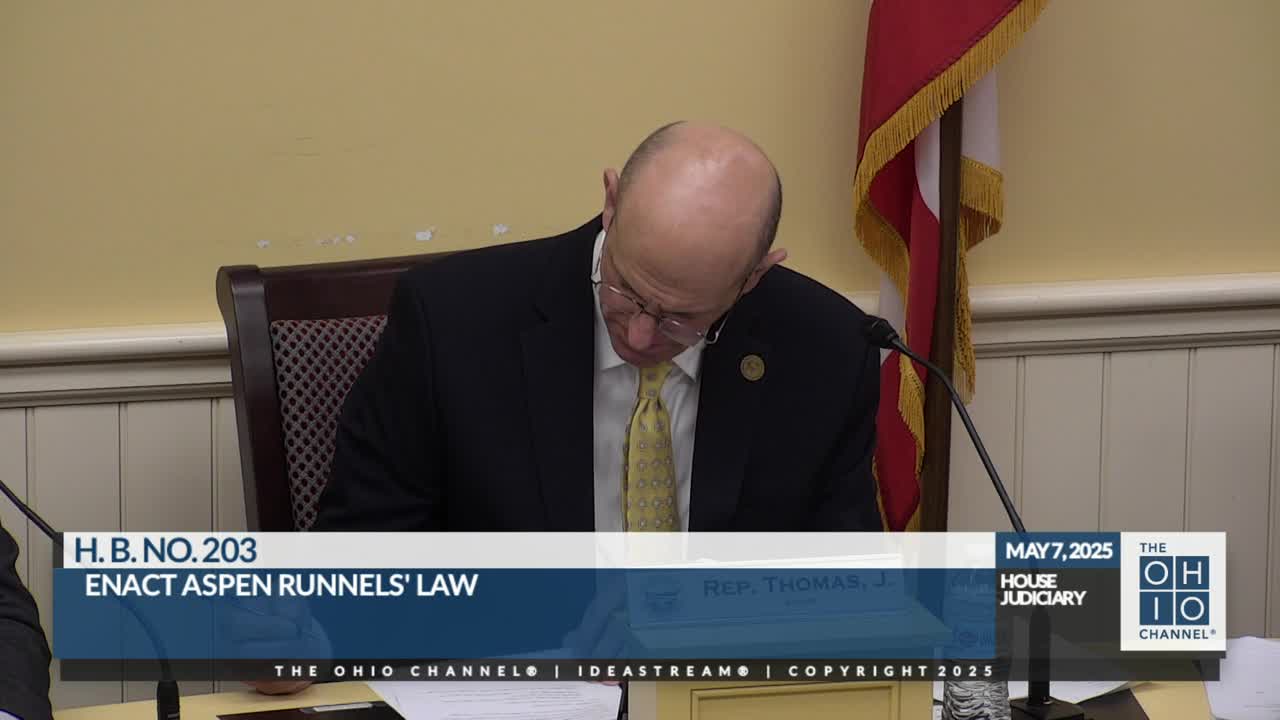
Chairman Thomas and the House Judiciary Committee heard sponsor testimony on House Bill 203, the "Aspen Reynolds" law, which would raise penalties and fines for vehicular homicide and assault committed in active school zones after a student was struck and killed near a Lakota Local Schools building in May 2024.
Chairman Thomas and members of the House Judiciary Committee heard sponsor testimony on House Bill 203, known as the Aspen Reynolds law, at a committee hearing. Representative Hall, who introduced the bill with Representative Williams, told the committee the legislation was drafted after Aspen Reynolds, a Lakota East freshman, was struck and killed as she walked between school buildings in May 2024.
"This important legislation was brought to me from constituents in my district as a result of a recent tragedy," Representative Hall said, describing local outrage after a driver pleaded guilty to a misdemeanor charge in the case. Hall and his joint sponsor said the bill is intended to treat active school zones more like active construction zones by increasing penalties and fines when a traffic offense occurs in an active school zone.
The bill would do several things, according to the sponsors' presentation and the committee bill analysis they cited: increase penalties for vehicular manslaughter and vehicular assault involving speeding or commission of a traffic offense in an active school zone; double the fine for certain traffic offenses in an active school zone; add requirements for driver's‑license reinstatement for offenders (including completion of a remedial driving course); and require signage in school zones warning motorists of the bill's increased penalties.
Representative Hall said the bill applies only to "active" school zones and that committee work was still needed to define the term clearly. "I must admittedly say to the members of the committee, I believe there needs to be more work done by members of this committee to better define what that active school zone is," Hall said.
Representative Williams, the bill's joint sponsor, emphasized a policy rationale familiar to several members: Ohio already treats active construction zones differently, often with higher penalties, and school zones should receive comparable protections. "Just as we protect our construction workers on highways and work zones, we must offer similar protections to our most vulnerable group, our children," Williams said.
Committee members asked sponsors several implementation questions. Representative Odioso said he was concerned about potential unfunded mandates on school districts; Williams and Hall replied that signage and enforcement typically fall to municipalities, townships or counties and that sponsors were open to including an appropriation or dedicating fine revenue to cover local costs. Ranking Member Isaacson suggested routing some or all of the increased penalties toward a restricted fund to pay for signage, lighting or other local safety measures; Williams said he was open to directing increased fines into a fund that schools, municipalities or townships could draw from.
Members also asked about the bill’s geographic scope. Chair Thomas and other members pressed sponsors to propose precise language to avoid overbroad school‑zone definitions; the sponsors said they had already consulted prosecutors and local law enforcement and expected additional edits in committee.
No vote was taken on House Bill 203 at this hearing; sponsors concluded their testimony and the committee moved to other agenda items. The record of questions and sponsor responses shows the committee is likely to return to HB 203 with drafting instructions about (1) a statutory definition of "active school zone," (2) any required signage or lighting standards, and (3) options for directing increased fine revenue toward local safety measures.
The witnesses who testified or were quoted were Representative Hall (sponsor) and Representative Williams (joint sponsor).