Get Full Government Meeting Transcripts, Videos, & Alerts Forever!
Get email alerts on the Drug Trafficking Fentanyl Policy topic
No spam. Unsubscribe anytime.
Prosecutors urge removal of knowledge requirement for fentanyl mixtures; civil-rights group warns HB88 expands incarceration
Summary
Prosecutors testified the bill's change is needed to prevent traffickers from evading fentanyl penalties by mixing it with Schedule III–V drugs; the ACLU of Ohio opposed other HB88 elements, saying the bill vastly increases trafficking penalties and will expand prison populations.
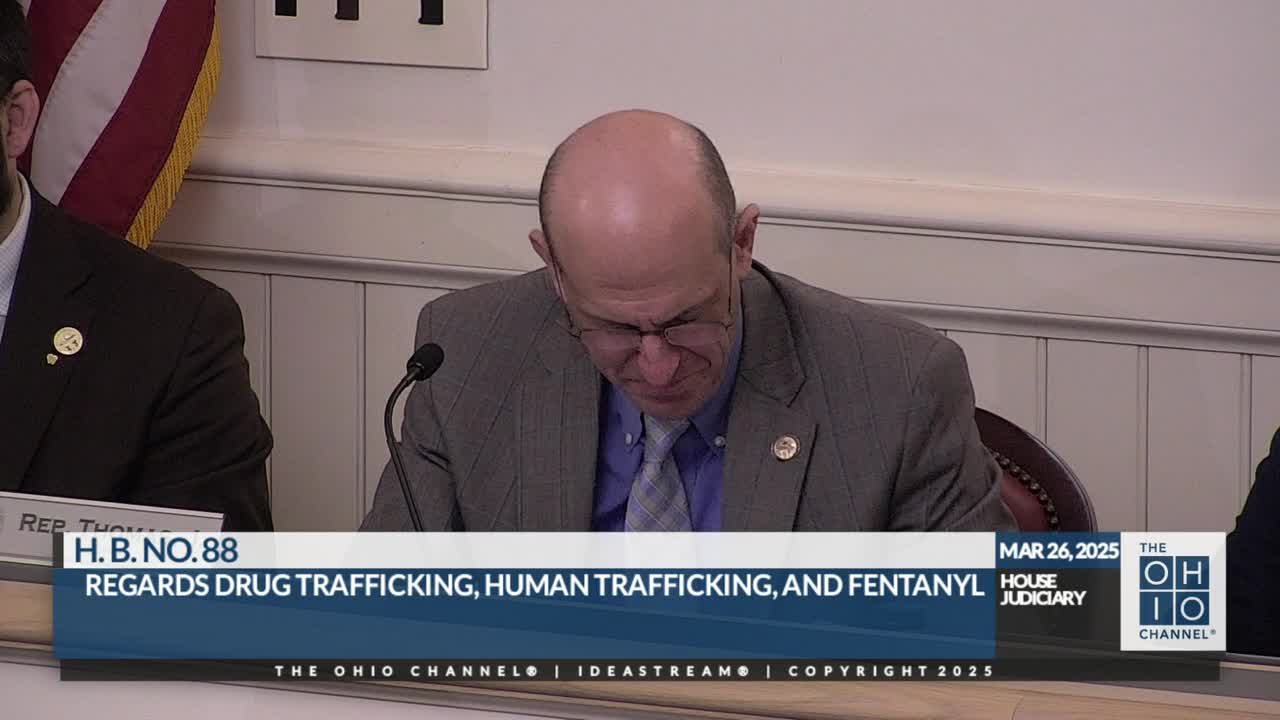
At the House Judiciary Committee's third hearing on House Bill 88, witnesses offered sharply different views about proposed changes to fentanyl-related possession and broader trafficking penalties.
Lewis Tobin of the Ohio Prosecuting Attorneys Association told the committee the bill addresses a prosecutorial hurdle in cases where Schedule III, IV or V drugs are mixed with fentanyl. Tobin explained that under current law prosecutors generally must only prove a defendant knowingly possessed a controlled substance, not a specific drug, but that a provision affecting mixtures of Schedule III–V drugs with fentanyl creates an additional requirement. He said the bill would remove the requirement that prosecutors prove the defendant "knew or had reason to know that a schedule 3, 4, or 5 drug was mixed with fentanyl" for punishment as a fentanyl-related compound, a change Tobin described as necessary because "requiring prosecutors to prove that the defendant knew that schedule 3, 4, or 5 drugs contained a mixture of fentanyl...has created a huge incentive for drug traffickers to mix fentanyl with schedule 3, 4, and 5 drugs."
Tobin provided detail from attached materials in his testimony, including a Department of Public Safety / Ohio Narcotics Intelligence Center bulletin (August 2024) describing mixtures referred to as "tranqdope" and "benzo dope," and cited the Ohio Board of Pharmacy controlled-substance reference table when explaining statutory "bulk amount" thresholds (for example, that a compound mixture containing a Schedule III or IV substance can reach a bulk amount at 100 grams or 30 times maximum daily dose and thus remain a misdemeanor unless fentanyl can be proven).
By contrast, Gary Daniels of the ACLU of Ohio testified in opposition to HB88's trafficking provisions. Daniels said HB88 "increases trafficking penalties at least 27 times" across the bill's pages, raises felony levels, and will expand the prison population and state costs. He urged the committee to consider demand-side measures — treatment, prevention and social supports — and to ask how many additional prison beds would be required and how they would be funded. Daniels said Ohio has relied heavily on punishment for decades and argued the bill repeats that approach.
Committee members questioned witnesses about middle-ground options. Representative Isaacson raised the risk that ordinary people could be swept into severe penalties if thresholds are set too low; Tobin replied prosecutors would welcome working with sponsors on a compromise if one exists. Representative Williams and others voiced concern about removing the knowledge requirement for mixtures in cases involving small or unprescribed amounts; witnesses acknowledged both the risk that some users could be severely penalized and the prosecutorial concern about a sentencing loophole that mixes fentanyl into other substances.
Ending: The committee concluded the third hearing for House Bill 88 after testimony from prosecutors and civil-rights advocates; no committee vote on final passage was recorded in the hearing transcript.