Get Full Government Meeting Transcripts, Videos, & Alerts Forever!
Get email alerts on the Courts Administration topic
No spam. Unsubscribe anytime.
Ohio Judicial Conference seeks funding to replace retiring staff and modernize website
Summary
The Ohio Judicial Conference asked the House Judiciary Committee for a larger operating appropriation to cover an anticipated staff replacement for a long-serving employee, employee compensation, and a planned website overhaul; committee members pressed on lobbying and overlap with the Judicial College.
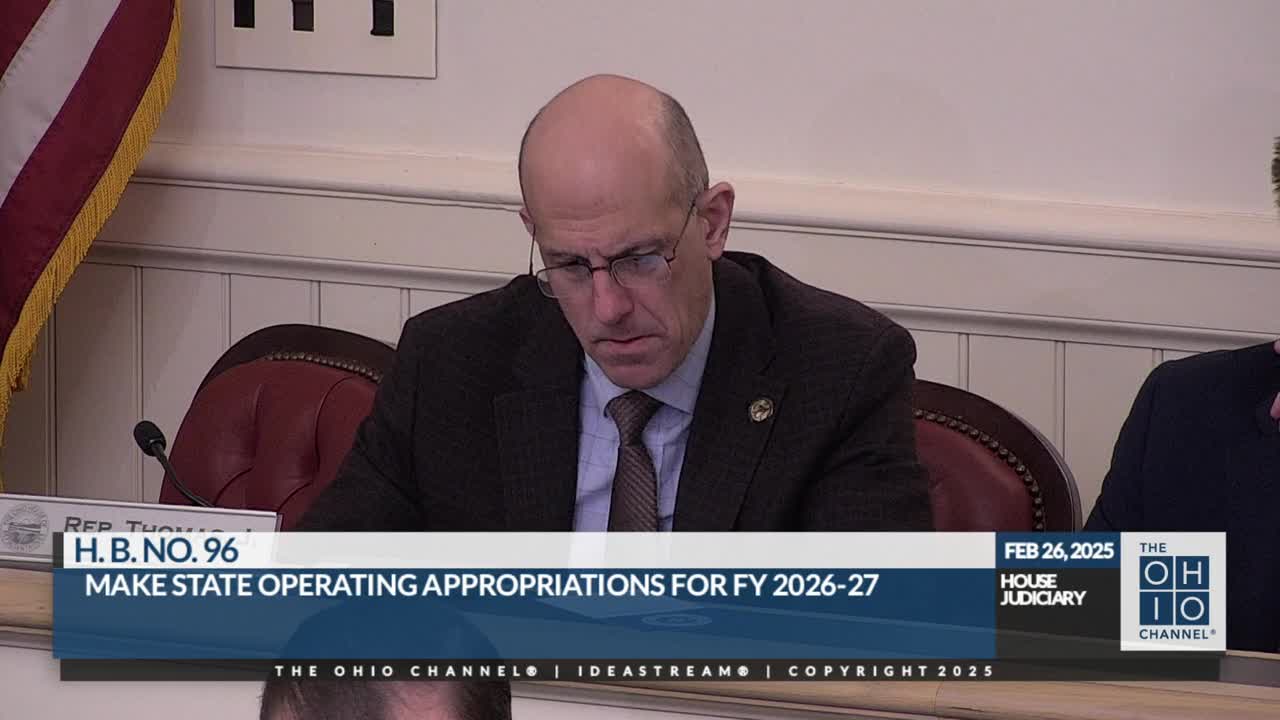
Judge Tom Pfeiffer, executive director of the Ohio Judicial Conference, testified to the House Judiciary Committee about the association’s budget request during invited testimony on the state operating budget.
Pfeiffer said the conference’s biennial request is higher than its customary 5% increase mainly because a long-time employee, Trina Bennington, is expected to retire; her accumulated duties and leave will require overlap and training costs for a successor. The conference also sought funding for employee compensation adjustments and a planned redesign of its 15-year-old website, Pfeiffer testified. He described many internal functions the conference performs for judges across Ohio, including staffing six judicial specialty committees and publishing jury-instruction materials.
Committee members pressed the conference on the organization’s role in the legislative process and on apparent functional overlap with the Ohio Judicial College and other entities. Representative Stewart asked whether two entities—one funded by the Supreme Court and one by the legislature—are duplicative. Pfeiffer said the Judicial Conference focuses on tracking legislation affecting judges and educating judges about implementation, while the Judicial College focuses on judicial training and employs different staff; he said the two organizations work together. He also confirmed the conference registers and reports lobbyists and that it sometimes takes positions on legislation, which he described as assisting the legislature by pointing out implementation issues and operational consequences.
Pfeiffer described the conference’s volunteer structure—20 standing committees made up of judges—and said the organization staffs meetings and educational programs that otherwise would lack administrative support. He noted the conference has no audit findings and that it was reauthorized in a recent sunset review. Pfeiffer also said the conference handles certain pass-through payments, including an annual payment to a national uniform-law organization.
Ending
Pfeiffer answered members’ questions and the committee moved to the next invited witnesses. The Judicial Conference’s requested appropriation will remain subject to the committee’s budget deliberations.