Get Full Government Meeting Transcripts, Videos, & Alerts Forever!
Get email alerts on the Criminal Justice Gun Policy topic
No spam. Unsubscribe anytime.
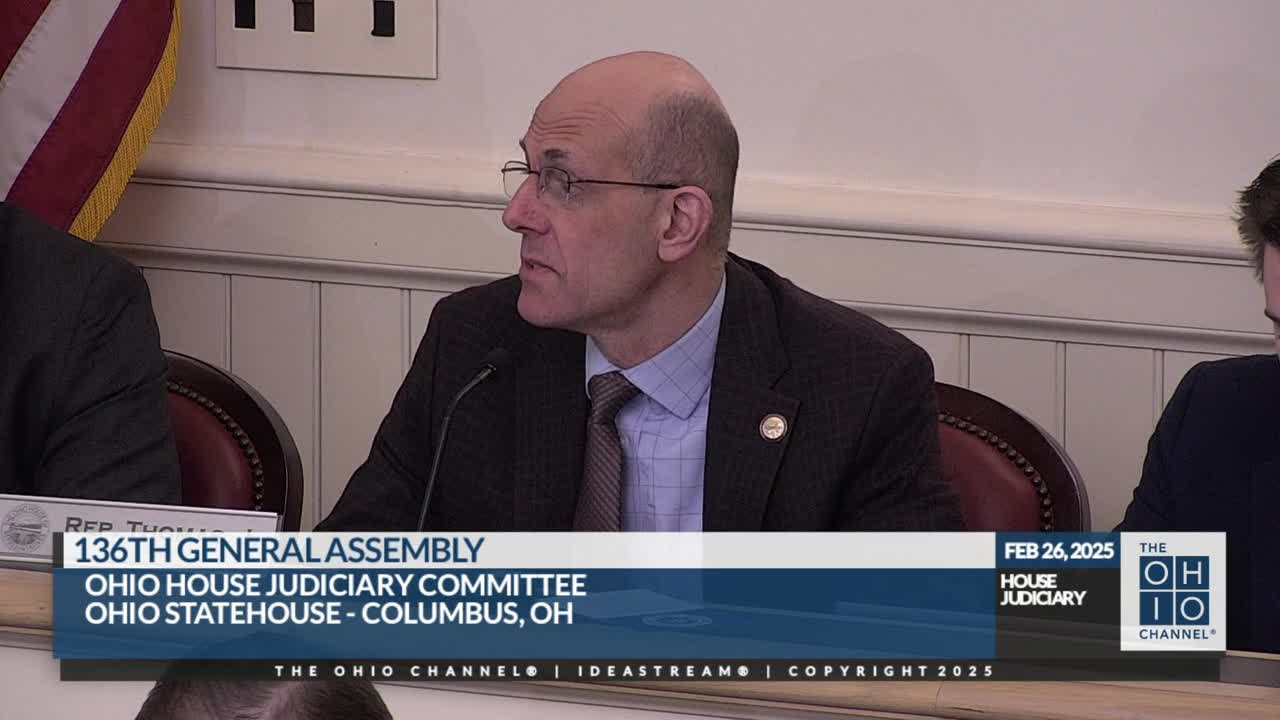
Ohio House Judiciary Committee holds first hearing on HB 5, the Repeat Offender Act
Summary
Sponsors of House Bill 5 presented the Repeat Offender Act to the House Judiciary Committee in a first hearing, proposing increased penalties and new firearm specifications for repeat violent felons; committee members questioned sentencing ceilings, juvenile-record treatment and preemption of local ordinances.
House Representative sponsors introduced House Bill 5, called the Repeat Offender Act, for a first committee hearing before the Ohio House Judiciary Committee on the bill’s intent to increase penalties for repeat violent felons found in possession of firearms.
Representatives Timothy Willis and Matthew Williams, sponsors of HB 5, told the committee the bill is designed to preserve law-abiding citizens’ Second Amendment rights while increasing penalties and mandatory prison presumptions for violent felons who repeatedly possess firearms. “This bill will get those offenders off the streets by increasing penalties and requiring mandatory prison time for repeat offenders,” Representative Williams said in testimony.
The bill would raise repeated weapons-under-disability violations from a third-degree felony (currently up to 36 months) to a second-degree felony, with an underlying sentencing range described in testimony as 2 to 8 years and a potential “Reagan Tokes” tail that could extend the term up to 12 years depending on behavior in prison. Sponsors also described a new set of firearm specifications tied to the severity of the conduct: a 1-year specification for basic possession, a 3-year specification for brandishing, a 5-year specification for discharging a firearm during a crime, and a 7-year specification for drive-by shootings. In addition, the repeat-offender specification would apply on a third qualifying felony of illegal possession by a violent felon and could add up to 5 years to an underlying sentence, according to sponsor testimony.
The sponsors cited research they said supports increasing penalties for repeat violent offenders: testimony referenced a U.S. Sentencing Commission finding that sentences of 60 months or longer correlate with reduced recidivism and a University of Pennsylvania study that found gun specifications can have a deterrent effect. Sponsors also said the bill has support from Governor DeWine, Attorney General Yost and a municipal mayors’ alliance.
Committee members pressed sponsors on several policy details. Ranking Member Isaacson questioned the “ceiling” and expressed concern about increasing terms beyond the point of societal benefit and the risk of excessive stacking of specifications; sponsors said they were open to drafting an amendment to prohibit stacking firearms specifications so penalties do not compound indiscriminately. Isaacson also asked whether sponsors would limit stacking; Representative Williams said the bill’s intent is that the new repeat-offender specification not stack on top of other firearms specifications and confirmed that an amendment addressing stacking had been discussed in prior sessions.
Several members asked about juvenile records. Isaacson and others pressed sponsors on language that would allow courts to consider sealed juvenile records when determining repeat-offender status. Sponsors said the bill follows the legislature’s existing approach: a juvenile conviction that would have been disqualifying if committed by an adult can serve as a disqualifier later. They said legislative changes over recent years already make expungement and sealing more accessible and that the bill’s sealing and restoration provisions were negotiated over months with stakeholders to allow pathways to relief for some low-level offenders while still treating serious juvenile violent felonies as relevant to adult firearm disqualifications.
Representative Sittingberg asked how the bill interacts with municipal home-rule and local gun-safety measures. Sponsors said they respect home rule but argued for a uniform statewide statutory framework to avoid a patchwork of local rules; one sponsor said the state has successfully defended that approach in court and emphasized the bill targets repeat unlawful possession and certain modified weapons. Sponsors also described increases in specifications for fully automatic weapons and suppressors (from prior specifications to new 10- and 15-year specifications) to align with federal penalties for some modified firearms.
No committee vote was taken during the first hearing; sponsors agreed to take questions and appear open to amendments on stacking and other technical points.
Ending
The committee moved on after questioning; sponsors asked members to consider the bill as a step they described as aimed at reducing violent crime perpetrated by repeat offenders. The bill remains in committee for further drafting and possible amendment.