Get Full Government Meeting Transcripts, Videos, & Alerts Forever!
Get email alerts on the General Government topic
No spam. Unsubscribe anytime.
House Government Oversight Committee holds first hearing on bill to require legislative approval, fiscal review of major rules
Summary
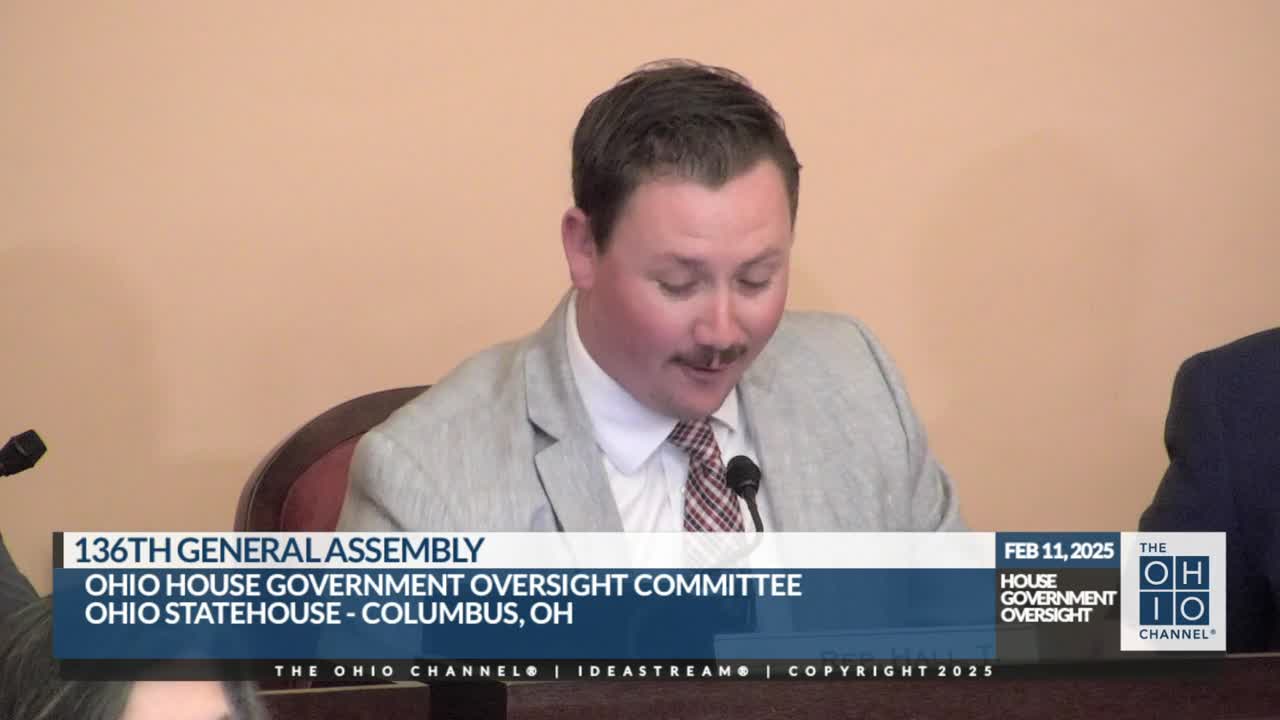
The House Government Oversight Committee held a first hearing on House Bill 11, which would require the Ohio General Assembly to review and approve major administrative rules and impose additional fiscal-analysis requirements on agencies.
The House Government Oversight Committee held a first hearing on House Bill 11, which would require the Ohio General Assembly to review and approve major administrative rules and impose additional fiscal-analysis requirements on agencies. The hearing included sponsor testimony, questions from committee members, and staff explanation of the proposed review process; no vote or formal action was taken.
Rep. Ferguson (Vice Chair of the House Government Oversight Committee) opened sponsor testimony saying, "HB 11 is designed to accomplish 3 main objectives, restore legislative control, increase transparency, and empower the people of Ohio." A second sponsor added that the bill "ensures that every major rule gets an independent economic review before becoming law, and it requires state agencies to publicly disclose their policies so Ohioans know exactly what's happening in our government." These sponsors framed the bill as a measure to increase legislative oversight of rules that currently take effect unless invalidated by committee and both chambers.
Committee members pressed sponsors on specifics. Rep. Rob King asked how the bill’s offset requirement would work and whether the director of budget and management would be authorized to transfer funds for any independent analysis. Sponsors responded that agencies would have an allotment for administrative costs set at the start of each biennium and that costs beyond that allotment would trigger legislative review; they said that, in rare instances when a chamber chair requests an independent analysis, the chamber could authorize a third party and that the expense would be borne from the agency’s normal budget. Rep. King asked, "So is there an appropriation with this, or how would that work?" and sponsors described the limited circumstances in which outside costs would be sought and where the funding would come from.
Sponsors and lawmakers described the bill’s threshold for legislative review: any rule with a $100,000 or greater administrative cost or a $100,000 or greater impact on an individually affected person would be routed to the full legislature; rules below that threshold would remain under the current JCAR process. Sponsors said Legislative Service Commission (LSC) data indicate that if the bill had been in effect during 2023–2024, roughly 83 rules would have triggered legislative review.
Members also discussed process and timing. Sponsors said emergency rules and the existing 180-day emergency rule expiration would remain in place and that the proposal is not intended to require the full legislature to review every minor rule. Representative commenters from different parts of the state noted geographic coverage concerns for the current JCAR membership and said HB 11 would give all 132 legislators the opportunity to weigh in on major rules that affect specific regions or industries.
The committee did not take any formal action on HB 11 at the hearing; sponsors said they would continue discussions with interested parties and expect to file follow-up information requested by members, including examples and the list of other states that have enacted similar measures.
The first hearing on House Bill 11 concluded with the committee scheduling further consideration at a later date; no votes or referrals were recorded at the session.