Get Full Government Meeting Transcripts, Videos, & Alerts Forever!
Get email alerts on the Constitutional Amendment Process topic
No spam. Unsubscribe anytime.
Ohio lawmakers hear sponsor testimony on Article V convention call limited to budget, federal power and term limits
Summary
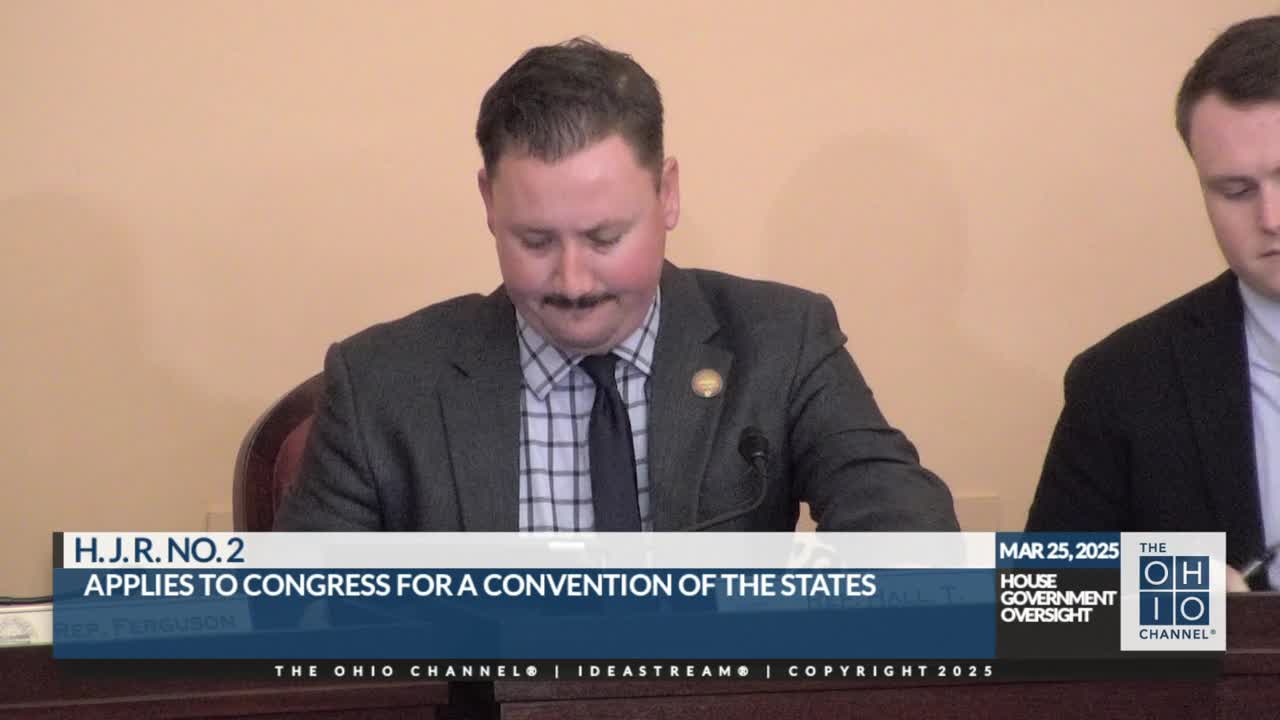
State Representative McLean and State Representative Willis on Wednesday presented sponsor testimony to the Ohio House Government Oversight Committee on House Joint Resolution 2, urging Congress to call an Article V convention limited to a balanced-budget amendment, limits on federal power and term limits.
State Representative McLean and State Representative Willis on Wednesday presented sponsor testimony to the Ohio House Government Oversight Committee on House Joint Resolution 2, which urges Congress to call a convention of states under Article V of the U.S. Constitution limited to three subjects: a balanced-budget amendment, limits on federal power and jurisdiction, and term limits for federal officials.
Representatives McLean and Willis told the committee the resolution is intended to restore federalism and check what they described as decades of federal overreach. "This resolution issues a call for a convention of states under Article 5 of the U.S. Constitution to propose amendments regarding limited subjects," McLean said in his opening remarks. McLean also cited the national debt, saying the federal government has borrowed to the point that the United States is "now $36,000,000,000,000 in debt." Willis said the measure is a way for states to press for changes if Congress will not act.
The committee discussion focused on three recurring concerns: how delegates would be appointed and constrained at a convention, whether a convention could become "runaway" and consider topics beyond the three subjects listed, and how essential federal programs such as Social Security and Medicare would be protected. Committee members asked for legal precedent and clarity about how subject-matter limits would be enforced if a convention were called.
Representative Gross asked whether delegates could change the convention's scope once convened; McLean and Willis said the intent is to limit the convention to the specified subject matters and that legal experts are split on how strictly Article V limits delegates. "There are legal scholars on both sides of the issue," McLean said, and he told the committee he expects proponent and opponent legal testimony in future hearings.
Several members raised the ratification threshold and the multistage nature of the process. McLean noted that a convention call requires two-thirds of the states (34) to request a convention and that any proposed amendments would then require ratification by three-quarters of the states (38) before taking effect. Representative Rader asked how the process would protect entitlements; McLean replied that the high ratification threshold provides a safeguard and that proposed amendments would still require broad agreement to become part of the Constitution.
Lawmakers also debated alternatives to an Article V convention. Representative Rader and others pointed out that Congress can and has proposed amendments directly, as it did multiple times in U.S. history, and asked why the sponsors prefer an Article V route over pressing Congress to act. Willis and McLean said they view the resolution as a tool to increase pressure on Congress and to provide states a mechanism when Congress has been unwilling to act.
McLean and Willis told the committee they will bring legal experts and additional documentation to subsequent hearings and that they have been participating in mock conventions and preparatory work in other states. They said about 19 states already have similar subject-matter calls and that proponents seek to bring Ohio into that group.
No committee vote was taken at the conclusion of the testimony. The sponsors indicated they expect further hearings with legal experts and additional testimony before any vote on the resolution.
The committee moved next to separate legislation on delegate selection and oversight (House Bill 67).