Get Full Government Meeting Transcripts, Videos, & Alerts Forever!
Get email alerts on the Parole Transparency topic
No spam. Unsubscribe anytime.
Proponents tell committee House Bill 31 would make parole and violation hearings more transparent with recordings and transcripts
Summary
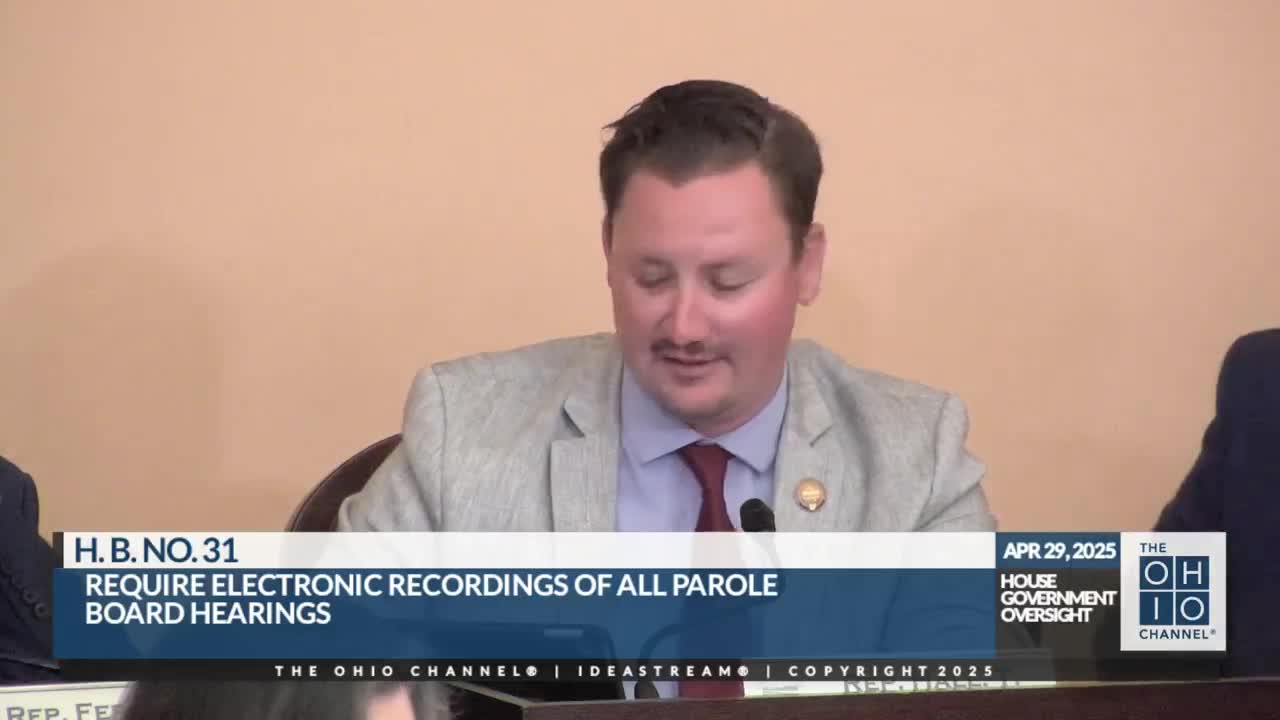
Supporters including a legislative director with Americans for Prosperity Ohio and an experienced criminal defense attorney told the House Government Oversight Committee that HB 31 would improve consistency, oversight, and advocacy by requiring recordings and transcripts of parole board and certain supervision hearings.
Hannah Cubbins, legislative director for Americans for Prosperity Ohio, and attorney Spencer Cahoon testified before the House Government Oversight Committee in favor of House Bill 31, a measure that would require recording parole board hearings and preparing transcripts of parole and post-release control violation proceedings.
Cubbins told the committee the proposal is a "common-sense solution" that would provide "more transparency, accessibility, and accountability" because recording and transcripts already occur in many court settings and would extend that practice to parole board hearings. She said members of the public typically face hurdles to attend parole hearings and that transcripts would allow broader public access.
Spencer Cahoon, an 18-year criminal defense attorney and former supervisor of the prison legal services section of the Ohio Public Defender, said recordings and transcripts would improve consistency between parole board compositions, help incarcerated people and victims understand the reasons for decisions, and provide material for oversight. Cahoon told the committee Ohio has "over 200,000" people on probation or parole and that the state spends roughly $100,000,000 per year incarcerating people only for technical violations; he said continuances can run up to 10 years and that parole board members are term-limited to a maximum of 12 years.
Cahoon also discussed potential costs of erroneous decisions, saying incarceration consequences can range from the equivalent of a fifth-degree felony up to sanctions comparable to a first-degree felony, and he cited an estimated per-case incarceration cost range of roughly $19,000 to $386,000 in certain contexts. He said making hearing records available would allow errors to be identified and addressed and improve advocacy for incarcerated people and victims.
Representative Plaggart asked how large the problem of reversible error might be; Cahoon said it is difficult to say without records and that one of the bill's purposes is to create the records necessary to measure and address problems. The ACLU of Ohio submitted written testimony in opposition or comment but did not appear in person, according to the committee.
Ending: The committee received proponent testimony and concluded the hearing; no committee vote was recorded on HB 31 in the transcript.