Get Full Government Meeting Transcripts, Videos, & Alerts Forever!
Get email alerts on the Regulatory Sandbox topic
No spam. Unsubscribe anytime.
Committee hears sponsors on universal regulatory sandbox bill to spur innovation
Summary
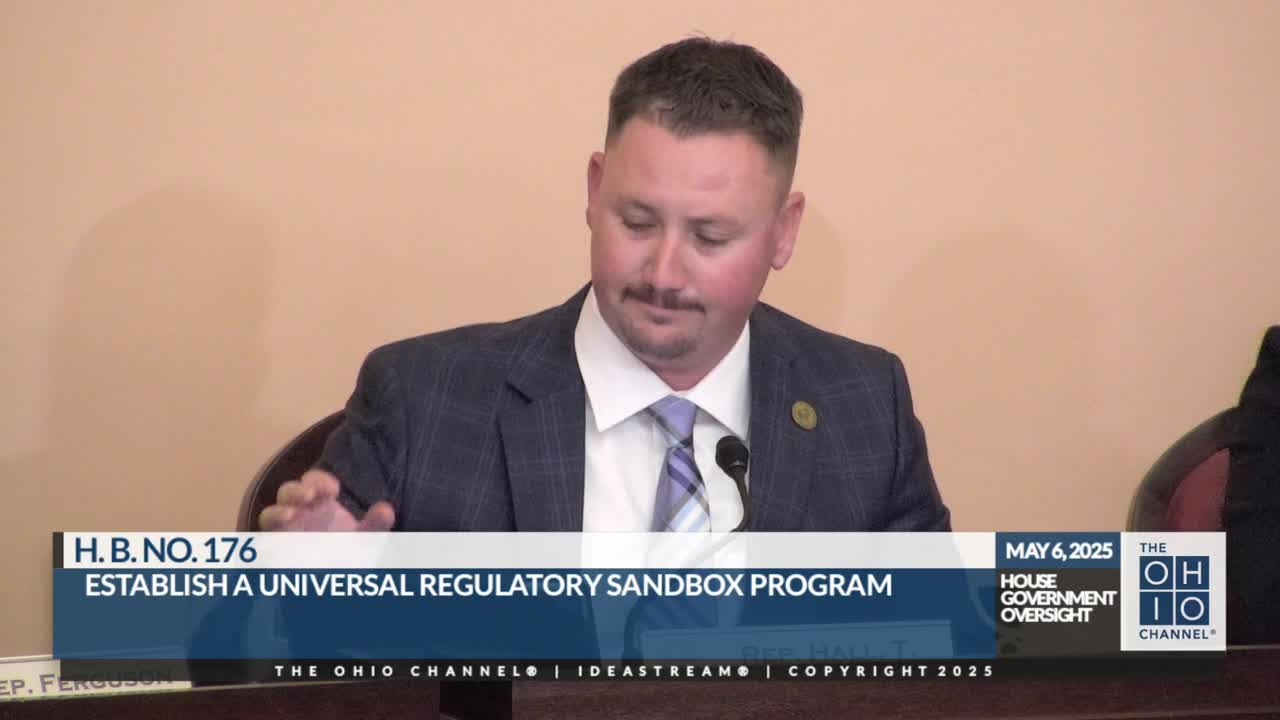
Representative Fisher and Representative Lorenz presented sponsor testimony on House Bill 176, which would establish a universal regulatory sandbox in Ohio and create a Regulatory Relief Office within the governor’s common-sense initiative to administer the program.
Representative Fisher and Representative Lorenz presented sponsor testimony on House Bill 176, which would establish a universal regulatory sandbox in Ohio and create a Regulatory Relief Office within the governor’s common-sense initiative to administer the program.
The bill would let businesses temporarily test products or services in Ohio markets with limited exemptions from state licensure or regulation for up to five years, with possible time-limited extensions, provided applicants meet consumer-protection, record-keeping and disclosure requirements. Sponsors said the program would be fee-supported by applicants and include an advisory committee and oversight mechanisms to protect consumers.
Representative Fisher described the sandbox as a tool to attract innovators and outside investment; he and Representative Lorenz said 14 states had sandbox laws as of 2024 and highlighted examples where broader programs drew firms to other states. They said the program is intended to be industry-neutral — not limited to fintech or insurance — and could apply to technologies such as telehealth, digital banking, AI and cryptocurrency under regulatory supervision.
Committee members pressed sponsors on cost and access for small businesses, the potential for larger firms to capture benefits, and executive-branch discretion. Sponsors said fees would be charged to applicants rather than taxpayers and that fee schedules could be scaled to accommodate small businesses. They said the Regulatory Relief Office is designed to work collaboratively with state agencies, maintain oversight and would not have authority to waive federal laws such as HIPAA. Sponsors emphasized that liability for consumer harm would remain with the company and that participants must notify consumers of sandbox status.
Representatives also sought detail about oversight transparency and accountability. Sponsors described guardrails including public feedback, record-keeping, required consumer disclosures and continued regulatory supervision by affected state agencies. They cited other states (Utah, Tennessee, Arizona) as models and gave an example of an Ohio-based firm, BrightFi, that relocated to Arizona where a sandbox allowed product testing.
The committee conducted a first hearing and asked clarifying questions; no vote was taken.