Get Full Government Meeting Transcripts, Videos, & Alerts Forever!
Get email alerts on the Daylight Saving Time topic
No spam. Unsubscribe anytime.
Ohio sponsors urge Congress to adopt permanent daylight saving time
Summary
Sponsors of House Concurrent Resolution 10 told the House Government Oversight Committee they support urging Congress to pass the Sunshine Protection Act and make Daylight Saving Time permanent nationally, citing family disruption, public safety and health studies; committee held a first hearing but took no formal action.
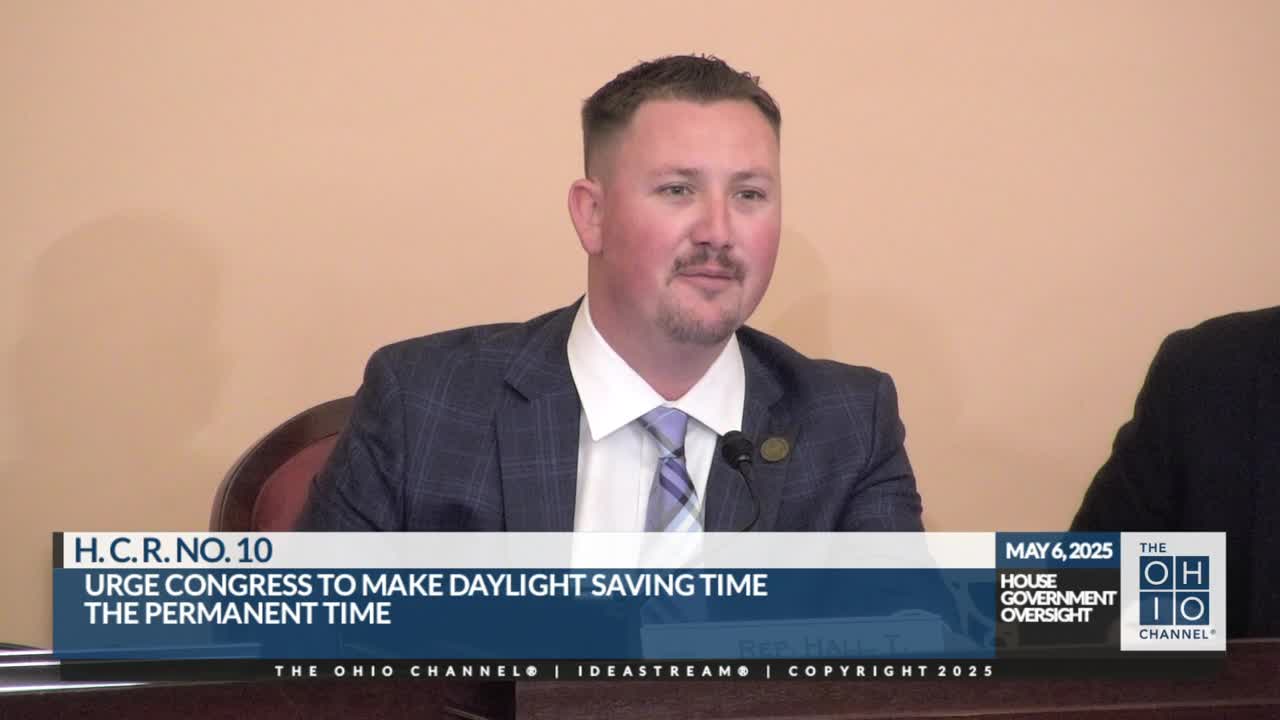
Representative Pickelantonio, sponsor of House Concurrent Resolution 10, and joint sponsor Representative Peterson urged the House Government Oversight Committee to ask Congress to adopt permanent Daylight Saving Time nationwide, citing family disruptions and health and safety studies.
The resolution asks Congress to pass legislation such as the Sunshine Protection Act of 2025 to allow states to adopt permanent Daylight Saving Time; sponsors said federal law currently restricts states from implementing permanent DST without a uniform federal change.
Representative Pickelantonio told the committee the twice-yearly clock change had personal effects on her family and that research tied the shifts to negative health impacts. “After that awareness I started researching and learned about lots of the negative health impacts that all of us have from the clock switching back and forth,” she said in sponsor testimony. She listed potential benefits of permanent DST including increased evening daylight, more outdoor time for children, “expanded economic opportunities, energy savings, improved traffic safety,” and reductions in some health events and crime.
Representative Peterson, the joint sponsor, said roughly two-thirds of the year is already spent on Daylight Saving Time and that surveys show a majority preference for the DST schedule. He acknowledged the concern about dark winter mornings for children waiting for buses and said local school districts could adjust start times as one possible mitigation. Peterson cited prior federal activity on this issue — noting a version of the Sunshine Protection Act passed the U.S. Senate in 2022 and that the Senate Commerce Committee had recently taken steps toward advancing related legislation.
Members asked about health evidence and neighboring states' positions. Committee members referenced studies presented by the sponsors — for example, testimony cited research showing increased heart attacks, workplace injuries and sleep disruption after the spring time change — and asked whether nearby states were lobbying Congress similarly; sponsors cited Indiana and other states that have engaged on the issue. Representatives discussed tradeoffs between more evening daylight and darker winter mornings and noted differing local impacts.
The committee held a first hearing on the resolution and received sponsor testimony; no committee vote or formal action on HCR 10 occurred during this meeting.
The resolution and sponsor testimony remain in committee pending any future action or amendment.