Get Full Government Meeting Transcripts, Videos, & Alerts Forever!
Get email alerts on the Energy Policy topic
No spam. Unsubscribe anytime.
House Energy Committee adopts substitute for House Bill 15, lowers tax on new generation and shortens review clocks for utilities
Summary
The House Energy Committee adopted a substitute amendment to House Bill 15 at its fourth hearing, advancing a package of changes to Ohio energy policy that include a reduced tax on new generation, new deadlines for utility and siting reviews, and changes to net‑metering and rate‑case procedures.
The House Energy Committee adopted a substitute amendment to House Bill 15 at its fourth hearing, advancing a package of changes to Ohio energy policy that include a reduced tax on new generation, new deadlines for utility and siting reviews, and changes to net‑metering and rate‑case procedures.
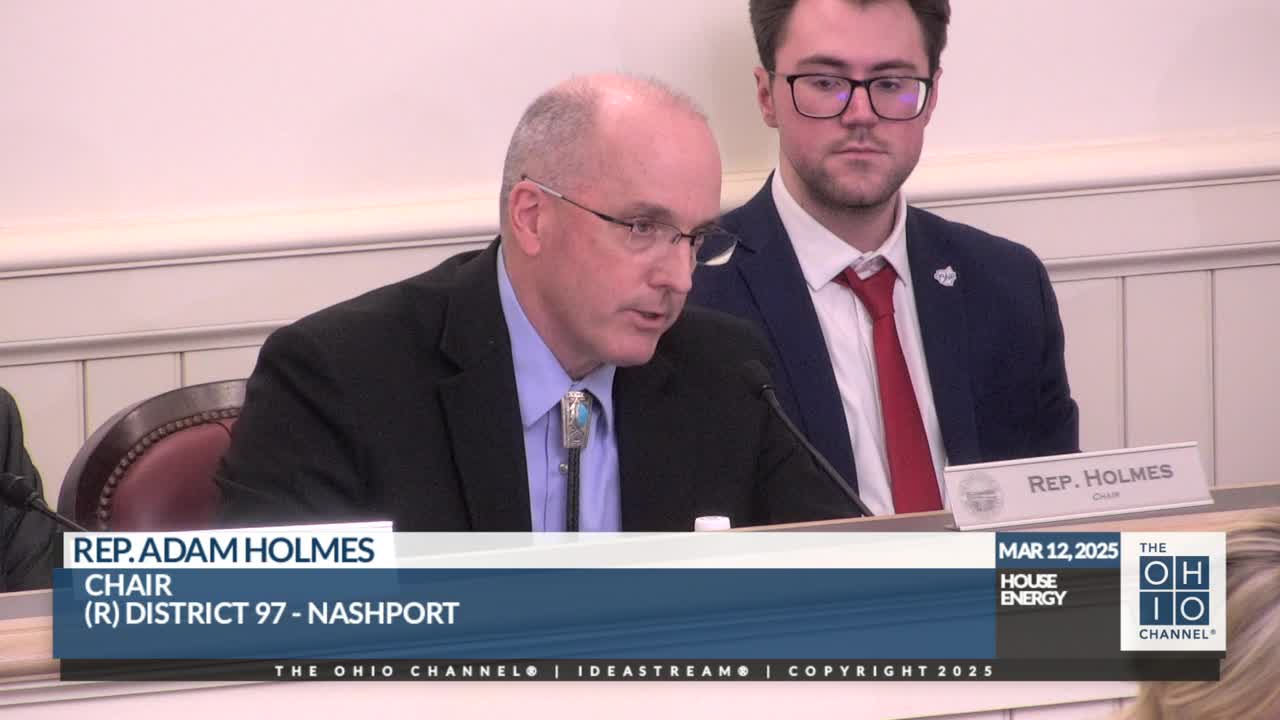
Chairman Holmes, chair of the House Energy Committee, opened the session and said the panel would "introduce and accept substitute bill, House Bill 15," and called for the motion to amend. Vice Chair Klopfenstein, vice chair of the committee, moved to amend House Bill 15 with the circulated substitute and then walked members through the principal provisions before the committee agreed to the motion by unanimous consent.
The substitute reduces the tangible personal property (TPP) tax rate for new generation and energy-conversion facilities from 25% to 7% while leaving existing plants and their current tax treatment in place. Vice Chair Klopfenstein said the lower rate is intended to keep Ohio competitive for new projects and to encourage base‑load generation and industry development.
The substitute also makes several procedural and regulatory changes for state energy regulators. It creates a PUCO (Public Utilities Commission of Ohio) "shot clock" for rate cases — a multi-step timeline described by sponsors that includes a staff report at 180 days and a temporary rate taking effect if a case is not completed by the approximately 275‑day milestone pending final reconciliation. The amendment also requires utilities to file rate cases at least every three years and permits multi‑year rate plans that spread base‑rate changes across up to three consecutive years with an annual true‑up.
For siting and transmission reviews, the substitute establishes an Ohio Power Siting Board (OPSB) 180‑day decision window after an application is complete and expands the OPSB's review threshold for transmission projects from 100 kVA down to 60 kVA, bringing more projects under its jurisdiction. If a utility owns a right-of-way, the substitute provides a 45‑day expedited process for adding transmission, distribution or pipeline infrastructure.
On taxation and local impacts, the substitute keeps current TPP collections in place for existing facilities but reduces the TPP applied to new transmission, distribution and pipeline infrastructure (described in committee as a decrease from 87% to 25% for certain new infrastructure categories). The bill also creates a priority investment area designation that local communities may seek from the Department of Development; when granted, the Ohio Power Siting Board's decision timeframe would be reduced to 45 days and new infrastructure in such areas would be exempt from TPP for five years before reverting to the 7% rate for new generation.
The substitute addresses several programmatic items: immediate repeal of the OVEC (Ohio Valley Electric Corporation) rider upon enactment, reinstatement of audit procedures for the legacy generation rider (LGR), suspension of continued collection of the Solar Generation Fund with guidance for settling existing memoranda of understanding (MOUs) and refunding remaining balances to ratepayers, and clarification that energy storage will be taxed as a facility (equipment tax) rather than as a kilowatt‑use tax (i.e., it is a one‑time facility tax, not a use tax when the stored energy is later dispatched).
The bill removes the ability for electric distribution utilities to own behind‑the‑meter generation and aligns net‑metering rules across resource types (wind, solar, biomass, landfill gas, hydropower, microturbine and fuel cells) for sizing. It exempts certain cooperative utilities from behind‑the‑meter requirements because of their nonprofit structures and creates a community energy pilot to promote generation on brownfields and distressed lands.
On transparency and grid planning, the amendment requires electric distribution utilities (EDUs) to publish quarterly capacity or "hosting" heat maps showing available distribution hosting capacity by location, circuit and substation voltage. PUCO would be required to hold annual stakeholder meetings on map design and publish a statewide reliability report annually. The bill also directs study and reporting on advanced transmission or grid‑enhancing technologies for congested areas.
Representative Lear asked whether the 7% tax applies only to new generation and whether existing plants would remain taxed at the prior level; Vice Chair Klopfenstein confirmed that existing facilities would retain current valuation and tax treatment while new projects receive the reduced rate. Representative Lear also asked how storage is taxed; committee sponsors clarified storage would be treated as a facility tax (equipment) rather than taxed again when energy is dispatched.
Representative Ray and other members praised the proposed shot clocks for PUCO and OPSB, noting outreach had occurred with regulators and stakeholders, and emphasized the need to balance speed with consumer protections. Vice Chair Klopfenstein said the office had reviewed more than 100 proposed amendments and expects only technical "tweak" amendments moving forward.
The committee agreed to the motion to adopt the substitute without objection; Chairman Holmes closed the fourth hearing of House Bill 15. The committee scheduled two public hearings next week (opponent testimony Tuesday, additional testimony and a vote Wednesday) and indicated any further amendments should be submitted 24 hours before the Wednesday vote.
"I move to amend House Bill 15 with Sub Bill 130 668083," Vice Chair Klopfenstein said during the meeting. Chairman Holmes closed the meeting by stating, "Without objection, the motion is agreed to and the sub bill is adopted."