Get Full Government Meeting Transcripts, Videos, & Alerts Forever!
Get email alerts on the Utility Billing Transparency topic
No spam. Unsubscribe anytime.
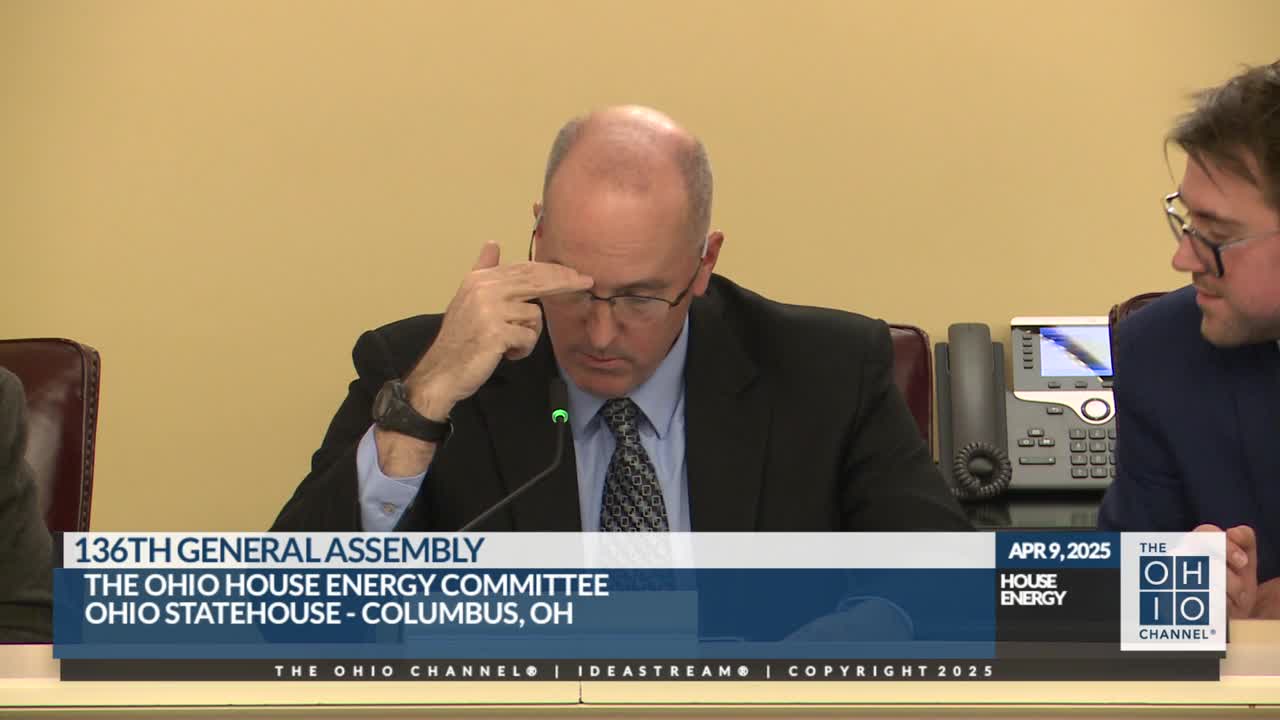
House Energy Committee holds first hearing on bill to itemize utility bills
Summary
Lawmakers heard testimony on House Bill 158, the Consumer Utility Billing Transparency Act, which would require clearer, itemized electric, gas and water bills; committee members urged clarifying language and templates but took no formal vote.
Rep. Brennan, sponsor of House Bill 158, told the Ohio House Energy Committee that the Consumer Utility Billing Transparency Act would require clear, itemized utility bills for electricity, natural gas and water so customers can see charges such as generation, transmission, distribution, supply, taxes and riders.
"Utility bills affect nearly every household in Ohio," Rep. Brennan said during the committee's first hearing on the bill. He described hidden fees, obscure riders and bundled costs that can leave customers "confused, frustrated, and powerless to make informed choices or hold providers accountable." He emphasized the bill would not set prices or add new costs to utilities, but would require providers to present existing calculations in an understandable, itemized format.
The bill's joint sponsor, Rep. Thomas, said the measure reflects his experience as an auditor visiting constituents with confusing bills and that an itemized statement would at least show "where the issue was" even if it did not change the final dollar amount. "Worst case scenario, our residents... just do their monthly payment. Nothing changes for them. I think best case scenario, our residents are able to at least look, see where their increases are," Thomas said.
Committee members broadly expressed support while pressing for clarifications. Rep. Hall asked whether the bill should require a glossary or plain‑language explanations of common utility terms, noting many consumers would not understand the difference between distribution, generation and transmission charges. Rep. Hall suggested the bill could be amended to provide definitions or a template. "I wonder if you're open to going a step further and requiring some sort of... glossary," he said.
Rep. Brennan said he was open to suggestions and noted variation across providers: some utilities offer interactive online bills with definitions, while others list charges without clear explanations. He said he had not consulted all electric distribution utilities (EDUs) on format but supported further discussion to make bills more accessible.
Rep. Zimrader asked whether the bill would cover investor‑owned utilities, municipal utilities, rural electric cooperatives and other providers. Brennan said the intention is to cover entities that provide water, electric or gas service but that he would review statutory definitions in the Ohio Revised Code to determine exact coverage. Zimrader urged care not to impose undue burdens on very small utilities and to preserve flexibility for differing local practices.
Other committee members suggested alternatives and implementation details. One member proposed providing a single annual explanation of bill components, similar to a financial account statement, rather than adding explanatory pages to every monthly bill. Rep. Williams and others compared the proposal to previous state transparency laws on higher education and medical billing and voiced support for consumer information.
No formal committee vote was taken on House Bill 158 during the hearing. The committee later approved the minutes of its previous meeting "without objection." The committee chair closed the hearing after members discussed the White House executive order on coal as a separate matter relating to the committee's broader energy policy work.
The hearing record shows committee members are supportive of the bill's intent but want specific amendments or templates to ensure explanations are in layman's terms and to clarify which utilities the requirement would apply to. Further committee action, including potential amendments and a formal vote, was not recorded in the transcript.