Get Full Government Meeting Transcripts, Videos, & Alerts Forever!
Get email alerts on the Submetering topic
No spam. Unsubscribe anytime.
Ohio submetering bill would codify PUCO case law, add consumer caps and oversight
Summary
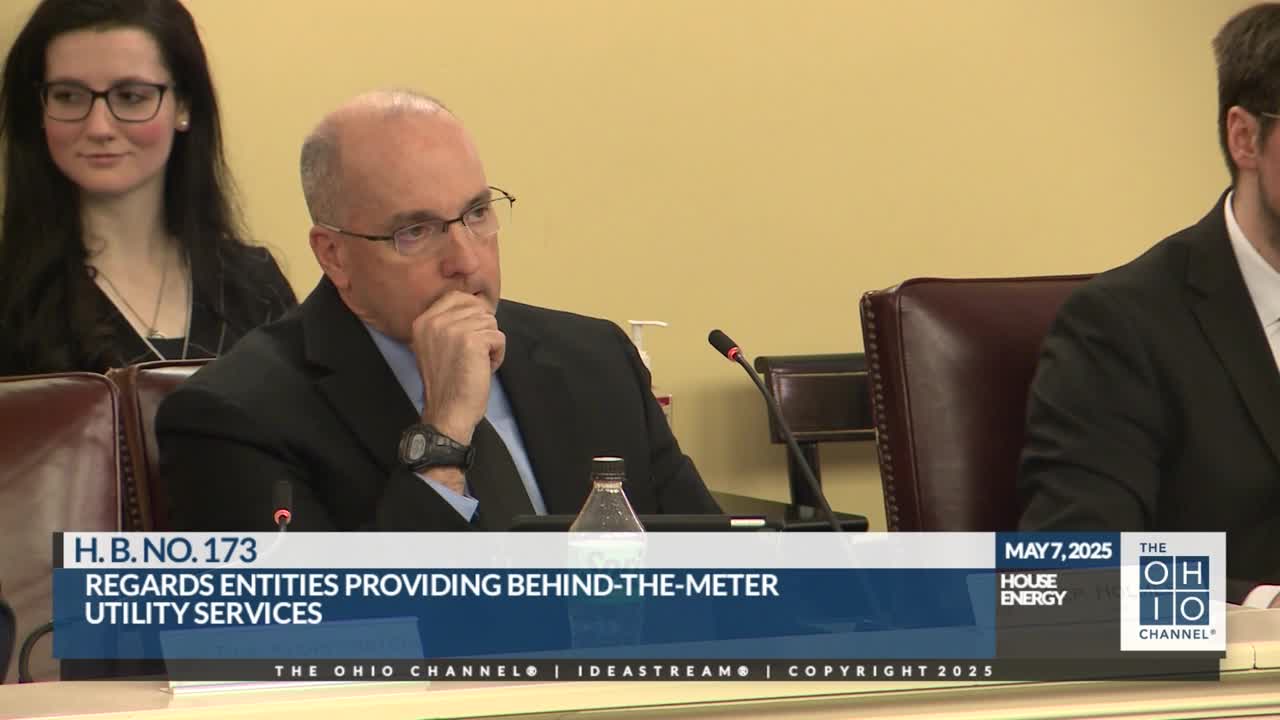
Representative Thomas told the House Energy Committee that House Bill 173 would clarify the legal status of submetering and add consumer protections after recent litigation over whether some submetering companies operate as public utilities.
Representative Thomas told the House Energy Committee that House Bill 173 would clarify the legal status of submetering and add consumer protections after recent litigation over whether some submetering companies operate as public utilities.
"This legislation accomplishes essentially both goals, private property rights and consumer protection," Thomas said, explaining the bill would put into code that "a monopoly public utility ends at the meter" and that behind‑the‑meter services such as submetering "is not considered a public utility." He told members the PUCO and Ohio Supreme Court have addressed related disputes and that recent PUCO rulings dismissed multiple complaints against a submetering firm following a 2021 case.
Thomas said the bill would give the PUCO clear jurisdiction to oversee complaints about submetering and would include language that caps what a landlord may bill a residential tenant so the tenant "will never be billed more for their usage than if that customer was with local host utility receiving the residential rate." He said landlords and submetering companies would continue to be able to operate, while consumers would gain clarity and explicit protections.
Committee members asked how the bill would affect tenants' access to assistance programs and consumer protections. Representative Fisher asked whether tenants could participate in the competitive electric market or would remain bound to the supplier chosen by the submetering contract; Thomas replied that disclosure at move‑in and contract terms typically determine the supplier and that the private property owner generally chooses the arrangement.
Representative Hall asked whether the bill would require landlords who receive a commercial account discount to pass savings to tenants. Thomas said the bill would not mandate pass‑through of commercial discounts but it would cap tenant charges at the equivalent residential rate and that landlords often use savings in a range of ways, such as funding building improvements.
A committee member raised concerns that submetered tenants can lose traditional consumer protections — for example, eligibility for the Home Energy Assistance Program or representation by the consumer advocacy office — because submetered accounts may be treated as commercial. Thomas acknowledged those concerns and said the PUCO is the appropriate venue to oversee complaints while tenant‑landlord law and other protections may require complementary fixes. He also noted that some protections and programs do apply in part and that management practices vary.
No vote or formal action was taken; sponsors and members discussed follow‑up items and technical clarifications that would be needed if the bill moves forward.