Get Full Government Meeting Transcripts, Videos, & Alerts Forever!
Get email alerts on the Electricity Resale Submetering topic
No spam. Unsubscribe anytime.
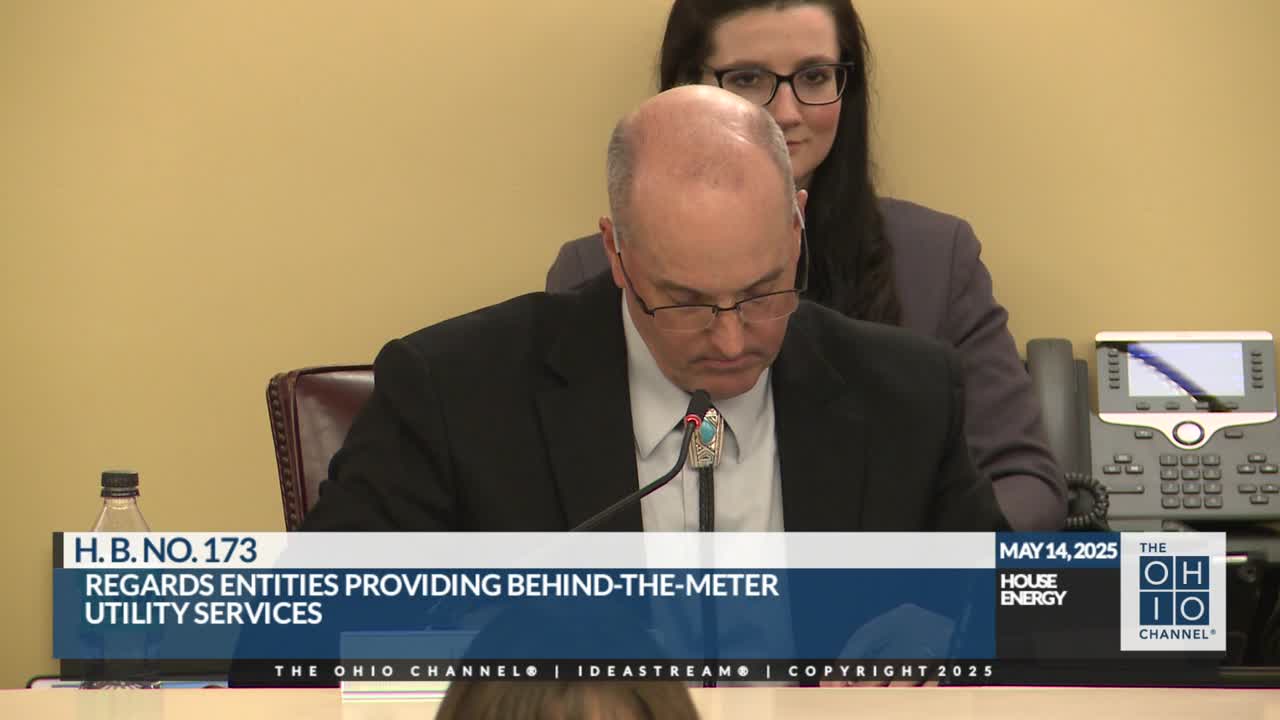
Ohio committee hears testimony to codify PUCO ruling letting landlords resell electricity to tenants
Summary
House Bill 173 would codify a recent Public Utilities Commission of Ohio decision that allows landlords and private companies to resell electricity and other utility services to tenants behind the meter while leaving the commission with authority to regulate those providers.
House Bill 173 would codify a recent Public Utilities Commission of Ohio decision that allows landlords and private companies to resell electricity and other utility services to tenants behind the meter while leaving the commission with authority to regulate those providers. Committee members heard proponent testimony and asked about consumer protections such as price caps, complaint mechanisms and eligibility for assistance programs.
Kim Boyko, partner at Carpenter Lipps testifying for Champion Companies, told the House Energy Committee that "House Bill 173 would codify a recent PUCO decision that offers protections to tenants while allowing them to receive electricity and other utility services from their landlords." Boyko said the commission’s order settled litigation and that landlords and their agents may provide electricity at or below the local utility standard service offer provided they separately meter individual dwelling units.
Theresa Ringenbach, senior vice president of corporate affairs at Nationwide Energy Partners, said her company already follows PUCO orders and provides additional operational protections. "When engaging in disconnection of electric service to a tenant for nonpayment of charges related to electric usage, the landlord must follow the same disconnect standards applicable to landlords under the PUCO's current admin code," Ringenbach testified, adding that Nationwide maintains Ohio‑based resident support staff and extra winter protections above minimum requirements.
Committee members pressed witnesses on enforcement and consumer access to assistance. Representative Brennan asked, "Are we to believe that this is enough teeth to stop submetering companies from overcharging our constituents?" Boyko and Ringenbach responded that PUCO oversight and the complaint process are the current enforcement tools and that the bill would give tenants a clear avenue to file complaints with the commission. Boyko noted the bill includes provision for forfeitures and registration authority that PUCO could expand.
The witnesses also discussed consumer assistance programs. Both witnesses confirmed tenants who receive resold electricity in a bundled rental payment are ineligible for the Percentage of Income Payment (PIP) plan under current state regulations; Ringenbach and Boyko said that change would require separate legislative action. They said HEAP (Home Energy Assistance Program) eligibility depends on having a qualifying utility bill or disconnect notice and that some submetering customers already receive HEAP when they meet program rules.
Members raised questions about business impacts and the scope of behind‑the‑meter projects. Representative Raider asked whether the bill would allow microgrids and rooftop solar behind the meter; Boyko said it would provide certainty for generation installed and operated on private property so long as the service remained behind the meter and did not serve customers outside the property’s boundaries. Representative Fisher and others asked how treating submeterers as regulated entities — without declaring them public utilities — would affect firms that do meter reading, billing and operations; witnesses said some third‑party service providers could be forced to change business models if stricter regulation were imposed.
No formal action or votes were taken; the committee recorded proponent testimony and concluded the bill’s second hearing.