Get Full Government Meeting Transcripts, Videos, & Alerts Forever!
Get email alerts on the Employment E Verify topic
No spam. Unsubscribe anytime.
Sponsors narrow E-Verify bill to construction contractors, adopt title amendment
Summary
Sponsors told the committee House Bill 246 would require contractors on public works and nonresidential construction projects to use the federal E‑Verify system to confirm new hires' eligibility; an amendment renaming the measure the "E Verify Workforce Integrity Act" was adopted without objection.
Representatives sponsoring House Bill 246 told the House Commerce and Labor Committee the bill would require contractors engaged in state or local public works projects and nonresidential construction contractors to use the federal E-Verify system to confirm that new hires are legally eligible to work in the United States.
Sponsor testimony described E-Verify as an internet-based service operated by U.S. Citizenship and Immigration Services in partnership with the Social Security Administration, and noted employers complete a federal I-9 form within the first three days of employment and must retain that form for three years.
Sponsors told the committee E-Verify typically returns confirmation within three to five seconds, and that participation is cost-free to businesses even though taxpayers underwrite the federal system. The sponsors said the bill’s scope is narrower than previous versions and applies only to contractors for public works and nonresidential construction.
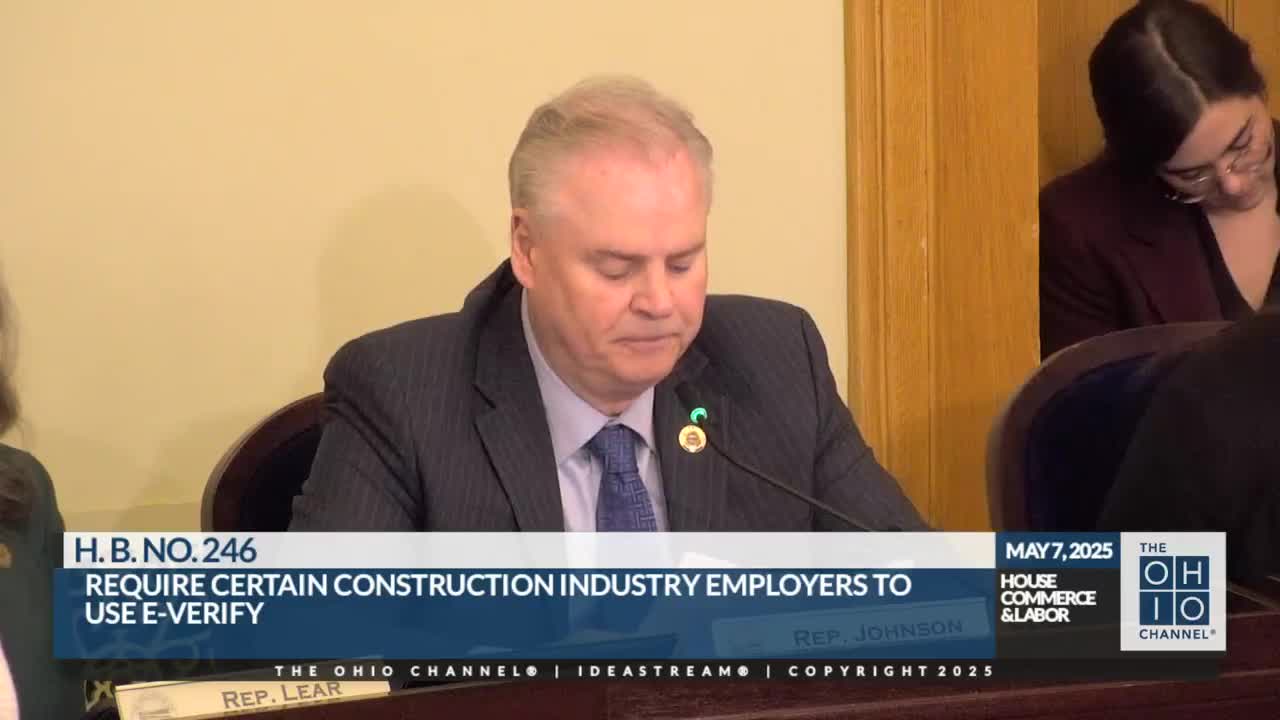
Vice Chair Lear moved an amendment (0454) to change the bill’s short title to the “E Verify Workforce Integrity Act.” The amendment was adopted without objection and became part of the bill.
Committee members questioned the sponsors on several topics. Vice Chair Lear and others asked why the bill was limited to construction; sponsors said the narrower scope reflected negotiations with opponents and the Senate to produce a bill that could pass. Representative Raider and others asked about protections for employees in cases where E-Verify produces an erroneous result; sponsors pointed out language in the bill that relieves employers of liability for certain technical E-Verify errors and said the bill includes a cure period and staggered fines for violations, while license revocation would be a last resort after notices, fines and an opportunity to cure.
Other members raised broadband access concerns and whether nonresidential construction contractors in the field would be able to use an internet-based system. A sponsor said the committee could consider technical fixes if testimony later showed contractors could not practically access E-Verify.
Several members challenged sponsors’ linking E-Verify to reduced human trafficking; one member said advocates had not placed E-Verify on their list of recommended anti‑trafficking measures. A sponsor replied he had not yet met with trafficking advocates but welcomed the opportunity and would encourage them to review the system.
Sponsors said the bill is modeled on laws in other states and noted the National Conference of State Legislatures lists 22 states with E-Verify requirements for some employers; sponsors provided examples and said they view this narrower bill as a start toward broader adoption.
No committee vote on final passage occurred; the committee adopted a title amendment and heard multiple follow-up questions and offers to meet with stakeholders.