Get Full Government Meeting Transcripts, Videos, & Alerts Forever!
Get email alerts on the Disability Employment topic
No spam. Unsubscribe anytime.
Ohio advocates urge five-year phase‑out of subminimum wages for workers with disabilities
Summary
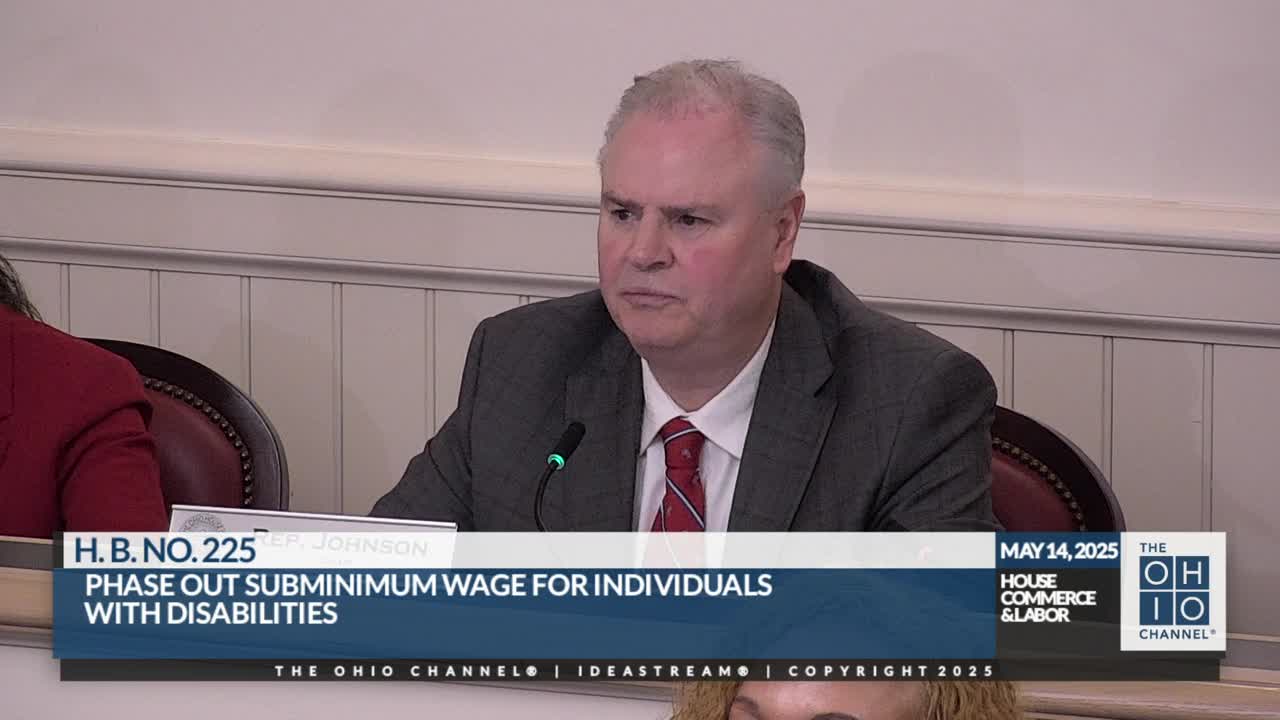
Supporters, including disability advocates, county board members and parents, testified in favor of House Bill 225, which would phase out Section 14(c) subminimum wage certificates over five years and add incentives and transition supports to move workers into community employment.
Supporters of House Bill 225 told the Ohio House Commerce and Labor Committee that the bill would expand employment opportunities and wages for Ohioans with disabilities by phasing out subminimum wages authorized by Section 14(c) of the federal Fair Labor Standards Act.
The measure would phase out the subminimum‑wage certificates over a five‑year period and create transition supports including a 15% nonrefundable tax credit for participating employers and additional requirements around employer‑provided coverage and supports, proponents said.
Advocates said the bill addresses an out‑of‑date federal provision that lets some employers pay people with disabilities less than the federal minimum wage. "Paying people with disabilities less than minimum wage devalues their labor and reinforces harmful stereotypes," said Justin Blumhorst, chief innovation officer at Capabilities, a provider that supports people with disabilities.
Witnesses described personal and programmatic experience with competitive employment. Katie Hunt Thomas of the Ability Center of Greater Toledo described her sister Maggie, who has Down syndrome, and said Maggie has worked in community jobs at market wages and benefited from job coaching. "She's proud of the work that she's done," Thomas said. Christopher Sabin of the National Federation of the Blind of Ohio said the bill would "gradually transition employers and employees from subminimum wages to competitive, meaningful employment."
County board leaders and parents framed the bill as fiscally and socially beneficial. Jan Daughtry, co‑president of Ohio APSE, said a family member who moved from a segregated setting into community employment generated direct savings to local and state systems and improved quality of life. Dan Suter, former Stark County Board of Developmental Disabilities president, said community internships and employer partnerships can substantially raise individual outcomes, citing a local example of a person who moved from day programs to sustained competitive employment.
Witnesses acknowledged challenges and asked the committee to ensure adequate supports during the phase‑out. Stakeholders described existing Ohio supports — Opportunities for Ohioans with Disabilities (OOD), county boards and developmental‑disability services — and said those systems must be resourced to help workers, employers and providers adjust.
No formal votes or committee actions were taken at the hearing; testimony was for the record and the bill remained at its second hearing. Proponents asked lawmakers to advance the legislation with the five‑year transition and the built‑in supports to avoid sudden dislocation of services.
The committee received numerous written testimonies supporting the measure and did not record adversarial motions or final committee direction at the hearing.