Get Full Government Meeting Transcripts, Videos, & Alerts Forever!
Get email alerts on the House Bill 15 topic
No spam. Unsubscribe anytime.
Ohio House Energy Committee adopts sub bill to House Bill 15; utilities, advocates give mixed testimony
Summary
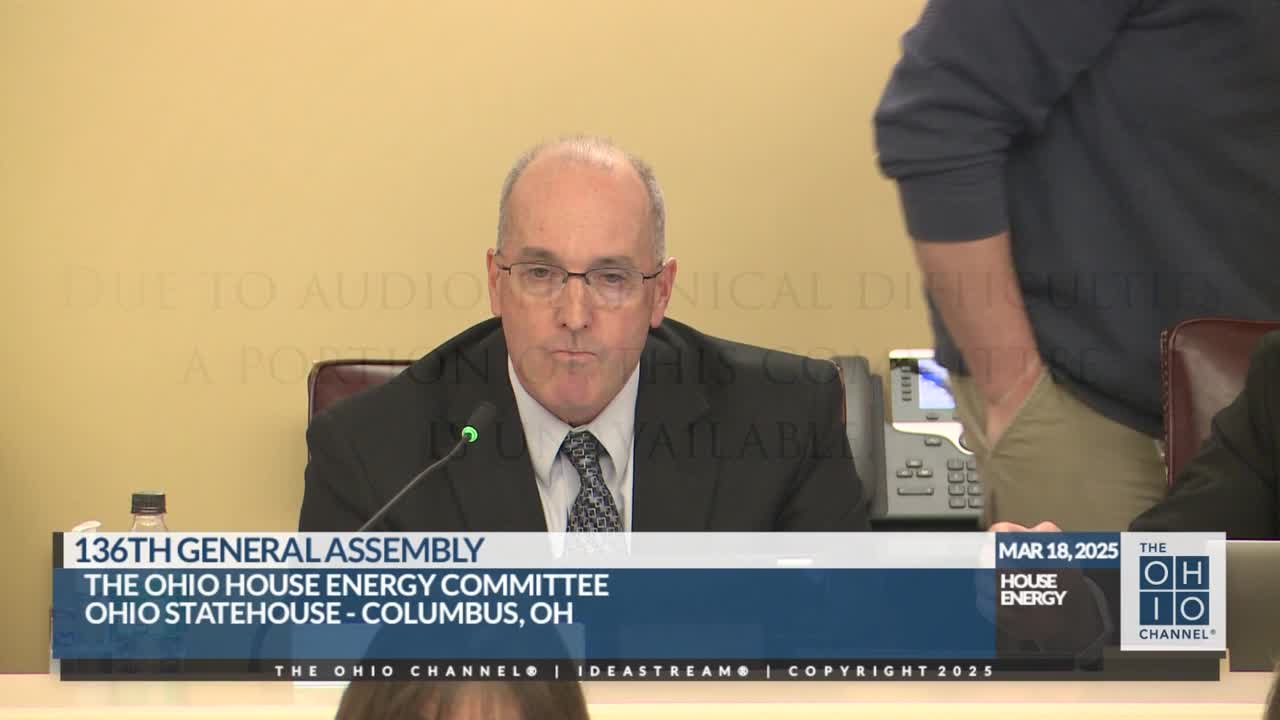
The Ohio House Energy Committee on the floor adopted a substitute amendment to House Bill 15 and then heard opponent and interested‑party testimony on the revised bill.
The Ohio House Energy Committee on the floor adopted a substitute amendment to House Bill 15 and then heard more than two hours of opponent and interested‑party testimony on the revised bill.
The committee approved a motion to amend House Bill 15 with sub bill L13606‑68085; Vice Chair Klopfenstein moved the amendment and, by unanimous consent, “the motion is agreed to and the sub bill is adopted,” the chair said. Witnesses who opposed aspects of the substitute bill included executives from Duke Energy Ohio, AEP Ohio and AES Ohio, while representatives of the Buckeye Institute and several advocacy groups testified in favor of parts of the measure.
Why it matters: Substitute House Bill 15 would change Ohio utility law across multiple areas — rate‑making, certification of transmission projects by the Ohio Power Siting Board, a community energy pilot program, and the treatment of legacy generation resources (LGR) such as OVEC. Utilities told the committee the combined changes could increase regulatory burdens and uncertainty and raise costs for customers, while proponents said the bill ends subsidies that distort markets and would encourage new generation.
Duke Energy Ohio: risk, regulatory lag and LGR. Amy Spiller, president of Duke Energy Ohio, said the substitute bill “in the aggregate … still pose[s] significant challenges to our ability to meet the needs and expectations of our customers and our communities.” She told the committee the bill’s three‑year forward‑looking rate plan (where only capital is forecast in years two and three and expense true‑ups are limited) reduces regulatory lag for some investments but does not fully address expense recovery and thus could increase the utility’s cost of capital and ultimately customer rates.
Spiller urged a transition for the legacy generation resource statute. She noted Duke relied on the LGR statutory sunset date of Dec. 31, 2030, and requested at least a short glide path if lawmakers accelerate that repeal (she suggested 2028 as an example). She also criticized lowering the Ohio Power Siting Board’s voltage threshold from 100 kV to 60 kV, saying it would “triple the number of project applications” requiring certification and could delay local reliability and economic development projects because OPSB decisions are immediately appealable to the Ohio Supreme Court.
AEP and AES: common concerns. Steve Nurse (AEP Ohio) and Christopher Holland (AES Ohio) echoed many of Duke’s points. AEP said the bill should preserve clarity in statutory cross‑references and urged grandfathering of customer‑sited arrangements entered in reliance on current law (for example, fuel‑cell contracts). AES asked for consistent, audited three‑year test periods with timely true‑ups, and AEP urged a glide path for OVEC rather than an abrupt repeal.
Community energy and cost shifting. All three investor‑owned utilities warned the committee that the proposed community energy pilot — which allows subscribing customers to receive a bill credit for energy from a shared project — could shift transmission and distribution costs to nonparticipating customers. “Those customers are using both the transmission and the distribution grids,” Spiller said. “Our concern is that under this community energy program, those customers would avoid certain charges and that those charges would otherwise have to be made up from other non‑subscribing customers.” Committee members asked multiple follow‑ups about whether the bill’s language could be clarified to prevent cost shifting.
Advanced technologies, heat maps and siting. Utilities also criticized new study and filing requirements tied to so‑called advanced transmission technologies and expanded mapping/heat‑map obligations, saying mandated modeling would be costly, slow projects and duplicate PJM/FERC functions. Witnesses warned that imposing OPSB review on many lower‑voltage projects (e.g., roughly 69 kV facilities commonly used for local reliability and economic development) could create bureaucratic delays and additional costs without clear system benefits.
Support for ending subsidies; opposing voices on siting and nuclear. Greg Lawson of the Buckeye Institute said HB 15 contains broadly pro‑market reforms — ending certain subsidies, streamlining siting, and modernizing rate making — and urged prompt action. Environmental advocates supported some provisions (for example, a community energy pilot and ending certain LGR payments), while opposing expanded support or labeling for nuclear or fossil fuels as “green.” Several commenters urged guardrails on fast‑tracked OPSB approvals and protection for local input, especially where large facilities could be sited near residential areas.
Other details raised during testimony. Witnesses and public commentators cited several numeric specifics discussed in committee: the sub bill’s tax changes would take effect for tax year 2027; the substitute reverts certain siting and intervention provisions to existing ORC sections; the bill would cap a PIA‑eligible brownfield remediation project at $10,000,000; and Duke cited recent economic development figures for its region (it said its 2023 work supported 276 new jobs and $263 million in capital investment).
Where it goes from here. Committee members accepted the sub bill and set further work sessions; the chair indicated future hearings and a dash‑6 sub bill would be considered. Lawmakers asked utility witnesses to provide audit reports and to continue working on clarified language for community energy credits and any grandfathering for customer contracts entered in reliance on current law.
Ending note: The hearing made clear the bill combines reforms affecting rate making, siting, remediation funding and community energy. Committee members and witnesses repeatedly returned to three central tradeoffs: reducing regulatory lag and encouraging investment, avoiding unintended cost shifts to nonparticipating customers, and preserving timely project approvals for economic development and reliability.