Get Full Government Meeting Transcripts, Videos, & Alerts Forever!
Get email alerts on the Whitney Former Landmark Designation topic
No spam. Unsubscribe anytime.
Landmarks Commission holds public hearing on former Whitney Museum interior and exterior landmark proposals
Summary
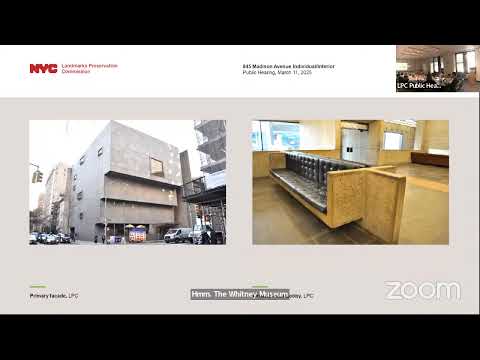
The New York City Landmarks Preservation Commission on March 11 heard testimony on proposals to designate 945 Madison Avenue — the former Whitney Museum of American Art designed by Marcel Breuer — as an individual and interior landmark.
The New York City Landmarks Preservation Commission on March 11 heard testimony on two proposals to designate 945 Madison Avenue — the former Whitney Museum of American Art designed by Marcel Breuer and Associates (1964–66) — as an individual exterior landmark (LP2685) and as an interior landmark (LP2686).
The research department presented the proposals, with Lisa Buckley of the research department outlining the building’s history and character. "945 Madison Avenue was home to the Whitney Museum of American Art from its construction in 1966 until 2014," Buckley said, describing the building as a "brutalist style, inverted stepped pyramid" notable for its raw concrete, stone and distinctive circulation spaces.
The nomination drew broad support from preservation and design organizations, which urged the commission to extend protections beyond the proposed lobby, lower-level spaces and main stair. Zainab Turan of Friends of the Upper East Side testified that the interior spaces "are integral to Marcel Breuer's architectural vision and warrant further protection." John Arbuckle, representing DOCOMOMO US New York Tri-State, said the building’s interiors "are not only of local significance, but of national significance and arguably also of international significance." The New York Landmarks Conservancy and the Historic Districts Council also testified in favor of both exterior and interior designation.
The building’s new owner, Steven Wrightson, speaking for Sotheby's, told commissioners the auction house supports designation but that its proposed new use as gallery and auction spaces will require "compatible modifications" to allow public access and programming. "We very much understand and deeply appreciate the building's architectural significance, and we are committed to preserving its original character," Wrightson said.
Some preservation advocates and architects urged the commission to include at least one of the building’s upper gallery floors in the interior designation. Theodore Grunewald and John Graham emphasized the significance of Breuer’s coffered gallery ceilings, the trapezoidal windows and the building’s distinctive prefabricated concrete ceiling system; Graham said those upper galleries are "a culmination and summary of Breuer's career" and are vulnerable if not explicitly included. Responding to those comments, Margaret Herman, director of research, said the commission selected the main lobby, lower-level and principal circulation spaces as the core areas for designation but asked staff to "take another look at the ceilings in the galleries" to determine whether distinctive ceiling features could be protected without unduly constraining future exhibition flexibility.
Commission members asked whether the commission’s prior approach to cultural-institution interiors (which typically focuses on entries, lobbies and circulation spaces) applied here; they also compared this case to a recent noncontiguous interior designation (346 Broadway) that used a different regulatory approach. The commission noted the need to balance preservation of character-defining features with the functional flexibility required for future occupants.
The public hearing was closed after public testimony and a short procedural motion; commissioners will consider the matter at a future public meeting when they will vote on designation.
Why it matters: Marcel Breuer's Whitney is widely recognized as one of his most important commissions and a notable example of mid-20th century brutalist museum design in Manhattan. Interior designation could protect Breuer’s integrated interior design — including materials, built-in furnishings and lighting — that proponents say are essential to the building’s architectural meaning.
Next steps: The commission closed the hearing and said it will bring a recommendation back at an upcoming public meeting for a vote; staff indicated they will reexamine how much of the gallery ceilings could be protected while preserving exhibition flexibility.