Get Full Government Meeting Transcripts, Videos, & Alerts Forever!
Get email alerts on the Commercial Signage topic
No spam. Unsubscribe anytime.
Landmarks approves New Era store signage at 300 Lafayette with condition to study diagonal screen
Summary
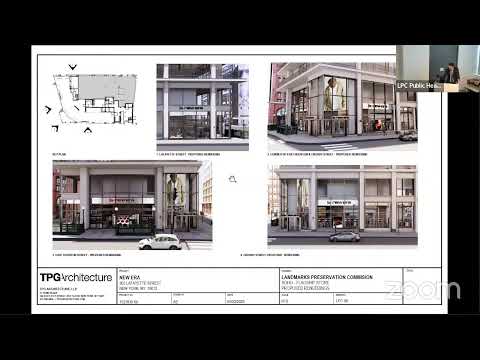
The Landmarks Preservation Commission on April 29 approved New Era Cap's request to install multiple signs and three interior-facing digital screens at its flagship store at 300 Lafayette Street in the SoHo Cast Iron Historic District Extension, while asking the company to study the size and illumination of a large diagonal screen with staff before final installation.
The Landmarks Preservation Commission voted 8-0 April 29 to approve New Era Cap’s application to install a set of exterior signs and three interior-mounted digital screens at its flagship store at 300 Lafayette Street, on the edge of the SoHo Cast Iron Historic District Extension, but directed the applicant to study the size and illumination of a large diagonal screen with staff before final installation.
The commission’s approval covers a mix of illuminated and non‑illuminated signage, two storefront video screens and a larger diagonal interior screen above the corner entry. Commissioners said the proposal keeps ground‑floor transparency while acknowledging the building’s modern design and the heavily commercial character of the intersection at Lafayette, East Houston and Crosby Streets.
The proposal, presented by Marika Morrow, senior manager of retail operations for New Era, and architects from TPG, included technical information from Planar, the proposed screen manufacturer. John Fox of TPG described the brightness controls and automatic dimming features the screens will use, saying, “The screens all 3 screens will be connected to a control system that has the ability to automatically adjust the screen brightness in response to the amount of sunlight.”
Why it matters: Commissioners weighed the storefront’s transparency, the scale of the screens relative to storefront bays, and the district context. Several speakers at public testimony — including Pete Davies of the Broadway Residents Coalition and Christina Conroy of the Victorian Society of New York — urged the commission to limit or reject the screens, saying the diagonal screen was too large and too prominent for the district.
Public comment and applicant response
Pete Davies testified for the Broadway Residents Coalition that he was "concerned about the diagonal screen," saying it would have "an overwhelming impact" and arguing its lighting could be visible down Houston Street.
Christina Conroy for the Victorian Society said the building’s glass facade is “made less compatible with a historic district designated for its cast iron and masonry buildings” by the applicant’s proposed "multitude of eye catching signs," calling the diagonal LED screen “an enormous LED sign proposed just inside the entrance” that she compared to signage more appropriate to Times Square.
New Era representatives said they reduced the screens’ maximum brightness from 3,000 nits (as previously presented to community board) to 1,600 nits, reduced the size of the vestibule screen by 26 square feet since the community board presentation, and said the screens will never be set to maximum brightness at night. Richard Condis of Planar demonstrated an in‑room sample and explained that brightness is adjustable in small increments and can be automatically dimmed by a light sensor.
Commission discussion and findings
Commissioners repeatedly noted the intersection’s commercial character and existing large-format displays nearby. Commissioner Laffey said she appreciated the applicants’ responsiveness and that the proposal "works" in this busy corner, adding, "I can approve this." Several commissioners flagged the diagonal screen for further study: while acknowledging the applicant’s reduction in brightness and size and the use of automatic dimming, they asked staff and the applicant to restudy the diagonal screen’s scale and illumination in the field prior to final sign permits.
Commission action
Commissioner Laffey made the motion to approve, Commissioner Jefferson seconded, and the commission voted 8‑0 to approve the signage overall, with an explicit recommendation that the applicant "continue to study the size and illumination of the diagonal sign working with staff." The motion’s text — prepared by staff and read into the record — concluded that the signage would not "damage or obscure any significant architectural features of the streetscape or historic district" and that the two storefront screens would be limited to separate storefront bays to preserve storefront transparency.
Clarifying details
- Maximum proposed screen brightness: reduced from 3,000 nits to 1,600 nits; applicant said screens "will never be at 1,600 nits at night." (applicant statement) - Vestibule (diagonal) screen dimensions presented: approximately 23 feet 4 inches high by 17 feet 11 inches wide; set ~14 feet 11 inches inboard of the corner and 24 inches from interior glazing (presentation figures) - Smaller street-facing screens: examples ~7 feet 11 inches by 6 feet 8 inches and ~5 feet 11½ inches by 6 feet 8½ inches, each set ~2 feet inboard of exterior glass - Screen mounting: interior millwork or soffit; halo‑lit signs set back roughly 2 feet from glazing - Light study: applicant presented a worst‑case model (static full‑white screens at night, otherwise dark surrounding) and reported average sidewalk illuminance of roughly 2–3 foot‑candles for the storefront as modeled; applicant emphasized the study excluded many real‑world light sources and said the study is a conservative estimate
Speakers (attribution whitelist)
- Chair Carroll, Chair, government - Commissioner Laffey, Commissioner, government - Commissioner Jefferson, Commissioner, government - Commissioner Bland, Vice Chair Bland, government - Commissioner Chapin, Commissioner, government - Commissioner Chen, Commissioner, government - Commissioner Ginsburg, Commissioner, government - Commissioner Goldblum, Commissioner, government - Commissioner Lutfi, Commissioner, government - Marika Morrow, Senior Manager, Retail Operations, New Era Cap, business - Jacqueline Katanese, Architect, TPG Architecture, business - John Fox, Architect, TPG Architecture, business - Richard Condis, Applications Engineer, Planar (display manufacturer), business - Richard Ferrara, SineWave Elite (sign vendor), business - Pete Davies, Broadway Residents Coalition, government (community board coalition) - Christina Conroy, Victorian Society of New York, nonprofit - Manhattan Community Board 2, Community Board, government
Authorities
- {"type":"regulation","name":"New York City Zoning Resolution","referenced_by":["signage-new-era-300-lafayette"]} - {"type":"other","name":"SoHo Cast Iron Historic District Extension (landmark designation)","referenced_by":["signage-new-era-300-lafayette"]}
Actions
- {"kind":"motion","motion":"Approve signage at 300 Lafayette, finding the proposed work will not damage or obscure significant architectural features, and recommend that the applicant continue to study the size and illumination of the diagonal sign working with staff.","mover":"Commissioner Laffey","second":"Commissioner Jefferson","vote_record":[{"member":"Chair Carroll","vote":"yes"},{"member":"Commissioner Bland","vote":"yes"},{"member":"Commissioner Chapin","vote":"yes"},{"member":"Commissioner Chen","vote":"yes"},{"member":"Commissioner Ginsburg","vote":"yes"},{"member":"Commissioner Goldblum","vote":"yes"},{"member":"Commissioner Jefferson","vote":"yes"},{"member":"Commissioner Lutfi","vote":"yes"}],"tally":{"yes":8,"no":0,"abstain":0},"outcome":"approved","notes":"Applicant to continue study of diagonal screen size/illumination with staff; approval includes two storefront screens limited to separate bays and a corner vestibule screen with reduced area and brightness."}
Discussion_decision
- discussion_points: ["scale and brightness of three proposed interior-mounted digital screens","compatibility of signage with SoHo Cast Iron Historic District Extension","public concerns about light spill and visual dominance down Houston Street","applicant's technical mitigation measures (reduced brightness, automatic dimming, reduced square footage)"] - directions: ["applicant to study diagonal screen size and illumination with staff before final sign permits are issued"] - decisions: ["commission approved signage application with condition to study diagonal screen size/illumination"]
clarifying_details
- {"category":"brightness_limit","detail":"Maximum proposed brightness reduced from 3,000 nits to 1,600 nits","value":1600,"units":"nits","approximate":false,"source_speaker":"John Fox"} - {"category":"vestibule_screen_size","detail":"Diagonal interior screen above vestibule reduced by 26 square feet since community board presentation","source_speaker":"John Fox"} - {"category":"inboard_setback","detail":"Primary screens set ~24 inches inboard of exterior glass; soffit‑mounted halo signs set ~2 ft from glass","source_speaker":"John Fox"} - {"category":"lighting_study","detail":"Applicant presented a worst‑case lighting model (static white screens in total darkness) showing average sidewalk illuminance ~2–3 foot‑candles; applicant said real conditions include many additional light sources","source_speaker":"John Fox"}
proper_names:[{"name":"New Era Cap","type":"business"},{"name":"TPG Architecture","type":"organization"},{"name":"Planar","type":"business"},{"name":"SineWave Elite","type":"business"},{"name":"SoHo Cast Iron Historic District Extension","type":"location"},{"name":"East Houston Street","type":"location"},{"name":"Lafayette Street","type":"location"},{"name":"Crosby Street","type":"location"},{"name":"Adidas","type":"business"},{"name":"Manhattan Community Board 2","type":"agency"}]
community_relevance":{"geographies":["Manhattan","SoHo","NYC"],"funding_sources":[],"impact_groups":["pedestrians","local retailers","historic district stakeholders"]},
meeting_context":{"engagement_level":{"speakers_count":12,"duration_minutes":120,"items_count":1},"implementation_risk":"low","history":[{"date":"2025-04-22","note":"Item read into record at public hearing; not presented then"}]},
searchable_tags:["signage","digital_screens","SoHo","New Era","LPC","zoning"],
provenance:{"transcript_segments":[{"block_id":"block_249.905","local_start":0,"local_end":426,"evidence_excerpt":"Preservation department public meeting item number 1, LPC 20 5Dash07216. An application for a certificate of appropriateness in the borough of Manhattan ... 300 Lafayette ... The application is to install signage.","reason_code":"topicintro"},{"block_id":"block_3473.7947","local_start":0,"local_end":320,"evidence_excerpt":"With 8 in favor and none opposed, the motion passes. Alright. That's approved.","reason_code":"topicfinish"}]},
salience:{"overall":0.78,"overall_justification":"High local civic salience due to visible storefront on a major Manhattan corridor, public testimony and commissioner condition on digital signage.","impact_scope":"local","impact_scope_justification":"Changes affect pedestrian experience and commercial district immediately around Lafayette/Houston/Crosby.","attention_level":"high","attention_level_justification":"Public testimony, technical lighting study, and specific commission condition.","novelty":0.45,"novelty_justification":"Digital storefront screens in landmark districts are increasingly common but still raise fresh policy questions.","timeliness_urgency":0.6,"timeliness_urgency_justification":"Applicant intends to install signage; commission asked for further study before final permits.","legal_significance":0.3,"legal_significance_justification":"Relates to zoning compliance and LPC certificate of appropriateness but no new statute invoked.","budgetary_significance":0.0,"budgetary_significance_justification":"No public funds involved.","public_safety_risk":0.1,"public_safety_risk_justification":"Minimal; concerns were about glare but applicant provided mitigation controls.","environmental_impact":0.05,"environmental_impact_justification":"Light emissions are environmental factors but not a major environmental hazard.","affected_population_estimate":50000,"affected_population_estimate_justification":"Pedestrians, shoppers and residents in SoHo/Lower Manhattan daily foot traffic estimate.","affected_population_confidence":0.5,"affected_population_confidence_justification":"Rough local foot traffic estimate; not measured.","budget_total_usd":0.0,"budget_total_usd_justification":"No municipal budget action.","policy_stage":"passed","policy_stage_justification":"Commission approved application with condition.","follow_up_priority":7,"follow_up_priority_justification":"Staff review of diagonal screen size/illumination required before permits.","fact_check_risk":0.1,"fact_check_risk_justification":"Most technical claims provided by vendor; can be verified.","uncertainty":0.2,"uncertainty_justification":"Implementation details depend on subsequent staff review and final permits.","source_diversity":0.6,"source_diversity_justification":"Includes applicant, vendor, community groups, community board, commissioners.","stakeholder_balance":0.5,"stakeholder_balance_justification":"Commission balanced applicant’s commercial interest and community concerns."}},{