Get Full Government Meeting Transcripts, Videos, & Alerts Forever!
Get email alerts on the Historic Designation topic
No spam. Unsubscribe anytime.
Landmarks Commission designates Paul Rudolph duplex at 246 East 50th as New York City interior landmark
Summary
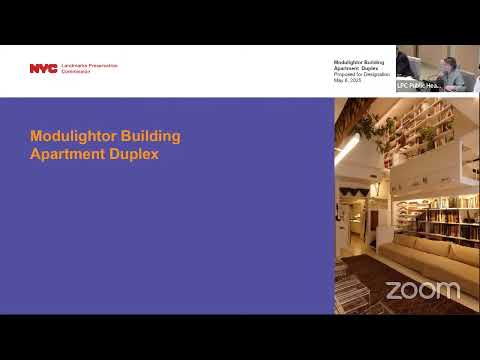
The New York City Landmarks Preservation Commission on May 6 voted 7–0 to designate the Modulator Building apartment duplex at 246 East 50th Street in Manhattan as an interior landmark, citing the space’s distinctive late-20th-century design by Paul Rudolph.
The New York City Landmarks Preservation Commission on May 6 voted 7–0 to designate the Modulator Building apartment duplex at 246 East 50th Street in Manhattan as a New York City interior landmark, accepting the Research Department’s designation report LP-2684.
The designation covers the duplex occupying the entire Third and Fourth Floors, including the entrance hall, north and south living rooms, kitchen, balconies, bedrooms and associated fixtures and interior components. The Research Department presented the proposal as a late-twentieth-century interior by architect Paul Rudolph, built in the late 1980s and early 1990s and notable for interlocking double-height spaces, cantilevered balconies, floating stairs and original fixtures and built-ins.
Why it matters: The commission’s vote preserves an intact example of Rudolph’s late-career interior work in New York City and recognizes the duplex as one of the few publicly accessible interiors by the architect in the city. The Research Department noted that the space served as headquarters for the Paul Rudolph Institute for Modern Architecture and remains open to the public by appointment and scheduled open houses.
Research staff presented evidence of public support: four speakers at the February 25 public hearing and ten written submissions supported designation, including statements from the Paul Rudolph Institute for Modern Architecture, DOCOMOMO US, the Historic Districts Council and the New York Landmarks Conservancy. The Research Department recommended designation based on the interior’s “special character and special historical and aesthetic interest and value,” language reflected in the motion put forward at the meeting.
Commission debate and remarks: Commissioners praised the interior’s spatial design and craft. Vice Chair Bland, who described studying with Rudolph at Yale in her early career, said she became an architect because of him. Commissioners emphasized the duplex’s human scale, detailing, and its value as a public interior example of Rudolph’s work.
Formal action: Vice Chair Bland moved the designation, Commissioner Chen seconded, and the roll call recorded Chair Carroll, Vice Chair Bland, Commissioners Chapin, Chen, Chu, Ginsburg and Jefferson voting in favor with none opposed. The Research Department’s designation report (LP-2684, 05/06/2025) was cited in the motion and will be the official designation document.
Background: Paul Rudolph (1918–1997) was a prominent American architect known for complex spatial arrangements and inventive use of industrial materials. The Modulator Building duplex combines residential program and showroom history and retains original fixtures and stairwork that staff described as central to its architectural significance.
What’s next: The designation establishes a new interior landmark protection for the described spaces; future proposed alterations to the designated interior will be subject to LPC review and the landmark’s designation report.