Get Full Government Meeting Transcripts, Videos, & Alerts Forever!
Get email alerts on the Flood Mitigation Upper Turkey Creek topic
No spam. Unsubscribe anytime.
Merriam council approves $42,590 hydraulic study to refine downtown flood options
Summary
The Merriam City Council approved a $42,590 addendum with HNTB to complete a phase‑2 hydraulic analysis of historic downtown as the city evaluates Army Corps of Engineers proposals for Upper Turkey Creek.
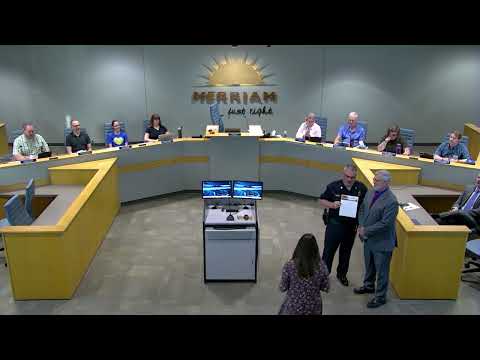
The Merriam City Council on May 20 approved a $42,590 contract addendum with engineering firm HNTB to complete a phase‑2 hydraulic analysis of historic downtown Merriam.
City staff said the analysis is intended to give council members more precise cost estimates and design options for removing downtown from the FEMA floodplain while the U.S. Army Corps of Engineers completes its 35% design for the Upper Turkey Creek project. "We want the council to know if there are or not other options out there," Mr. Engel, a city staff member, said as he described two alternative approaches HNTB identified: a "full build" that would pull all of historic downtown out of the floodplain and a "no rise" option that would elevate property east of Merriam Drive without creating negative impacts upstream.
Why it matters: the Army Corps has a working budget figure for the broader Upper Turkey Creek project of about $120 million; city staff and council members said that number appears large relative to the roughly $15 million in property value cited for the downtown area, and that the council needs other options before committing to the Corps' approach. "We would anticipate getting the 35% at the end of this month, having the summer to talk about the Corps project ... and making a decision by October," Engel said.
The HNTB phase‑2 work will refine utility impacts, provide better cost estimates, and test whether a downtown‑only solution could accomplish many Corps goals at lower cost or with fewer impacts. City staff noted HNTB was selected partly because the firm already has access to Corps datasets and is performing related hydrology work. City staff said the downtown study budget is $142,500 in total; the council approved the $42,590 addendum to move to the next level of detail.
Discussion and concerns: council members and the public pressed cost and schedule questions. Council member Lahiri asked for the Corps' current working budget; Engel said $120 million is the figure in the Corps' working budget but cautioned it may not include all expensive pieces, such as potential replacement or relocation of the Johnson Drive bridge and the Merriam Drive bridge. A resident and several council members raised the tradeoffs that come with different approaches, noting a costly option could require extensive property acquisition or major roadway moves.
Action taken: Council member Hans moved to approve the HNTB addendum, Miss Shandridge seconded, and the motion passed 8–0.
Next steps: staff said the city expects to receive HNTB's refined analysis and use it in summer and fall deliberations, alongside the Corps' 35% design, to decide whether to pursue the Corps project, a downtown‑only approach, or other options. Any formal decision on a preferred flood solution was not made at the meeting.