Get Full Government Meeting Transcripts, Videos, & Alerts Forever!
Get email alerts on the Housing Development Rhid topic
No spam. Unsubscribe anytime.
Commission finds housing need, approves resolution to pursue RHID for Northeast Village townhomes
Summary
The Ottawa City Commission voted to approve a resolution declaring a housing need and to begin the process to designate a Reinvestment Housing Incentive District (RHID) for the proposed Northeast Village townhome project at 1426 East Wilson Street.
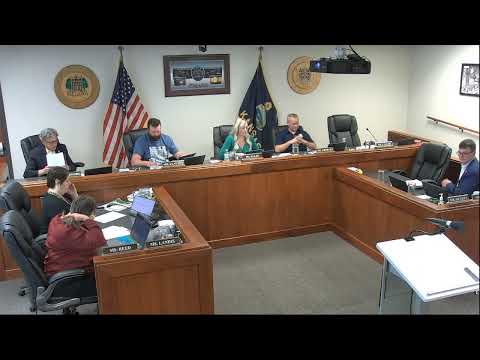
The Ottawa City Commission voted to adopt a resolution April 23 that finds the city has a shortage of quality housing and moves the next step toward creating a Reinvestment Housing Incentive District, or RHID, for the Northeast Village project at 1426 East Wilson Street.
Director Landis told commissioners the proposed development is a 40-unit single-family townhome project with a two-bedroom, two-bath product and a proposed market rent of about $1,250 per month. She said the developer lists $1,957,000 in eligible expenses and is seeking roughly $1,675,000 in reimbursements over a 15-year term if the district and incentives are approved. "The project is eligible for RHID incentives by definition under Senate Bill 17," Landis said during the presentation.
The resolution before the commission does not commit the city to any specific dollar amount or term. It records four required findings under the RHID process: that Ottawa faces a shortage of several types and price ranges of housing; that the shortage is expected to persist despite private and public efforts; that additional incentives are needed to spur private-sector construction or renovation; and that addressing the shortage is important to the city's future economic well-being. Landis said the city’s financial advisor, Ehlers Inc., is conducting a feasibility analysis and a recommendation on incentive terms will return to the commission later.
Commissioners asked about the mechanics and risks of the RHID structure. "For RHID, it's a rebate of taxes paid, correct? The increment of taxes paid," one commissioner said during the roll-call discussion; Landis confirmed that taxes must be paid before any reimbursement is issued. Landis described the arrangement as limiting city risk because reimbursements are capped by the increment generated and the number of years authorized: the developer fronts construction costs and is reimbursed only from the tax increment produced by the project.
Landis said the developer began concept work in August 2023, worked through planning and neighborhood review, and completed final plat work in March 2024. She told the commission the developer indicated construction could begin promptly if incentives are approved, with an estimated completion in 2026.
The commission voted by roll call to approve the resolution. Votes recorded on the motion were: Commissioner Skidmore — yes; Commissioner Kaylor — yes; Commissioner Crowley — yes; Mayor Pro Tem Clayton — yes; Mayor Allen — yes. The motion carried.
The RHID process now proceeds to the Kansas Secretary of Commerce for review; if the state approves the findings, the commission would later consider creation of the district, a development plan and a development agreement that would set specific reimbursement terms and caps. Landis emphasized those subsequent steps would include public notice and a public hearing before the commission would adopt any final incentive agreement.
Developer representation and legal counsel were present during the discussion. Doug Bohai, listed in the meeting packet as the developer representative, attended in the audience, and the city had bond counsel representatives from Kutak Rock available to answer legal questions.
The action on April 23 was limited to the findings required by state law to initiate the RHID process; no incentive amounts, contract terms or disbursement schedules were approved at the meeting.
Questions and next steps identified by staff included completion of the Ehlers financial feasibility study and a future development-agreement negotiation if the state and commission follow subsequent steps.