Get Full Government Meeting Transcripts, Videos, & Alerts Forever!
Get email alerts on the Land Use Zoning topic
No spam. Unsubscribe anytime.
Commissioners pause Unified Development Ordinance while court reviews carbon sequestration language
Summary
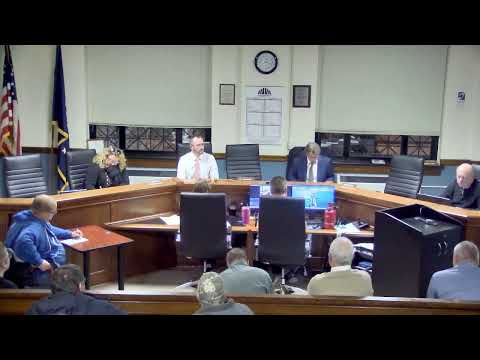
Vermillion County commissioners on Tuesday agreed to delay adopting a revised Unified Development Ordinance and zoning map until a declaratory judgment clarifies whether local rules can cover carbon sequestration and associated pipeline infrastructure.
Vermillion County commissioners on Tuesday agreed to hold off on adopting a revised Unified Development Ordinance (UDO) and zoning map while a declaratory-judgment action proceeds in circuit court to test whether parts of the draft exceed local regulatory authority.
The UDO, developed by the Area Plan Commission, includes new language aimed at regulating siting and related infrastructure for carbon sequestration projects. Brad, representing the Area Plan Commission, told commissioners the most recent draft incorporated changes requested by commissioners and emergency services personnel and that “all of the changes are coded in red” so reviewers can see what was revised.
The decision to pause followed public comments and concerns about a proposed Wabash Valley Resources project. Clay Sanquinetti, speaking for Citizens Against Wabash Valley Resources, asked how the company could send letters threatening eminent domain before acquiring the required percentage of pore space. Susan Strelkos, who lives just across the Vermillion County line, said she had attended energy conferences and read technical presentations and described the project as “an experimental test pilot project” with unresolved scientific and safety questions.
County staff and legal advisers told the commissioners they had asked a circuit court for a declaratory judgment to clarify whether state law prevents local regulation of pipelines and carbon-sequestration operations. A staff speaker noted there are state statutes and regulatory bodies—such as the Department of Natural Resources and the Utility Regulatory Commission—that already govern aspects of these activities, and that the statute dealing with consolidation of pore-space interests is cited as 14-39-2-4 in early drafts (the enacted law raised the threshold elsewhere to 70 percent). Commissioners said they would await the court’s guidance before proceeding.
Brad said the plan commission had attempted to address other local concerns in the UDO: it added definitions (for example, for “truck stop”), added signage rules for agricultural areas and added driveway/load-bearing standards requested by county emergency services. He said driveways in rural areas had sometimes prevented fire apparatus from reaching houses and that the draft driveway standard was revised from 30,000- to 50,000-pound capacity based on fire-chief input.
Commissioner discussion emphasized two points: commissioners did not intend to adopt the revised UDO immediately, and they wanted the legal question resolved first. Brad said the Area Plan Commission will continue preparing the ordinance but will leave contested sections in place until the court rules; staff also reported that the county has identified a land-use attorney to assist the plan commission if needed.
Why it matters: commissioners and the plan commission are trying to reconcile local land-use controls with state regulatory authority on energy infrastructure. The public speakers and some commissioners said the stakes include property rights, public-safety concerns and whether a project that relies on high-pressure CO2 pipelines and subsurface storage can be regulated locally.
The commissioners did not take a final vote on the UDO. Instead they agreed to pause adoption and to let the circuit court consider briefs from interested parties before the county takes further action.