Get Full Government Meeting Transcripts, Videos, & Alerts Forever!
Get email alerts on the Land Use Rezoning topic
No spam. Unsubscribe anytime.
County Council approves rezoning of 40‑acre Cleveland Road parcel for Microsoft data‑center development
Summary
On May 13 the Saint Joseph County Council voted 9‑0 to rezone an unaddressed roughly 40‑acre parcel near the Cleveland Road/Current Road intersection to industrial for a data‑center project tied to Microsoft, subject to written commitments and required traffic, drainage and site‑plan reviews.
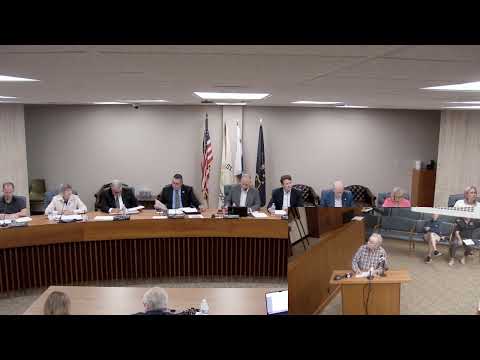
The Saint Joseph County Council voted 9‑0 on May 13 to rezone a roughly 40‑acre parcel southwest of the Cleveland Road and Current Road intersection from agricultural to industrial to allow development tied to a Microsoft data‑center project, subject to written commitments and subsequent site reviews.
The rezoning matter, filed as bill 30‑25, was presented to the council by Sean Klein, director of the Area Plan Commission, and by Angela Smith of Dan Charlier Associates, who said Microsoft now owns surrounding parcels and is seeking to include the 40‑acre “missing tooth” to permit cohesive development and utility routing. Smith told the council, “we are taking this very slow and methodically,” and said the petitioner supports the same written commitments already applied to adjacent parcels.
The written commitments include a prohibition on several heavier industrial uses and off‑premise signs, a requirement for a traffic‑impact study, and meeting all local, state and federal requirements related to wetlands, the floodplain and floodway. Klein told the council a minimum 200‑foot green space buffer had been committed along Juday Creek for the broader development; Smith said the 40‑acre parcel itself does not touch Juday Creek but the team will continue to coordinate with the Juday Creek Task Force.
Public commenters pressed the council on several points. Dan Caruso of New Carlisle asked that road improvements identified in the traffic study be completed before construction begins; Caruso asked for “some sort of a commitment… that the developer will wait until the road studies are done.” Multiple residents raised concerns about traffic at Cleveland and Current, local drainage and the protection of Juday Creek. Mary Countryman and other residents said they wanted more specific information about the number of buildings and the traffic and water impacts before rezoning.
Smith said the petitioner has engaged Sky Metters to complete the traffic study and that the written commitments require completion of that study before development advances; she said the team expects to finish the traffic study by early July. On water use she said this design would use a closed‑loop cooling system and that daily water needs would be comparable to an office building, with additional water capacity reserved for fire suppression. As she told the council, “the water and sewer usage that we're talking about is for the use of restrooms, use of break rooms… not for the cooling system.”
Council members and county staff emphasized the remaining review steps: county engineer approval of any access on Cleveland Road, completion of the traffic study, compliance with drainage and landscaping requirements, and a subsequent site‑plan and commercial plan review before any building permits are issued. Councilman Brian Tanner noted that site plans must then pass final site review and, where required, state commercial plan review as well.
The Area Plan Commission recommended approval 6‑1 at its hearing; the council motion to approve bill 30‑25 was made by Councilman Brian Tanner, seconded by Councilman Rutten, and passed unanimously 9‑0. The approval was explicitly “subject to the written commitments,” and the council record shows continued coordination with county staff and the Juday Creek Task Force as next steps.
Why this matters: the rezoning enables additional industrial development tied to a major technology company on a corridor already designated for light industrial/business‑tech uses in the county’s adopted comprehensive plan; residents and council members raised concerns about traffic, drainage, ecological buffers and long‑term land‑use tradeoffs.