Get Full Government Meeting Transcripts, Videos, & Alerts Forever!
Get email alerts on the K12 Standards Revision topic
No spam. Unsubscribe anytime.
Steering Committee endorses draft foundational reading standards, advances K‑12 ELA and math revisions
Summary
A state steering committee approved draft foundational reading standards and discussed a series of K–12 revisions to language and math standards, directing staff and work groups to continue drafting and to provide more guidance and examples for teachers.
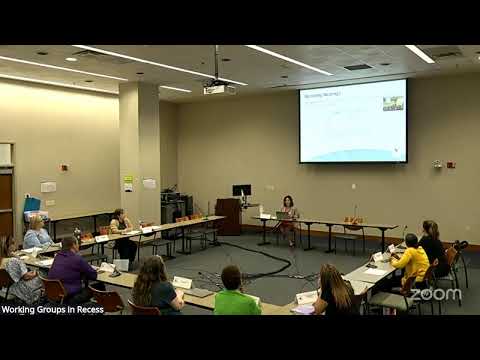
The Steering Committee for Academic Content on Oct. 12 endorsed draft updates to foundational reading standards and discussed broader K–12 revisions to English language arts (ELA) and mathematics standards.
Committee members said the draft updates aim to clarify language, improve vertical progression between grade levels and add guidance for teachers. The committee voted to approve the minutes from the previous meeting and then moved to consider the standards revisions; a motion to adopt the proposed foundational skills language and listening-and-speaking guidance passed without recorded opposition.
Committee facilitators said the revisions to reading foundational skills replace earlier references to “high‑frequency” phrasing with more specific guidance on regular and irregular words, word recognition, and spelling patterns, and add grouped quality indicators across grade bands. The draft also calls for clearer, vertically coherent expectations so teachers and curriculum developers can see how skills should progress from one grade to the next.
For K–5 mathematics, the work group recommended replacing diagonal fraction bars with horizontal fraction bars in examples to improve visual representation, and adding a glossary of terms. The committee discussed changes to number systems, operations, and the presentation of fractions and proportional reasoning at elementary and middle grades.
At the middle‑ and high‑school levels, presenters described formatting changes intended to improve clarity: moving some items to bulleted guidance, adding examples and guidance for conceptual categories such as functions, complex numbers and transformations, and tightening language around expressions and equations. The group also discussed consolidating substandards and simplifying terminology where repeated or unclear examples have appeared across grades.
Staff said draft guidance documents, example sets and revised text were provided to committee members before the meeting and that members would break into subject working groups (K–5, middle, high school) to review sections in more detail. Working groups were scheduled to meet immediately after the full‑committee session to refine wording, examples and guidance documents.
The committee directed staff to incorporate revisions suggested by the work groups — including adding example problem sets and clarifying transition language between grade bands — and to return draft language for further review at a subsequent meeting. No final statewide adoption of the standards was reported at this meeting; the committee acted on draft endorsement and drafting directions only.
The discussion included repeated emphasis on producing teacher supports: a glossary, clearer examples, and formatting changes to make the standards easier to read and implement in classrooms. Committee members asked that documents clearly indicate where guidance is recommended versus required and requested more explicit cross‑referencing between grade levels.
Next steps: staff will update draft standards and guidance to reflect the working groups’ input, redistribute materials to committee members ahead of the next meeting, and continue deliberations in the subject working groups.