Get Full Government Meeting Transcripts, Videos, & Alerts Forever!
Get email alerts on the Education Standards Review topic
No spam. Unsubscribe anytime.
State standards review committee outlines goals, timeline and breakout work for ELA and math
Summary
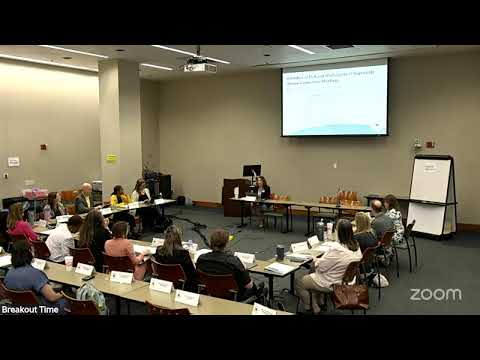
The first meeting of the 2025 English language arts and mathematics content standards review committee convened at the Department of Education to review goals, organization and a multi-month timeline for revising Louisiana’s ELA and math standards.
The first meeting of the 2025 English language arts and mathematics content standards review committee convened at the Department of Education to review goals, organization and a multi-month timeline for revising Louisiana’s ELA and math standards.
Deputy Assistant Superintendent Sharon Nikas, the meeting facilitator for the Louisiana Department of Education, told members the review will be led by Louisiana educators and is intended to produce “the best Louisiana standards for students.” She said the committee’s immediate priorities include strengthening foundational skills in early grades, clarifying language and grammar expectations for high school, and identifying high-school mathematics pathways that support college, career and service readiness.
The committee’s work is governed by state policy. Nikas noted DESE policy in Bulletin 741 requires content standards to be reviewed and revised on a seven-year cycle, and she explained meetings will be open to the public, follow Louisiana’s open meetings law, and adhere to Robert’s Rules of Order for formal decision items.
Why it matters: The review will shape what schools teach statewide and influence materials adoption and professional learning. Nikas described a schedule that gives the committee four months of drafting work plus two months of public comment, with an optimal target to present draft standards to the Board of Elementary and Secondary Education (BESE) in October.
Process, structure and timeline The committee is organized as a 15-member steering committee that will guide and vote to send a committee draft to LDOE staff for final recommendation to BESE. Content-area work groups (grade-band ELA and conceptual-category math groups) will draft standards and designate representatives who report back to the steering committee. Nikas said LDOE staff will join work groups to capture notes and prepare summary materials for subsequent steering-committee review.
Nikas explained meeting procedures for future sessions: steering-committee meetings will open at 9 a.m., work groups will meet from about 10:15 a.m. to 2 p.m. with a 30-minute lunch break, and the steering committee will reconvene after work groups. She emphasized quorum rules (a majority of the 15-member steering committee, eight members) and noted proxies may participate in discussion but cannot vote.
Key ELA and math goals Nikas and LDOE directors laid out subject-specific aims. For ELA, the committee will: - Strengthen foundational skills progression K–5 to align with the science of reading work; - Reinforce measurable language and grammar progressions, especially grades 9–12; - Provide exemplars — voluntary sample texts appropriate by grade band, including Louisiana and American literature, to illustrate text complexity and range.
Kenna Mañana (director of ELA) explained ELA standards are organized into strands (reading literature, informational text, foundational skills, speaking and listening, language) and follow anchor standards for vertical progression.
For mathematics, Jamie Hebert (director of mathematics) summarized the standards’ organizing principles — focus, coherence and rigor — and said the review will emphasize early-grade foundations that build advanced skills, including logic and reasoning. Hebert noted high-school work will examine algebra, geometry and algebra II standards and consider “fourth-course” options so high-school pathways are clearer and more relevant.
Quotes from leaders State Superintendent Kaye Brumley urged the committee to connect standards to relevance and careers. “How can we make education relevant for kids?” Brumley asked, recounting an example from a Career Technical Education tour where welders and fitters relied on mathematics such as the Pythagorean theorem. He also asked the group to consider how artificial intelligence should be reflected across curricula rather than as a separate standard.
Work-group summaries After breakout sessions, the steering committee received brief reports from content work-group representatives: - The K–12 ELA representative reported the group reviewed K–5 foundational skills and worked on wording changes to clarify expectations in grades K–2. - The K–5 math representative said conceptual categories are being used to integrate domains (for example, placing place value and number sense within broader numeracy and operational-fluency categories), recommended calling out subitizing and comparative language in early grades, and proposed reframing “word problems” as “real-world mathematical tasks.” - The 6–8 math representative described proposed conceptual-category edits for proportionality and functions across grades 6–8 and asked to return at the next meeting with refined proficiency language and examples. - The 9–12 math representative said high-school work focused on algebraic coherence, clarifying language for teachers (and especially for alternative-certification teachers), and deciding whether examples should be embedded in standards or placed in companion documents.
Public comments and next steps Nikas repeated that steering-committee meetings are open and live streamed; members of the public may attend work-group sessions but not participate there. Public comments for steering-committee meetings must be submitted in writing on comment cards and will be included in meeting records. The committee’s next meeting date was scheduled for April 16; committee members will receive agendas, logistics memos and draft minutes in advance and should review materials between meetings.
The meeting included no formal votes. The steering committee will begin carrying formal decision items at future meetings, following the motions/second/vote format described by the facilitator.
Ending Nikas closed by thanking members for attending and for the day’s “fruitful conversations,” and reminded participants to review materials sent by LDOE staff in between meetings so the committee can meet its timeline.