Get Full Government Meeting Transcripts, Videos, & Alerts Forever!
Get email alerts on the Municipal Finance Reports topic
No spam. Unsubscribe anytime.
Finance reports: uncollectible receivables fall; city budgets show staff growth concentrated in public safety and health
Summary
City finance staff reported lower non-utility write-offs in FY25 compared with FY24 and presented a multi-year comparison showing a notable rise in salaries and benefits from a compensation study, with the largest FTE increases in public safety and health departments.
City finance staff presented two finance items on March 17 showing changes in uncollectible receivables and a multi-year view of expenditures and full-time-equivalent (FTE) staffing.
Finance staff said FY25 non-utility write-offs decreased compared with FY24 levels; utility write-offs also fell. Staff identified one-time dumpster pickups among large non-utility write-offs and said the accounts-receivable team is coordinating with business licensing and planning to reduce future write-offs. Council asked staff to examine individual high-dollar write-offs and consider deposit options for large dumpster or one-time services.
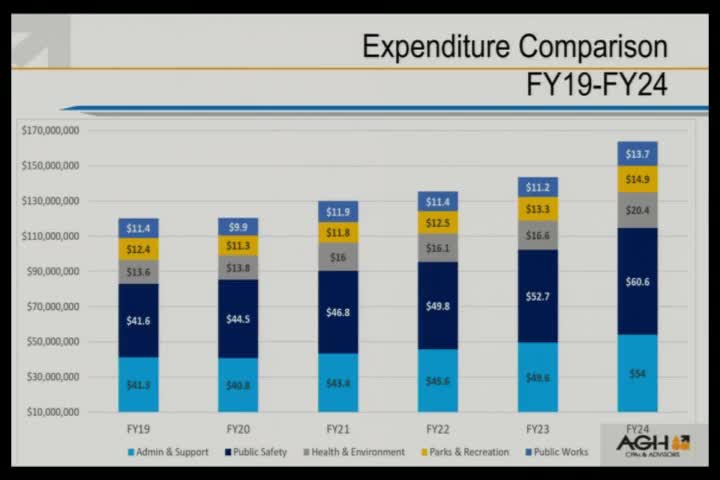
A separate monthly finance report compared fiscal 2019 to fiscal 2024 expenditures and budgeted FTEs. The city budgeted about $10 million in added salaries and benefits to implement phase 1 of the classification and compensation study; public-safety salaries and benefits had the largest dollar increase (about $19 million), while health and environment saw the largest percentage increase (driven by health-department expansion). Overall, budgeted FTEs grew by about 110 positions (approximately 12%) across the period, with public safety (police and fire) and the health department accounting for most of the increase. Staff noted some services contracted by public works remain high-cost contractuals rather than payroll.
Council members asked for further details on particular non-utility write-offs and suggested working with solid-waste contractors about deposit options; finance staff agreed to follow up with breakdowns on large items.