Get Full Government Meeting Transcripts, Videos, & Alerts Forever!
Get email alerts on the Budget topic
No spam. Unsubscribe anytime.
Columbia officials warn of fiscal 2026 shortfall; council weighs tax options and priorities
Summary
City finance staff told the Columbia City Council a projected revenue shortfall begins in fiscal 2026 and outlined revenue trends, threats and potential voter-approved tax options as council members discussed priorities including public safety, housing and infrastructure.
Columbia — City finance staff told the Columbia City Council on during a March work session that the city is projected to face a general-fund revenue shortfall beginning in fiscal 2026 and presented a menu of revenue options and priorities for council consideration.
Matthew Lu, director of finance, opened the presentation by saying the staff would “present just basically facts” about the city’s revenue outlook and possible policy choices. He and colleagues described a near-term flat to slow-growth picture for sales tax, steady but small growth for property tax, and several emerging risks to revenues.
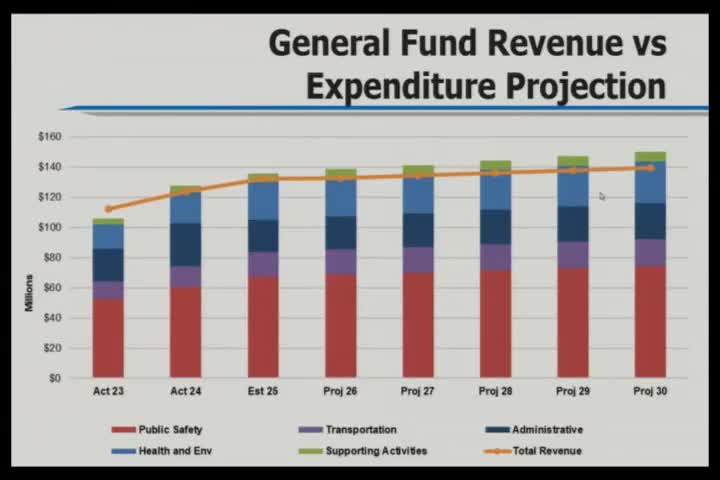
The nut of the presentation: using updated first-quarter receipts, finance staff said fiscal 2025 revenue is tracking close to budget but the city’s current projections show a gap beginning in fiscal 2026, driven largely by inflation-driven increases in personnel costs and only modest growth assumptions for major tax streams. “As you can see in ’26 … we will see a shortfall in revenue beginning in ’26,” Lu said.
Why it matters: the general fund supports core city services and salaries. Staff emphasized that options to cover a large revenue shortfall would include service cuts or layoffs if revenue is not replaced, and they presented a range of voter-approved tax mechanisms and other revenue tools the council could consider.
What staff told council
- Sales tax: Staff presented an updated sales-and-use-tax forecast that reflects a recent quarter-over-quarter slowdown. Finance staff said they purchased economic data (Oxford Economics) and are assuming roughly 2% annual growth in sales tax over the medium term, but cautioned the stream is relatively volatile and sensitive to recessions.
- Property tax: Staff described property tax as a more stable revenue source but noted slow growth; the forecast assumes modest valuation and revenue increases (about 1% in the near term). Staff also explained how the city’s share of a property-tax dollar compares to other Missouri cities and to Boone County jurisdictions.
- Payments in lieu of taxes (PILOT): Lu described the city’s PILOT from municipally owned utilities and other city-owned businesses as a meaningful portion of general revenue. Staff said PILOT accounts for “around 10% of governmental revenue, but about 15% of the general fund revenue.” During discussion a numerical example in the presentation that appeared as “$1,617,000,000” was clarified by staff as $1,617,000 (one million six hundred seventeen thousand) in annual transfers to the general fund.
- Other revenue streams: Marijuana excise tax receipts have fallen year-over-year and were noted as roughly half of the prior year’s intake, prompting staff to restate projections. Cable and telecommunications franchise revenues are declining due to state caps and the shift from cable to streaming.
- State legislation risk: Staff highlighted at least three pending state bills (one listed as House Bill 432 in the presentation materials) that would limit or eliminate local food-related sales taxes. Finance staff said Columbia currently collects about $10 million annually from food sales and that passage of a bill eliminating local food sales taxes would create a hole of roughly that size in the city’s revenue that would have to be backfilled or cut.
Potential revenue options presented
Finance staff outlined several voter-approved options and statutory limits, noting most would require voter approval or enabling state legislation: an additional quarter-cent (0.25%) capital improvement sales tax (up to a 1.0% cap in total), a public-safety sales tax, an economic-development sales tax (with at least 20% dedicated to long-term economic-development projects), and various property-tax increases up to statutory ceilings depending on prior voter actions and rollback rules. Staff emphasized that any new property tax earmarked for public safety would require a public vote and that the mechanics of levy increases depend on historical voter approvals and the Hancock Amendment rollbacks.
Council discussion and priorities
Council members asked for comparisons with other Missouri cities (Springfield, Joplin, Kansas City, St. Louis) and how those cities allocate property- and sales-tax revenues, including examples where property tax revenue has been dedicated to police and fire funds. Council members also pressed for clarity on who pays each tax (residents versus visitors), pass-through effects (for example, landlords passing increases to tenants), and the timing for placing tax measures before voters.
Several council members said public safety, housing and infrastructure should be among the top priorities as staff develops budget scenarios; staff asked council to narrow its six proposed priorities to three to guide new decision items and allocation of limited resources moving into the budget process. Staff confirmed they will return with additional analysis, including (per council requests) a deeper review of Springfield’s funding structure and the potential local impact if the food sales tax bills advance in Jefferson City.
Next steps
Finance staff said they will bring a revenue forecast for the next meeting (forecast session scheduled for April) and provide follow-up analyses requested by council members, including examples of cities that have used specific sales- or property-tax mechanisms and more detail about board-and-commission budget requests. Staff repeatedly noted that most options they presented would require council direction and, for many items, voter approval or state action before the city could implement them.
Ending note: staff counsel and council members framed the conversation as an early step in a longer budget process: staff provided updated revenue assumptions and a set of potential policy tools; council members signaled preferences and asked for follow-up details before making decisions that could affect taxes, services or staffing.