Get Full Government Meeting Transcripts, Videos, & Alerts Forever!
Get email alerts on the Traffic Calming Rollins topic
No spam. Unsubscribe anytime.
Columbia council approves traffic calming on Rollins Road after lengthy public hearing
Summary
After more than an hour of public comment and questions from council, the Columbia City Council voted unanimously to authorize staff to install three speed humps and a crosswalk with bulb-outs on Rollins Road between Stadium Boulevard and Fairview Road.
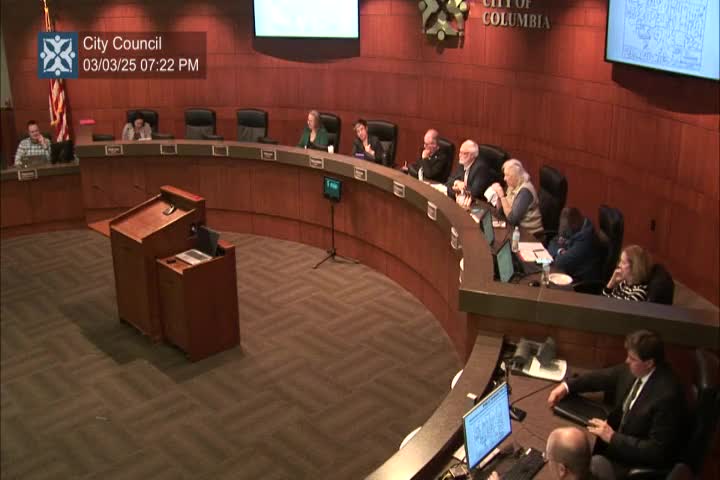
The Columbia City Council on March 3 authorized staff to proceed with installing traffic-calming measures on Rollins Road between Stadium Boulevard and Fairview Road, following a public hearing that drew neighborhood residents, engineers and council questions.
City Public Works Director Shane Creech described the proposed project as “the installation of 3 speed humps and 1 crosswalk with bulb outs during the 2025 construction season,” and said staff estimated the cost at $32,000 to be paid from the city’s annual traffic calming account.
Council members pressed staff about alternative treatments and site details. Richard Stone, engineering and operations manager in Public Works, said staff held two interested‑parties meetings and adjusted hump locations and bump‑out placements after participant feedback. “We look at all types and forms … and then take into consideration the comments that are made,” Stone said.
Residents who live near the proposed work offered differing views. Supporters said the plan would slow traffic where children cross to a church playground and near Trinity Lutheran School. “I believe this plan will do so effectively,” neighborhood resident Jim Belafless told the council. Other speakers urged moving some devices closer to a narrow curve near the lake, improving signage, or adding lighting rather than humps. “If you want people to stop and be on the brakes at those points where it’s narrow, put speed bumps in there,” said Colin Burgess, who recommended alternate locations.
Staff answered technical questions about expected effects and follow-up monitoring. Creech said the city measures performance after installation and typically remeasures speeds one to two months after completion; the project’s design aims to reduce the 80th‑percentile speed to something closer to the posted limit. He noted spacing for humps is typically 400–500 feet to reduce the overall speed profile.
Council moved to authorize staff to proceed; the motion was made by the mayor (unnamed in the record) and seconded by Council Member Nick Foster. Roll call was unanimous among present council members (Betsy Peters, Buffalo, Carroll, Foster and Waterman), and staff was directed to implement the project as proposed.
Council and staff also discussed related topics that residents raised during the hearing, including line‑of‑sight issues from vegetation and the privately owned dam/road section near the lake, which can limit options for widening or relocating devices. Staff said vegetation or sight‑distance concerns can be reported via the city’s SeeClickFix system for evaluation and possible remediation.
The installation plan will proceed in the 2025 construction season and staff said they can return to council to consider additional humps if post‑installation data show speeds remain above desired levels.