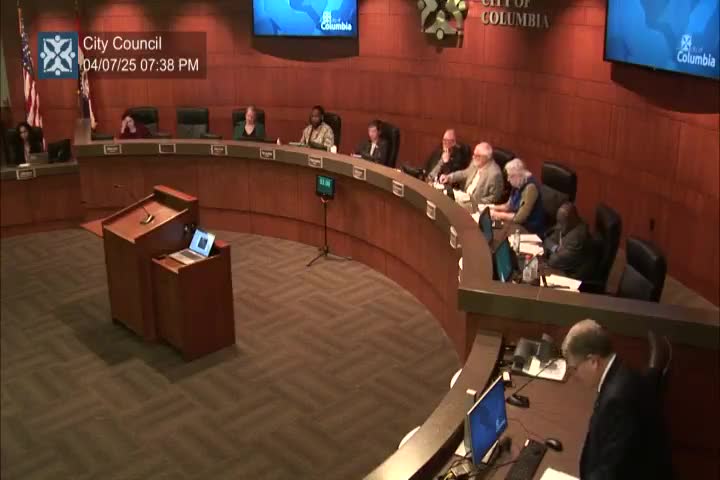
City Council approves master services agreement with Axon for police cameras, ALPR and evidence storage
Loading...
Summary
Columbia City Council approved Council Bill 48-25 to authorize a master services and purchasing agreement with Axon Enterprise Inc. to consolidate body‑worn and in‑car cameras, add automated license plate readers and holster signal technology, and migrate digital evidence storage to Axon Evidence.
Columbia City Council on April 7 approved an ordinance authorizing a master services and purchasing agreement with Axon Enterprise Inc. to provide body‑worn cameras, in‑car cameras with automated license plate reader (ALPR) capability, holster “signal” integration and cloud evidence storage for the Columbia Police Department.
The agreement, introduced as Council Bill 48-25 and considered at second reading, folds the department’s existing body‑worn camera contract into a single Axon ecosystem and would replace the current in‑car camera platform. City staff and Axon representatives said the change would also enable features such as automated tagging of videos to CAD/case numbers, geographic auto‑tagging of nearby officer cameras, integrated ALPR reads from patrol cars, and live‑streaming capability to assist supervisors in real time.
Why it matters: city staff framed the purchase as both a technology consolidation and a risk‑management move. The department currently stores large volumes of video on local servers and on physical media; the Axon proposal would move evidence storage to a CJIS‑compliant cloud (hosted via Microsoft Azure Government) and allow longer, automated retention schedules aligned with complaint/ordinance timelines.
Columbia Police Chief Slooty and an Axon representative, identified in the meeting as Josh, described anticipated benefits: improved evidence redundancy and retention (staff said storing more video for at least one year would reduce lost footage when complaints arrive months after an incident); reduced duplication of GPS/vehicle tracking systems; and potential operational advantages for supervision and training via live streaming.
Costs and timing: staff materials and discussion broke the proposal into components (body‑worn camera replacement cycle, in‑car Axon Fleet 3 units with ALPR, holster signal technology, and cloud evidence subscription). Staff presented a five‑year cost picture and said the comparative incremental cost—after folding in replacement spending the city would otherwise make—was roughly $330,000 per year (staff characterized this as the annual difference to add the integrated Axon suite over existing expenditures). Implementation, staff told the council, could begin shortly after contract signature with most equipment delivered within 4–5 weeks and full field deployment and training expected in roughly 90–120 days.
Data security: Axon noted its cloud hosting partnership with Microsoft Azure Government and listed FIPS/ISO certifications and CJIS compliance as part of its security posture. Axon described geo‑diverse and redundant storage and said agencies can set automated retention schedules to match policy and ordinance requirements.
Questions raised: council members asked about interoperability with the county sheriff and University (MUPD), integration with the recently approved Flock ALPR network, staffing for evidence management and retention schedules, and whether the live‑stream function would be used only in tactical situations or more broadly. Staff said the sheriff and MUPD also use Axon or compatible systems and that API integrations allow cross‑database searching of ALPR reads (each vendor keeps separate databases). The department said it has requested an additional property/evidence technician in the budget to manage growth in digital evidence.
Council action and vote: Sheila called the roll on Council Bill 48-25. The vote was recorded as unanimous: Miss Carroll — Yes; Mister Lovelady — Yes; Mister Foster — Yes; Mister Waterman — Yes; Miss Peters — Yes; Miss Buffalo — Yes. The ordinance was approved and will take effect according to the ordinance language.