Get Full Government Meeting Transcripts, Videos, & Alerts Forever!
Get email alerts on the Police Oversight topic
No spam. Unsubscribe anytime.
Columbia review board says state law narrows civilian complaint investigations
Summary
Members of the Citizens Police Review Board at a Columbia meeting said state statutes and recent bills limit the board’s ability to investigate incidents beyond the narrow allegations in civilian complaints, and they discussed potential steps to respond or seek changes.
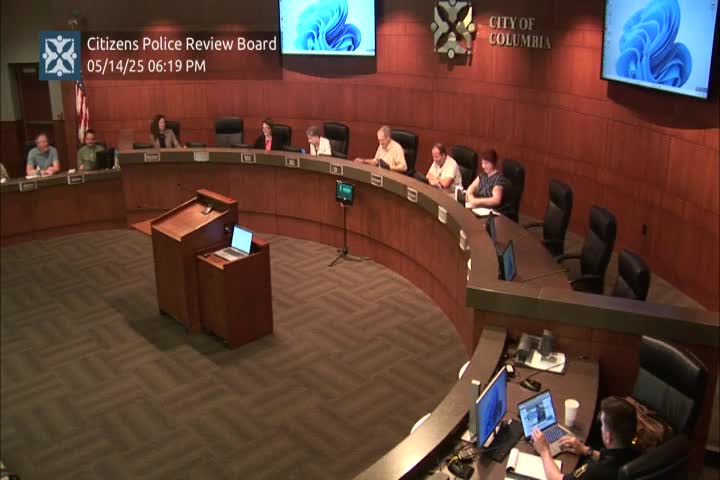
At a Citizens Police Review Board meeting in Columbia, board members said state law and recent legislation constrain how broadly the Columbia Police Department can investigate civilian complaints, limiting civilian oversight of connected conduct.
Board Chair Doug Hunt summarized answers he said were provided at an earlier session by Columbia Police Department leadership, saying Chief Slooty told the board that investigators "doesn't want to cast a wider net than necessary" when pinpointing which officer and which specific alleged behavior a complaint targets. Hunt said Assistant Chief Dickinson told the board, "It's the complainant who makes the complaint. We don't take ownership," comments the board cited in the meeting record.
The board discussed how that practice can narrow an investigation to a single officer or action and, in the board’s view, leave related conduct by other officers unexamined. Doug Hunt described a hypothetical in which an apparent handcuffing problem by one officer could stem from an unjustified search ordered by a supervisor; the board said state law can prevent sharing whether those related matters were later investigated.
Members identified two legislative sources they feel affect review: the police officer's bill of rights (referred to at the meeting as "Senate Bill 26") and a more recent bill the board identified as "SB 754," which they said limits review boards to specified categories. Board members said those measures, as interpreted by department staff, mean internal investigations or supervisor-initiated complaints may proceed without the board seeing outcomes if they fall outside categories the board is permitted to review.
Board members described possible consequences for trust between the department and the public. "Given that our mission is to build trust between the Department and the citizenry, this is obviously a problem," Hunt said when summarizing the board’s concerns. Several members called the constraint "troubling" and recommended keeping the issue on the board’s agenda for future discussion and possible referral to the city council or state lawmakers.
Board members clarified that this discussion was not intended as criticism of CPD staff, but as recognition of statutory limits that require further attention. Matt Unrein, the deputy city manager, confirmed the department and staff were following current administrative law as applied to investigations.
No formal action or policy change was adopted at the meeting. The board agreed to keep the topic on future agendas and to consider whether a more systematic review or a request to the City Council for legislative clarification would be appropriate.
The board moved this item onto the record and planned further internal discussion at a later meeting; the next formal step was left unspecified.