Get Full Government Meeting Transcripts, Videos, & Alerts Forever!
Get email alerts on the Police Complaints topic
No spam. Unsubscribe anytime.
Human Rights Commission to sample 2024 complaint records, schedule internal‑affairs Q&A; board votes to enter closed session
Summary
The Columbia Human Rights Commission agreed to sample complaint records listed as having “no allegation of misconduct,” asked staff to arrange an internal‑affairs question-and-answer at the next meeting, and voted to go into closed session to review protected records.
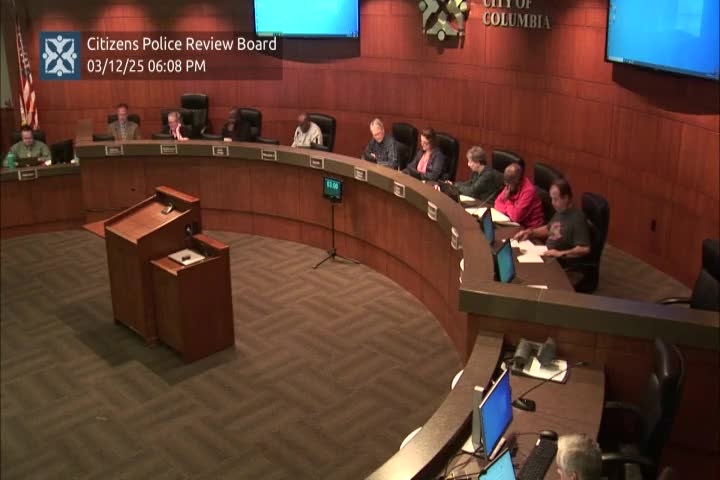
The Columbia Human Rights Commission on an unspecified March meeting agreed to sample complaint records from 2024 to better understand entries categorized as having “no allegation of misconduct,” and set a staff‑facilitated internal‑affairs question‑and‑answer for the next meeting. Chair Doug Hunt moved the board into closed session under Missouri statutes to review records protected from disclosure.
Commission members discussed a spreadsheet of complaints and noted that 35 entries on the sheet were marked as containing “no allegation of misconduct.” Hunt said sampling those entries could reveal whether dismissals were appropriate and recommended dividing a random selection of cases among small teams for review so that “more than one set of eyes” looks at each sampled complaint. He said staff would generate a random selection and provide materials for reviewers.
The commission agreed that naming complaint reference numbers and dividing work might be better done in closed session because the review would reference case identifiers. Earl Krause, law department, advised that citing complaint numbers should not be a disclosure problem when dealing with larger volumes. Hunt and other members said they would have staff put the commission’s list of suggested questions to Paul, the commission’s liaison, so Paul or an internal‑affairs investigator could prepare answers in advance.
Members also discussed how to publicize a planned internal‑affairs presentation. Communications staff member Matt described limits on proactive promotion for routine board meetings because city communications resources are shared among many boards. Commissioners proposed sending questions to staff in advance and having staff blind‑copy the group when circulating them to avoid inadvertently creating a quorum via email.
At the end of the open session, Chair Doug Hunt moved to go into closed session “to discuss records which are protected from disclosure by law” under the Revised Statutes of Missouri (sections as quoted during the meeting). Hunt made the motion; a second was stated on the record but the speaker who seconded was not named in the public transcript. The commission took a roll‑call vote; members present voted in favor and the chair closed the open session.
Why it matters: The commission’s work includes oversight and reassurance to Columbia residents that complaint and investigation processes are operating appropriately. Sampling complaints flagged as lacking an allegation of misconduct could show whether dismissals reflect process gaps affecting complainants.
Board and staff next steps include: staff producing a randomized sample of complaint records for the commission’s review; commission members sending written questions about complaint intake and internal‑affairs processes to staff so Paul or an IA investigator can prepare answers; and scheduling an extended presentation or Q&A at the next regular meeting. The commission also discussed logistics for reviewing files (thumb drives, adapters, or printed copies) and agreed to return temporary drives once reviews conclude.
The meeting record shows commissioners repeatedly cautioned against discussing particulars of individual cases in open session and recommended reserving case‑level follow‑up for closed session to protect confidentiality.