Get Full Government Meeting Transcripts, Videos, & Alerts Forever!
Get email alerts on the Police Accountability topic
No spam. Unsubscribe anytime.
Board hears detailed briefing from Columbia Police on complaint intake and internal-investigation process
Summary
The Citizens Police Review Board received a step‑by‑step briefing from Columbia Police Department officials on how citizen complaints are received, classified and investigated, including limits when criminal cases are involved and how internal affairs and supervisors share responsibility.
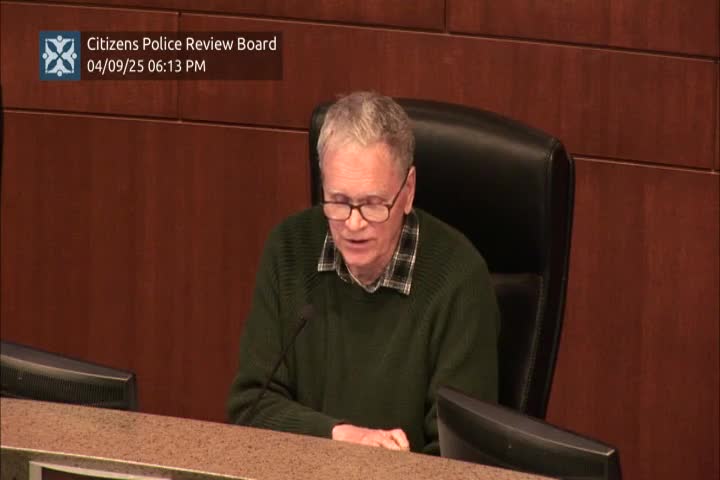
The Citizens Police Review Board on April 9 heard a detailed presentation from Columbia Police Department officials about how citizen complaints are taken, routed and investigated and about the limits of the board’s access to personnel records.
The briefing, led by Board member Ed Robinson and answered by Assistant Chief Paul Dickinson of the Columbia Police Department, covered seven prepared questions the board had circulated in advance. “Complaints are... dictated by policy, it’s dictated by city ordinance, it’s dictated by state law,” Assistant Chief Dickinson said, explaining that intake follows state law, department policy and city ordinance and that oral accounts can be reduced to a written complaint and entered into the department’s case-tracking software (Blue Team).
Why it matters: the board said it wants to be able to explain the complaint process to citizens and to understand when contacts that look like complaints are not classified as such. Robinson told the meeting the board plans a closed‑session review of 2024 contacts that the department did not classify as formal complaints to see whether the initial classifications were appropriate.
How complaints are recorded and routed: Dickinson said officers commonly refer on‑scene concerns to a supervisor; supervisors or citizens can file complaints in person, by phone, or through the forms available at CPD and City Hall. Dickinson said staff often take an oral report and then input the narrative into Blue Team, which generates an automated notification to Internal Affairs (IA). “We’d input that into Blue Team. And then again, it’ll get forwarded to internal affairs,” he said.
Who decides whether alleged misconduct merits investigation: Internal Affairs and the officer’s chain of command make the initial classification. Dickinson said IA reviews the narrative, body‑worn camera footage and other material and opens an investigation when the conduct meets the department’s definitions. Board members asked for clarity on whether supervisors perform a separate, informal review; Dickinson and other CPD leaders said lower‑level or routine matters may be handled by supervisors as “class 1” incidents while more serious matters or anything requiring broader due‑process protections go to IA as “class 2.”
Scope and linkage of investigations: The board asked how investigations handle collateral findings—such as paperwork or body‑camera policy violations discovered while investigating an external complaint. Dickinson said IA will open separate internal investigations when the review uncovers additional violations. He also cautioned that some personnel steps (coaching, mentoring, non‑disciplinary training) do not become part of the investigative record the board can review.
Independence of Internal Affairs and command review: Dickinson described IA investigators as seasoned professionals who lead investigations and said final findings are routed up the IA chain of command to a lieutenant, then to senior command and the chief for determinations. “When it gets through the investigation, the investigation is complete, but it’s not a team process in the investigation,” he said; command staff may request clarifications or further work but do not “look over the shoulder” of investigators on a day‑to‑day basis.
Limits when criminal cases are involved: On complaints alleging false arrest, Dickinson noted that IA is an administrative process and that simultaneous criminal‑case processes can create legal complications for interviewing subjects and disclosing internal records. Quoting the CPD policy language under discussion, he said the department avoids internal investigations into alleged false arrests when doing so would interfere with or duplicate criminal proceedings.
Board follow-up: The board agreed to continue review of the 2024 unclassified contacts in closed session at its next meeting and asked CPD staff to present an explanation of Blue Team operations at a future meeting so board members can see how intake and routing appear in the department’s system.
Members of the public were not recorded as commenting on the training during the session. The police chief, Jill Schlutte, introduced several command staff present and thanked the board for the opportunity to present the department’s process.
The board’s next regular meeting will include the planned closed‑session review and a potential Blue Team overview for training purposes.